Editorial
Vol. 4 Núm. 3 (English)
7 min
The platypus and the pediatric emergency physician
El ornitorrinco y el pediatra emergentólogo
Sulim Abramovici¹ Hany Simon-Junior²*
¹Sociedade de Pediatria de São Paulo, São Paulo, Brazil.
²Instituto da Criança, Hospital das Clínicas, São Paulo, Brazil
Correspondencia:
Recepción:
15/09/2025
Aceptación:
17/09/2025
Publicación:
16/12/2025
Métricas
78
Visualizaciones
11
Descargas
Compartir
Compartir
Fables, myths, legends, parables, analogies, or simply images are resources the human mind can use to communicate ideas. Very often, they can express everything we wish to say about a given topic with subtlety and depth, saving words.
We propose an analogy. We want to talk about the pediatric emergency physician. To do so, we will examine one of the most interesting and intriguing animals known: the platypus, Ornithorhynchus anatinus.
It is a unique animal, full of contrasts and ambiguities. It is an enigma—nature’s joke—for it has hair like mammals, a bill like a duck, and forelimbs shaped like wings. Its hind legs have venomous spurs.
Its name means “bird-bill.” It is an animal with aquatic habits, but it builds its burrow on land. It has webbed feet and is therefore an excellent swimmer, able to remain underwater for five minutes.
It lives near lakes and rivers in Australia and Tasmania, always in pairs, digging burrows along the edges of riverbanks. It usually comes out at dawn and dusk in search of food.
It reproduces through mating but lays eggs two weeks later through something resembling a cloaca. The female builds a tunnel up to 1.80 meters long, where she prepares a nest lined with moist leaves and lays 2 to 3 eggs, incubating them for ten days(1,2).
It is the only mammal that lays eggs. At birth, the young have no hair and cannot see. They hatch measuring about 1.5 cm and remain in the nest until they reach about 30 cm. Like all mammals, they suckle, but in a particular way: since the young have no lips and the mother has no teats, breastfeeding is different. The mother lies on her back and the young climb onto her belly, bouncing on it to express the milk stored in special glands through openings located on the abdomen; thus, they lick the milk that accumulates among the hairs of the mother’s belly.
Around four months of age, they begin to leave the tunnel in search of food. They learn to swim and hunt by imitating the mother. They dive into the river waters and, with their sensitive (non-bony) bill, search the mud for small crustaceans, tadpoles, small fish, worms, and aquatic plants(1,2,3).
An adult male reaches 45 cm in body length, plus a 15 cm tail, and weighs about two kilos, with a life expectancy of 15 years(1,2).
The platypus is striking because of its complexity, because of the difficulty of fitting it into taxonomic classification: it has attributes of a bird, but is not one; of a fish, but is not one; of a reptile, but is not one; and also of a mammal.
It is striking because it is a living being with multiple abilities, allowing it to travel through water and land, ensuring the survival of the species.
In 1799, George Shaw described it as Platypus anatinus(4), but only 80 years later, in 1884, W. Caldwell defined its classification(5):
• Phylum: Chordata
• Class: Mammalia
• Order: Monotremata
• Family: Ornithorhynchidae
The first appearance of this animal caused such astonishment in the Royal Society of London that Shaw stated it was “a deceptive preparation, artificially made.” The bewilderment was such that many thought it was a hoax, given the impossibility of classifying it (Figure 1). It could only have been the invention of someone who today would be working in Disney studios creating cartoons or fiction films.
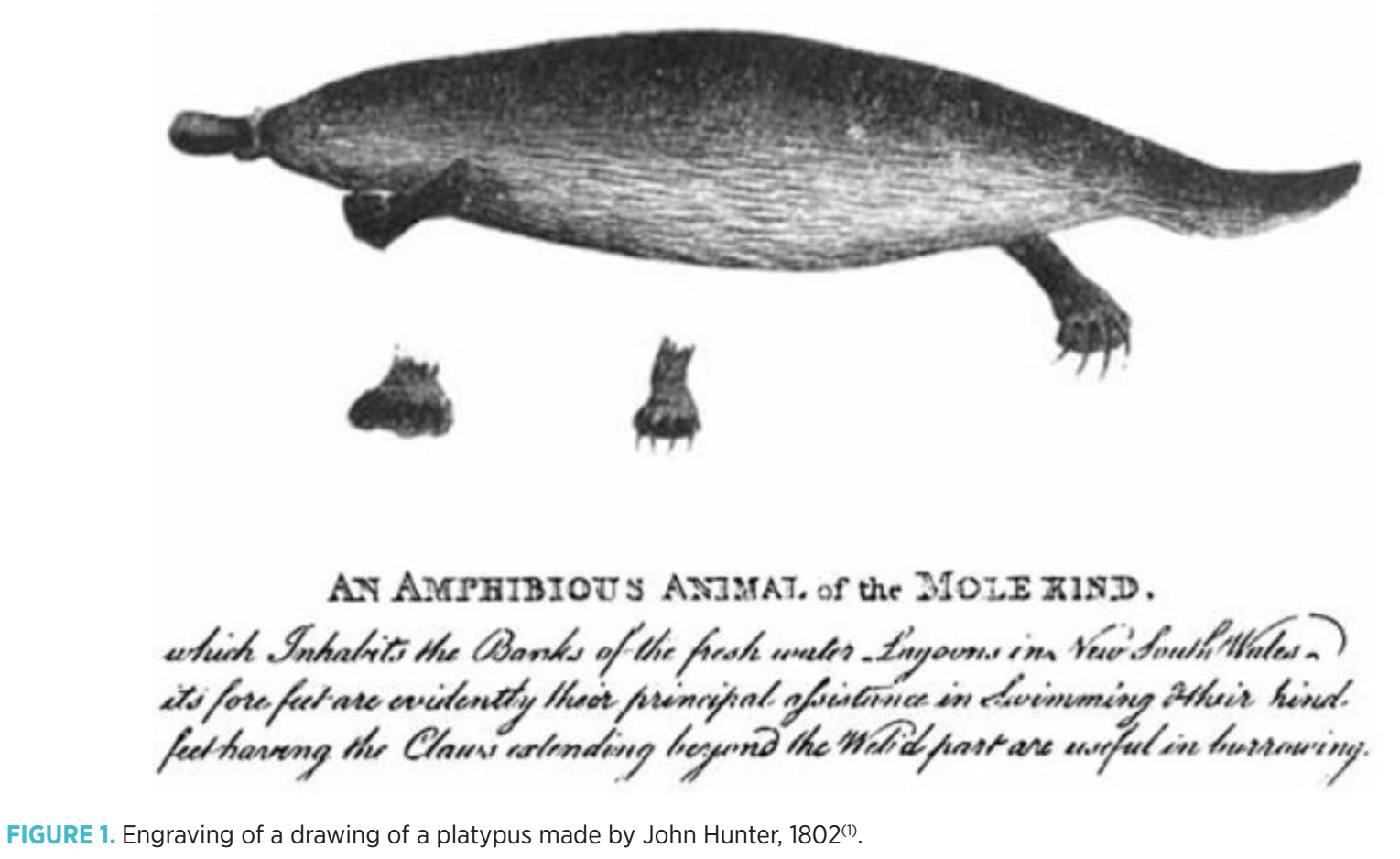
This controversy was splendidly described by Umberto Eco in his book Kant and the Platypus(6).
We want to propose an analogy.
The time has come, now that we have presented this unique and incredible being that, if it did not exist in reality, would have been an extraordinary invention: a being with multiple aptitudes, capable of functioning in diverse environments. Someone might call it a “complete being.”
However, someone else might conjecture that it must have been a primordial being that, precisely because of its nonspecific nature, could survive only precariously, but from which more perfected descendants evolved—adapted to specific environmental circumstances, with greater chances of perpetuation. In this case, those descendants would be the most developed.
We want, however—contrary to that viewpoint—to suggest that we need, especially in the Emergency Department and within our socioeconomic reality, a generalist pediatrician with complex and versatile characteristics, like the platypus.
Today’s accumulated medical knowledge is immense, making it impossible to master every field of medicine in depth. The time of geniuses such as Leonardo da Vinci— capable of painting the Mona Lisa while also designing aircraft—or Edward Jenner, who discovered the smallpox vaccine in 1796, described coronary obstruction as the cause of angina pectoris, and still found time to pursue music, poetry, hydrogen balloons, and the migration of English songbirds, is long gone. His study of the cuckoo(7) was what earned him admission to the Royal Society of London for Improving Natural Knowledge, the most renowned scientific institution of its time.
Of course, some cases will inevitably require specialized care. But we need specialists—among them pediatric emergency physicians—who, with appropriate training, understand sufficiently many areas of medicine, enabling them to navigate the most frequent pathologies and resolve the majority of cases(8).
The pediatric emergency physician must be trained in various areas: orthopedics, anesthesia, intensive care, traumatology, surgery, toxicology, neurology, cardiology, infectious diseases, otolaryngology, and many more(9). They must care for children with complex and varied medical conditions(10), maintain emotional balance, make rapid decisions, act as the child’s advocate in risky situations, and also serve as the family’s psychologist.
This professional possesses features and skills that distinguish them from other pediatric specialties: they can move comfortably among several medical disciplines, solving problems that would typically require a multidisciplinary team.
This plurality makes the pediatric emergency physician the platypus of medicine, endowed with multifunctionality that allows adaptation to diverse situations.
Like the platypus, the pediatric emergency physician inhabits a hostile environment: limited human and financial resources, heavy workload(11)… and still must live—and make others live.
That is what we are: pediatric emergency physicians… and platypuses.
Platypuses are endangered. A sadness.
Generalist pediatricians are also declining(12). Pediatric emergency physicians as well.
It is up to all of us to fight for the preservation of both species.
It is up to us to ensure recognition of pediatric emergency medicine as a specialty.
References
- Manger PR, Hall LS, Pettigrew JD. The development of the external features of the platypus (Ornithorhynchus anatinus). Philos Trans R Soc Lond B Biol Sci. 1998 Jul 29;353(1372):1115.
- Griffiths M. Platypus research 1798–1998. Philos Trans R Soc Lond B Biol Sci. 1998 Jul 29;353(1372):1059–61.
- Grant TR, Temple-Smith PD. Field biology of the platypus (Ornithorhynchus anatinus): historical and current perspectives. Philos Trans R Soc Lond B Biol Sci. 1998 Jul 29;353(1372):1081–91.
- Shaw G. Account of a new animal from New South Wales. Nat Miscell. 1799;10:451–4.
- Caldwell WH. On the results of investigations into the morphology and development of the Monotremata and Marsupialia, carried out in the zoological laboratory, Cambridge. Proc R Soc Lond. 1887;43:428–36.
- Eco U. Kant and the Platypus: Essays on Language and Cognition. Translated by Alastair McEwen. New York: Harcourt Brace; 1999.
- Jenner E. Observations on the natural history of the cuckoo. Philos Trans R Soc Lond. 1788;78:219–37.
- Kissoon N, Goldman RD. Pediatric emergency medicine: a world of potential. CJEM. 2007 Nov;9(6):453–8.
- Doan Q, Piteau S, Sheps S, Singer J, Wong H, Johnson D, Kissoon N. The role of physician assistants in pediatric emergency medicine: the physician’s view. CJEM. 2013 Nov;15(6):321–9.
- Pulcini CD, Dubuque A, Lamberson M, Macy ML, Mistry RD, Pruitt CM, Schnadower D, Zorc JJ, Stevens MW. Pediatric Emergency Medicine Physicians’ Perspectives on Emergency Care of Children With Medical Complexity: A Multi-institution Mixed-Methods Assessment. Pediatr Emerg Care. 2022 Aug 1;38(8):e1423–e1427.
- Doan Q, Sabhaney V, Kissoon N, Johnson D, Sheps S, Wong H, Singer. The role of physician assistants in a pediatric emergency department: a center review and survey. J Pediatr Emerg Care. 2012 Aug;28(8):783–8.
- Vince RJ. The Pediatric Workforce: Recent Data Trends, Questions, and Challenges for the Future. Pediatrics. 2021 Jun;147(6):e2020013292.
Explorar
Artículos
Volúmenes
Sobre la revista
Más leídos
Emergencias Pediátricas
Emergencias Pediátricas
Emergencias Pediátricas
1º Congreso Mundial de Emergencias Pediátricas
Emergencias Pediátricas
Una nueva mirada a la vía aérea pediátrica: secuencia de intubación diferida como alternativa segura en situaciones de urgencias
Emergencias Pediátricas