Otro
Vol. 5 Núm. 2 (English)
8 min
SEUP simulation working group: from the first steps towards new horizons
Grupo de Trabajo de Simulación de SEUP: desde los primeros pasos hacia los nuevos horizontes
David Muñoz-Santanach1*, en representación del Grupo de Trabajo de Simulación de la SEUP
1Emergency Department, Hospital Sant Joan de Déu, Barcelona, Spain
Correspondencia:
Recepción:
30/04/2026
Aceptación:
05/05/2026
Publicación:
26/06/2026
Métricas
34
Visualizaciones
2
Descargas
Compartir
Compartir
Resumen (EN)
Clinical simulation is key to training and safety in pediatric emergencies. Since 2017, the Simulation Working Group (WG) of the Spanish Society of Pediatric Emergencies (SEUP) has promoted quality standards and simulation-based training, integrating professionals from multiple national and international centers. Its initiatives emphasize the stabilization of critically ill patients and non-technical skills. The WG has consolidated its presence at SEUP meetings with workshops and innovative simulations, fostering interdisciplinary collaboration and participating in the Pediatric Simulation Games. Scientifically, it has published recommendations for designing high-quality simulations focused on pedagogy, psychological safety, and structured debriefing. Looking ahead, the group aims to advance online training, develop quality indicators, and strengthen strategic projects, establishing itself as a benchmark for educational innovation and multidisciplinary collaboration.
Palabras clave (EN):
Resumen (ES)
La simulación clínica es clave en la formación y seguridad en urgencias pediátricas. Desde 2017, el Grupo de Trabajo (GT) de Simulación de la Sociedad Española de Urgencias de Pediatría (SEUP) promueve la calidad y la formación mediante esta herramienta, integrando a profesionales de múltiples centros nacionales e internacionales. Sus iniciativas destacan en la estabilización del paciente crítico y en el desarrollo de habilidades no técnicas. El GT ha consolidado su presencia en las reuniones de la SEUP con talleres y simulaciones innovadoras, fomentando la colaboración interdisciplinar y participando en los Pediatric Simulation Games. Científicamente, ha publicado recomendaciones para diseñar simulaciones de alta calidad centradas en pedagogía, seguridad psicológica y debriefing estructurado. De cara al futuro, el grupo apuesta por la formación online, el desarrollo de indicadores de calidad y proyectos estratégicos, consolidándose como un referente en innovación docente y colaboración multidisciplinaria.
Palabras clave (ES):
Clinical simulation has consolidated in the last decade as one of the most effective educational tools in the healthcare field and, particularly, in pediatric emergencies. In addition to its training value, it allows for practicing in a safe and controlled environment, which reduces the risks inherent to direct learning with patients, contributing significantly to improving patient safety. Within this conceptual framework, and with the help of figures such as doctors Luaces and González-Hermosa, the Simulation Working Group (WG) of the Spanish Society of Pediatric Emergencies (SEUP) was created in 2017, with the general objective of encouraging and promoting quality standards that facilitate the development of clinical simulation activities oriented towards learning in Pediatric Emergency Departments(1).
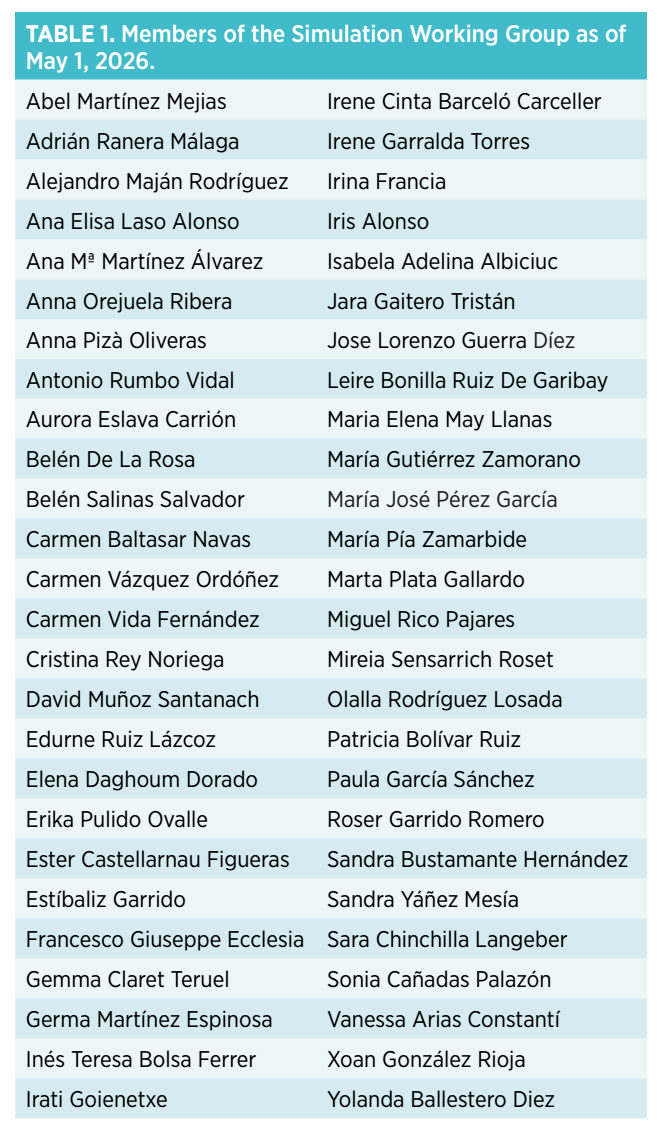
In almost ten years of history, the Simulation WG has experienced notable growth in both the volume and complexity of its activities. At the same time, the group has expanded its membership to currently bring together 48 SEUP members from centers in 19 Spanish provinces and one Argentine center. This journey invites us to stop and analyze with perspective the path taken, the achievements reached, and the future challenges, but above all to thank the colleagues met along the way.
The First Steps
The first meeting of the Simulation WG took place during the 22nd SEUP Meeting held in Santander. One year later, at the Sitges meeting in 2018, the group developed its first formal activity: two workshops on stabilizing the critical patient in emergencies and a workshop focused on the Crisis Resource Management methodology. From these beginnings, a special interest in non-technical skills—such as communication, leadership, and teamwork—was already evident, and it has been maintained and reinforced over time.
At the 24th SEUP Meeting, held in Murcia in 2019, the WG collaborated in organizing the award for the best simulation team in emergencies. Twelve multidisciplinary teams formed by specialists, residents, and nursing staff participated in this activity, facing the stabilization of a patient with shock. The initiative was one of the best valued at the congress and highlighted the potential of gamified simulation as a training tool. Shortly after, the COVID-19 pandemic caused an abrupt interruption of many face-to-face activities, marking a period of pause and uncertainty.
Consolidation at Congresses
Starting in 2022, the SEUP Board of Directors decisively promoted the participation of the WGs in organizing activities for the annual meetings, especially pre-congress workshops and meetings with the expert. Since then, the Simulation WG has maintained a stable and growing collaboration.
At the 27th SEUP Meeting, held in Las Palmas in 2023, WG members G. Claret and JM Quintillà coordinated the pre-congress workshop “Development of relational skills through clinical simulation: addressing conflicts and communicating a medical error.” This three-hour workshop, preceded by individual work, aimed to equip participants with tools to face difficult communication situations, improve the families’ experience, and reduce the emotional impact on professionals. The workshop focused on the Bridge model of relational styles, choosing the right environment to communicate bad news, adapting the message to the interlocutor, and subsequent support for both the patient and their family. Based on a simulation with actors, the workshop was replicated at the A Coruña meeting in 2024 and, after evaluating its impact on satisfaction and learning, was repeated for a third time at the 29th SEUP Meeting.
The 2024 meeting was especially significant for the WG. The round table “Simulation: different ways, same objective” was moderated, with the participation of national and international references in clinical simulation such as M. García, JM Quintillá, and C. Díaz-Navarro, and the meeting with the expert “Starting to simulate: the first steps for high-quality clinical simulation” was organized, aimed at facilitating the design and implementation of simulation activities in pediatric emergencies. At the end of this meeting, Dr. Gema Martínez Espinosa was appointed co-coordinator of the group.
At the Seville 2025 Meeting, intergroup collaboration was a priority, organizing pre-congress workshops with other WGs: Quality Improvement (“Escape room: Improving patient safety, do you dare?”, G. Martínez, V. Arias), Critical Patient (“Simulation: emergencies in the complex chronic patient,” together with M. Leonardo), and Mental Health (“Initial care for patients with mental health problems,” J. Pérez, A. Hernández, and S. Yáñez), the latter with actors. All of this reinforces the multidisciplinary and transversal approach of the WG.
Finally, at the 30th Bilbao 2026 Meeting, the WG collaborates in several pre-congress workshops focused on both the dissemination of key elements of simulation, such as psychological safety or scenario design methodology, in addition to collaborating with the workshop “CPR from my school”.
Pediatric Simulation Games and Advanced Training
One of the most relevant milestones for the WG has been its involvement in the Pediatric Simulation Games (PSG), an annual international clinical pediatric simulation training competition held in Latina (Italy) and considered one of the largest simulation initiatives in pediatric emergencies in Europe. In 2019, SEUP began organizing the National Phase of the PSG so that its residents could demonstrate and individually and collectively evaluate their abilities in managing pediatric emergencies(2). Our WG has collaborated in the organization and development of this activity since the second edition held in 2022 in Pamplona(3).
The joint work with the Critical Patient WG coordinated by Dr. A. Martínez has led to an event that has already become traditional for our society, the MIR Days/National Phase of the Pediatric Simulation Games. In the last edition held at the Fray Luis de León Convention Center, in the Guadarrama mountains, 24 teams formed by pediatric and nursing residents participated, accompanied by a specialist in the role of coach. The teams faced multiple simulation scenarios in parallel, with the collaboration of more than thirty members from the involved WGs. Beyond the competition, the event is conceived as a powerful formative experience, in which the preparation phase is key for the learning of both residents and trainers. These inspiring days have led to regional competitions such as the SIMGAMES organized by the Pediatric Society of Eastern Andalusia (SPAO) and the Pediatric Society of Western Andalusia and Extremadura (SPAOYEX), which reached their third edition in 2026.
Publications and Scientific Production
In line with its mission, the Simulation WG has contributed to the dissemination of knowledge through publications with a clear educational focus. The articles “Simulation in Emergency Services”(4) and “Simulation-based activities: how to start?”(5) offer conceptual frameworks and practical tools for designing high-quality simulations. Both texts emphasize that the success of simulation does not depend exclusively on technology, but on a rigorous pedagogical design, with clear objectives, needs assessment, and application of adult experiential learning principles.
In this same line, the document “Recommendations of WHAT NOT TO DO in simulation activities in Pediatric Emergencies”(6), led by X. González, A. Orejuela, A. Pizà, and V. Arias, identifies practices that should be avoided as they could compromise the educational value of simulation. Through expert consensus, the importance of psychological safety, the adjustment of scenarios to the actual competencies of participants, and the need for a structured and reflective debriefing are emphasized.
The WG has presented various communications at SEUP meetings, addressing the impact, satisfaction, and results of different simulation-based activities, and has collaborated on two SEUP Senior Days focused on training.
New Horizons
Looking ahead, the group proposes to continue the training initiative “Sharing to learn” through bi-monthly online sessions, as well as to advance the development of quality indicators in clinical simulation, without losing sight of the growth and consolidation of the Pediatric Simulation Games as a strategic training axis.
To all members, those who are and those who were, thank you very, very, very much.
Funding
No funding was received for the research, authorship, and/or publication of this article.
Authorship contribution
David Muñoz Santanach: Conceptualization, Methodology, Writing – original draft, Data acquisition, Formal analysis, Visualization, Supervision, Project administration, and Funding.
Conflicts of interest
The author declares that there is no commercial or financial conflict of interest for this research.
Use of artificial intelligence tools
The author declares that no artificial intelligence tools (such as ChatGPT, Copilot, Gemini, or others) have been used in the writing, analysis, or review of this article.
References
- Web del Grupo de Trabajo de Simulación. Available from: https://seup.org/gtsimulacion/
- Martínez Mejías A. Los juegos de simulación, un camino para la educación en Urgencias de Pediatría. Emerg Pediatr. 2023;2(2):135‑137.
- Web de los Juegos de Simulación SEUP. Available from: https://seup.org/juegos-de-simulacion/
- Muñoz‑Santanach D. Simulación en los servicios de Emergencias. Emerg Pediatr. 2022;1(3):171‑177.
- Martínez Espinosa G, Muñoz‑Santanach D, en representación del Grupo de Trabajo de Simulación de la Sociedad Española de Urgencias de Pediatría. Actividades basadas en simulación: ¿cómo empezar? An Pediatr (Barc). 2025;103:503957.
- Grupo de Trabajo de Simulación de la Sociedad Española de Urgencias de Pediatría. Recomendaciones de NO HACER en actividades de simulación en Urgencias Pediátricas. SEUP; 2025. Disponible en: Available from: https://seup.org/wp-content/uploads/2025/06/RECOMENDACIONES-NO-HACER-EN-SIMULACION_DOCUMENTO-2.pdf
Explorar
Artículos
Volúmenes
Sobre la revista
Más leídos
Emergencias Pediátricas
Emergencias Pediátricas
Emergencias Pediátricas
1º Congreso Mundial de Emergencias Pediátricas
Emergencias Pediátricas
Una nueva mirada a la vía aérea pediátrica: secuencia de intubación diferida como alternativa segura en situaciones de urgencias
Emergencias Pediátricas