Artículo original
Vol. 4 Núm. 3 (English)
8 min
Reduction in the time to admissions for hospitalized patients in Pediatric Department of Hospital General San Juan de Dios, Guatemala
Disminución del tiempo en el ingreso escrito de los pacientes hospitalizados en el Departamento de Pediatría del Hospital General San Juan de Dios, Guatemala
Eugenia Argentina Álvarez-Gálvez*, Marina Odeth Chinchilla-Chinchilla, Gladys Amabelly Montufar-Huite
Pediatric Emergency Service, Hospital General San Juan de Dios, Guatemala City, Guatemala
Correspondencia:
Recepción:
26/06/2025
Aceptación:
28/06/2025
Publicación:
16/12/2025
Métricas
81
Visualizaciones
10
Descargas
Compartir
Compartir
Resumen (ES)
Introducción: La demora en el ingreso de los pacientes desde los servicios de urgencias está determinada por muchos factores, uno de ellos es que el ingreso escrito.
Objetivo: El objetivo de esta investigación es mostrar los resultados en la implementación de un ingreso corto para la disminución del tiempo de los pacientes hospitalizados en el servicio de Emergencia de Pediatría, utilizando el ciclo PDSA (Plan, Do, Study, Act).
Metodología: Un equipo multidisciplinario utilizando la metodología de mejora midió el tiempo utilizado por el médico residente para realizar el ingreso de los pacientes hospitalizados, durante los meses de septiembre a noviembre de 2023. La población objetivo fueron los ingresos realizados de lunes a viernes de 7 am a 1 pm, en el servicio de emergencia de pediatría del Hospital General San Juan de Dios. Utilizando el ciclo PDSA (Plan, Do, Study, Act) se diseñó un formato de ingreso corto el cual se implementó y se midieron los tiempos posteriormente a la implementación.
Resultados: El tiempo promedio utilizado por los médicos residentes previo a la implementación del formato nuevo, fue un promedio de 90 a 120 minutos, luego de la implementación se determinó que el tiempo promedio utilizado disminuyo a 26 minutos, rebasando el objetivo de nuestra intervención que eran 50 minutos. La implementación de formato corto demostró que es una medida acertada y en general una mejora en el sistema de atención de nuestros pacientes.
Limitaciones: El tiempo en que implementamos la mejora fue corto, en una época y horario específico, por lo que podría ser útil si se hubiese hecho por más tiempo en diferentes meses durante el año.
Conclusiones: La intervención realizada logró disminuir de 75 minutos a 26 minutos el tiempo utilizado en realizar el ingreso, superando nuestro objetivo.
Palabras clave (ES):
Resumen (EN)
Purpose: The objective of this research is to show the results in the implementation of a short admission in the reduction of the time of the hospitalization process of patients in the Emergency Department of Pediatrics, using the PDSA cycle (Plan, Do, Study, Act).
Method: In this study, the time used by the resident physician to admit hospitalized patients in the period was measured from September to November, Monday to Friday from 7 am to 1 pm, in the pediatric emergency department of the Hospital General San Juan de Dios, then a short admission format was designed which was implemented and the times after implementation were measured.
Results: The average time used by resident physicians prior to the implementation of the new format was an average of 90 to 120 minutes, after implementation it was determined that the average time used decreased to 26 minutes, exceeding the objective of our intervention 45 minutes. The implementation of short format proved to be a wise measure and in general an improvement in the care system for our patients.
Conclusion: The intervention achieved a reduction in admission time from 75 minutes to 26 minutes, exceeding our objective.
Palabras clave (EN):
Introduction
The role of the Pediatric Emergency Service (PES) is crucial for public health. Providing critically ill patients with rapid access to emergency care is the primary function of emergency medicine; however, this function is overshadowed by overcrowding in such services(1,4). The quality of PES depends on the teamwork of physicians, nurses, laboratory staff, imaging services, and other departments or units(2,3,4).
Overcrowding in emergency services is defined as a situation in which demand exceeds the capacity of physicians and nurses to provide quality care within a reasonable time(3). The factors contributing to overcrowding in emergency services can be divided into three groups. First, prehospital causes such as lack of care in primary care services and transfers from regional hospitals. Second, causes related to the emergency service itself, including delays in the triage system, lack of medical or nursing staff, delays in laboratory or imaging tests, and delays in patient admission. Lastly, hospital factors, such as patients remaining for extended periods in the emergency service while awaiting inpatient bed availability(5).
The hospitalization process for a patient from the emergency department is complex and often delayed. A patient may remain in the emergency service for more than 24 hours(2,5).
The Pediatrics Department at Hospital General San Juan de Dios has a hospitalization capacity of 200 beds and 46 intensive care beds, with an occupancy rate greater than 75%, varying throughout the year and reaching rates above 156% during peak periods. The hospitalization process from the emergency department includes the following steps: documenting the patient (admitting them into the hospital’s clinical registry system), triage performed by the physician, and admission to the emergency department, which includes the following areas: observation, respiratory therapy, shock room, procedure area, traumatology, and pediatric surgery. Patients admitted to these areas only use an emergency sheet (a document used exclusively for emergency admission). However, if the patient requires hospitalization, a complete written admission must be performed, since there is no electronic medical record system available. This procedure takes approximately 75 to 90 minutes. Furthermore, laboratory tests and imaging studies are performed when necessary. Medications are administered, nursing care is provided, and finally, the nursing staff requests a bed in the inpatient area. Completing this process can take from 8 hours up to 48 hours, causing overcrowding in the emergency department and discomfort for patients and their families. Several points within this process can be modified to reduce patients’ waiting time in the emergency department.
The objective of this project was to improve the hospitalization admission process. Our aim was to reduce the time required to complete the written admission from 75 minutes to 30 minutes in the PES by November 30, 2023. The intervention began on September 1 and ended on November 30, 2023, consisting of designing a shortened written admission form, thereby reducing the time residents needed to complete it.
Materials and methods
Context
This study was conducted in the PES of Hospital General San Juan de Dios, a tertiary-level hospital forming part of the public health system, which handles an average of 60,000 consultations per year. The emergency staff consists of: one emergency section chief, three pediatricians from 7:00 to 15:00 and two pediatricians from 13:00 to 20:00, Monday through Friday. Additionally, there are three pediatricians per shift from 16:00 to 7:00, and the residency team rotates monthly: one third-year resident, one second-year resident, and two first-year residents.
First-year residents are responsible for completing the written admissions, which must be handwritten using the Weed method (problem-oriented medical record). The hospital does not have an electronic medical record system.
Interventions
A multidisciplinary team was formed consisting of pediatric emergency physicians, residents, and nursing staff. Data collection was carried out Monday through Friday between 7:00 and 13:00. A pediatric emergency physician recorded the time it took residents to complete the written history. Baseline data prior to the intervention were collected from September to November 2023.
Using the improvement methodology model, process mapping was conducted to identify key factors influencing delays in patient admission to inpatient units (Figure 1).
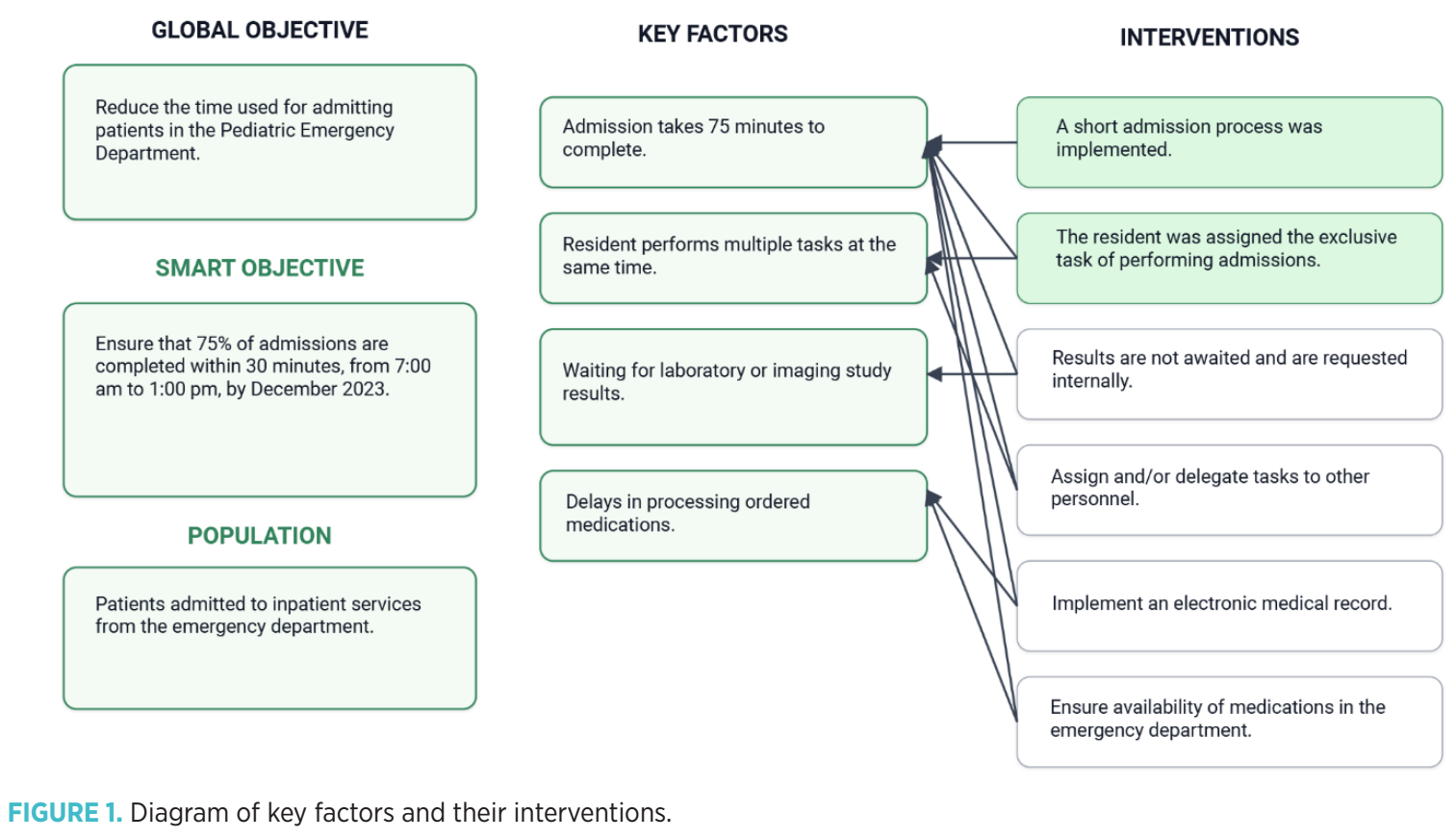
Using the PDSA cycle (Plan, Do, Study, Act), the team initially changed the admission model, designing a shortened admission note containing only the current illness and significant medical history. The full admission note would later be completed in the inpatient units by the corresponding medical staff. Additionally, one physician was assigned exclusively to complete the written admissions without interruptions. Another intervention used to reach the objective was to avoid waiting for laboratory or imaging results before completing the admission and allowing nursing to proceed with their responsibilities.
Analysis: All collected data were placed on a run chart, and SPC rules were used to analyze special-cause variation. Sequence run charts were used.
The reference period was September to November 2023. The intervention period was October and November 2023.
Significant changes in the measurements (i.e., special-cause variation) were identified using run chart rules or SPC, and the centerline was recalculated, showing improvement in the process.
Ethical considerations
The work was approved by the Hospital Research Committee.
Results
A total of 189 admissions were analyzed between 7:00 and 13:00, Monday to Friday, from September 10 to November 25, 2023. In the first 50 patients, the time needed for a resident to complete an admission averaged 75 minutes. After implementing the shortened admission and assigning a physician exclusively for this task without interruptions, the time was reduced to 26 minutes.
As shown in Figure 2, the time used to complete patient admissions was observed over an 11-day period. Our goal is indicated by the green dotted line. At the start of the intervention, an improvement was observed, with times ranging between 80% and 100% of the expected time. Later, a decline to pre-intervention levels was noted. Upon investigation, this coincided with a non-working shift and a new resident who had not been informed of the process change. This demonstrates that all improvements implemented must be communicated to every team member. Once the intervention was explained to the new resident, the times again remained above our goal (80%). Another decline occurred due to incorrectly completed admissions that had to be rewritten, doubling the processing time.
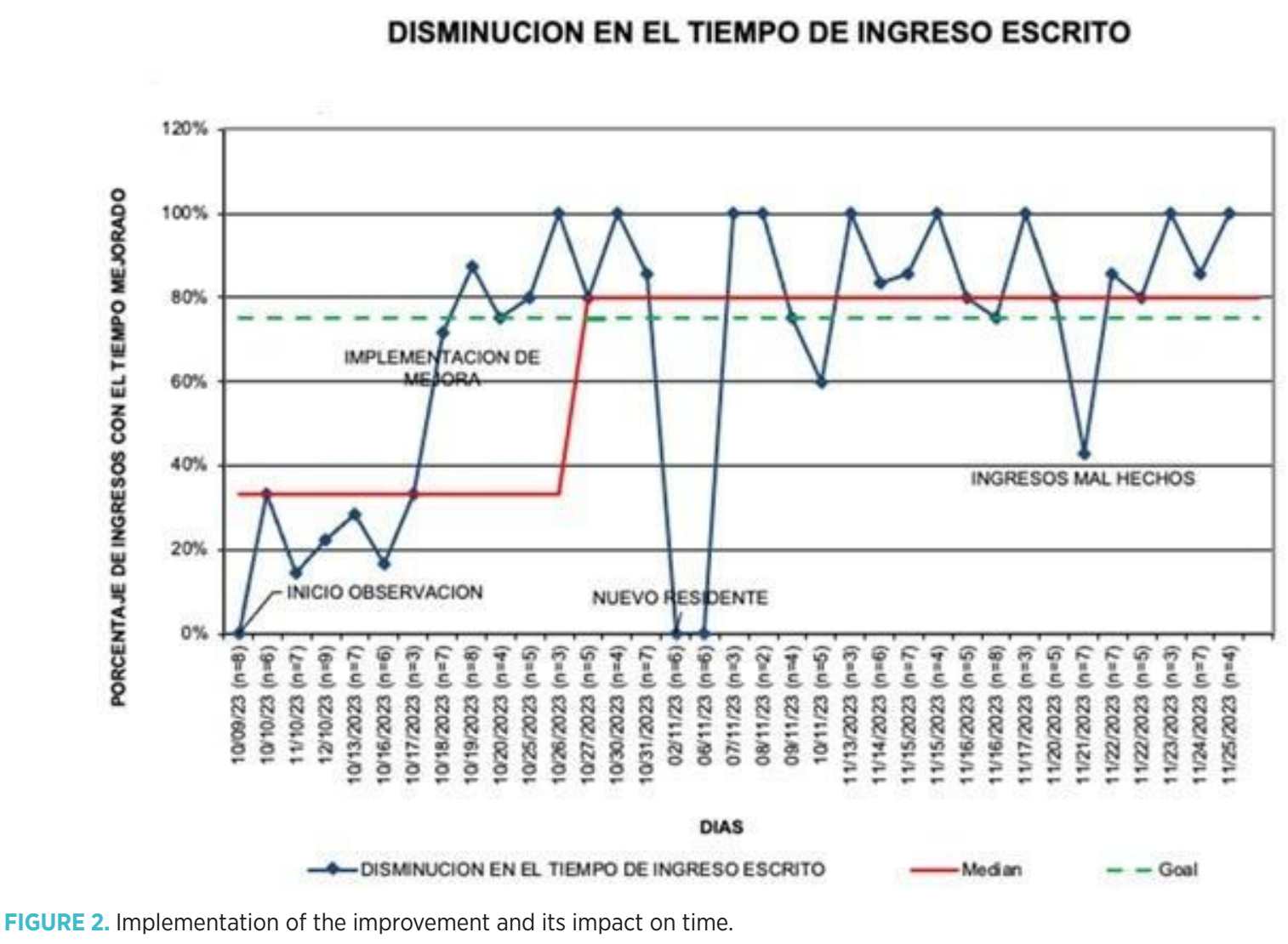
This chart is a valuable tool for improvement implementation, as it clearly visualizes whether the proposed goal has been reached.
Discussion
Implementing a shortened written admission completed by a pediatric resident assigned exclusively to this task was successful. It is known that delays in transferring patients from the emergency department to inpatient units are influenced by several factors. In the study by Nathan R. Hoot et al., three general causes of emergency department overcrowding are described: input factors, throughput factors, and output factors. Among the throughput factors, insufficient medical staff or trainees directly affects overcrowding.
Our SMART objective was to reduce the time required for residents to complete a written admission, successfully lowering it from 75 minutes to 26 minutes.
During the project, two declines were observed in the run chart: the first due to rotation transition, when the incoming resident was unaware of the implemented measure; and the second due to incorrectly completed admissions, which required correction and delayed the process. After identifying these causes, residents were informed of the new protocol for shortened histories, resulting in improvement in admission times.
The improvement methodology allowed the team to initially identify issues amenable to optimization through small interventions, which in the future will lead to better care for patients. By reducing the time required for residents to complete written admissions by more than half, patient waiting time decreases; the transfer process to inpatient areas is expedited; patients receive medical treatment and nursing care faster; and residents have more time available for other service tasks or even to rest or eat.
A long-term improvement would be the implementation of computers and an electronic medical record system in the emergency department. This measure would streamline processes, although it requires investment from the Ministry of Health. Relevant administrative actions were initiated, and implementation is expected in the future.
Limitations during implementation included conducting the improvement during morning shifts, where more medical staff is available and processes are naturally faster. Implementing the same intervention during afternoon and night shifts—when patient volumes are higher—would likely have a greater impact. Additionally, the measurement period was only three months. Assessing the impact of this intervention throughout different seasons would be important, given variations in patient influx.
Conclusions
In our study, the intervention reduced the time required to complete the written admission for emergency-to-inpatient transfers from 75 minutes to 26 minutes, thereby helping accelerate the admission process and reduce overcrowding in the emergency service.
Funding
This study did not require external funding.
Conflict of Interest
The authors declare no conflicts of interest.
Author Contributions
The authors certify equal contributions to the conception, design, scientific and intellectual content, and writing of the manuscript.
References
- Hoot NR, Aronsky D. Systematic review of emergency department crowding: causes, effects, and solutions. Ann Emerg Med [Internet]. 2008;52(2):126–36. Available from: https://doi.org/10.1016/j.annemergmed.2008.03.014
- Schneider S, Zwemer F, Doniger A, Dick R, Czapranski T, Davis E. Rochester, New York: a decade of emergency department overcrowding. Acad Emerg Med [Internet]. 2001;8(11):1044–50. Available from: https://doi.org/10.1111/j.1553-2712.2001.tb01113.x
- Sinclair D. Emergency department overcrowding: implications for paediatric emergency medicine. Paediatr Child Health [Internet]. 2007;12(6):491–4. Available from: https://doi.org/10.1093/pch/12.6.491
- Wang Z, Xiong X, Wang S, Yan J, Springer M, Dellinger RP. Causes of emergency department overcrowding and blockage of access to critical services in Beijing: a 2-year study. J Emerg Med [Internet]. 2018;54(5):665–73. Available from: https://doi.org/10.1016/j.jemermed.2018.02.009
- Yarmohammadian MH, Rezaei F, Haghshenas A, Tavakoli N. Overcrowding in emergency departments: a review of strategies to decrease future challenges. J Res Med Sci [Internet]. 2017;22:23. Available from: https://doi. org/10.4103/1735-1995.200277
Explorar
Artículos
Volúmenes
Sobre la revista
Más leídos
Emergencias Pediátricas
Emergencias Pediátricas
Emergencias Pediátricas
1º Congreso Mundial de Emergencias Pediátricas
Emergencias Pediátricas
Una nueva mirada a la vía aérea pediátrica: secuencia de intubación diferida como alternativa segura en situaciones de urgencias
Emergencias Pediátricas