Otro
Vol. 4 Núm. 3 (English)
9 min
Optimization of electronic health record documentation in the Emergency Department of the National Children's Hospital
Optimización de la documentación en el expediente digital en salud en el Servicio de Emergencias del Hospital Nacional de Niños
Adriana Yock-Corrales¹, Jessica Gómez-Vargas¹, Rafael Mena¹*
¹Emergency Department, National Children’s Hospital, Costa Rican Social Security Fund, San José, Costa Rica
Correspondencia:
Recepción:
08/07/2025
Aceptación:
08/07/2025
Publicación:
16/12/2025
Métricas
65
Visualizaciones
9
Descargas
Compartir
Compartir
Resumen (ES)
Introducción: La adecuada documentación en el Expediente Digital en Salud (EDUS) es esencial para estandarizar la atención clínica, mejorar la trazabilidad y garantizar la seguridad del paciente. Sin embargo, en entornos complejos como los servicios de emergencias, puede generar demoras en la ejecución de indicaciones médicas. Estudios reportan que el personal de enfermería destina hasta un 40% de su jornada a tareas de registro, lo que puede afectar la relación asistencial y la eficiencia operativa.
Objetivo: Optimizar el uso del EDUS en el área de inyectables, reduciendo el tiempo de finalización de órdenes médicas de seis a dos horas en un período de tres meses.
Métodos: Se realizó un estudio de mejora continua en el Servicio de Emergencias del Hospital Nacional de Niños “Dr. Carlos Sáenz Herrera” (Costa Rica). Se encuestó a 44 enfermeras y se revisaron 74 expedientes de pacientes con estancias prolongadas por indicaciones no cerradas. Las intervenciones incluyeron: capacitaciones al personal, refuerzo supervisado de la revisión de indicaciones y colocación de recordatorios visuales para mejorar la comunicación entre enfermería y prescriptores. Se utilizó un run chart para el seguimiento de indicadores.
Resultados: El 16% del personal no revisaba las indicaciones al finalizar su turno, y el 29,5% no cerraba órdenes si existía duda sobre su ejecución. El 40,5% de los errores ocurrió en el segundo turno. Las intervenciones permitieron alcanzar la meta establecida.
Conclusiones: El uso estratégico de herramientas simples, en conjunto con supervisión activa, capacitación continua y trabajo en equipo, mejora la documentación clínica y contribuye a una atención más segura y eficiente en los servicios de emergencia pediátrica.
Palabras clave (ES):
Resumen (EN)
Introduction: Proper documentation in the electronic health record (EDUS)is essential to standardize clinical care, improve traceability, and ensure patient safety. However, in complex environments such as emergency departments, it may cause delays in the execution of medical orders. Studies report that nursing staff devote up to 40% of their workday to record-keeping tasks, which can affect the care relationship and operational efficiency.
Objective: To optimize the use of the EDUS in the injectables area, reducing the completion time of medical orders from six to two hours over a three-month period.
Methods: A continuous quality improvement study was conducted in the Emergency Department of the National Children’s Hospital “Dr. Carlos Sáenz Herrera” (Costa Rica). Forty-four nurses were surveyed, and seventy-four patient records with prolonged stays due to unclosed medical orders were reviewed. Interventions included staff training, supervised reinforcement of order review, and placement of visual reminders to improve communication between nursing staff and prescribers. A run chart was used to monitor indicators.
Results: Sixteen percent of the staff did not review medical orders at the end of their shift, and 29.5% did not close orders when there was uncertainty about their completion. Forty point five percent of the errors occurred during the second shift. The interventions made it possible to achieve the established goal.
Conclusions: The strategic use of simple tools, together with active supervision, continuous training, and teamwork, improves clinical documentation and contributes to safer and more efficient care in pediatric emergency services.
Palabras clave (EN):
Introduction
Adequate documentation within the Electronic health record (EDUS) is an essential mechanism for recording information during clinical care and enables the standardization of medical records. However, this process may lead to delays in the execution of medical orders by personnel. Previous studies have reported that nursing staff spend up to 40% of their time documenting aspects of patient care(1), and one-quarter of respondents state that this task is sometimes cumbersome and negatively affects communication between nursing staff and patients(2).
Digital records are designed to support data entry, but their accuracy and timeliness depend on the personnel responsible for entering the information. Although nursing staff are the primary users of this tool, other healthcare workers also enter data, and improper use or incompatible workflows worsen the challenges of patient care, especially in complex environments(3). Quality improvement methodology must be part of the routine work in emergency services due to their complexity, in order to monitor processes and ensure patient safety(4).
The Emergency Service at our hospital comprises several functional areas staffed by physicians and nursing personnel. Documentation of clinical procedures and care must be completed in the EDUS, implemented in our institution in 2018. Incomplete or inadequate documentation, as well as the failure of nursing staff to finalize medical orders, leads to prolonged patient presence on worklists, resulting not only in delays in care but also in uncertainty regarding medication administration.
Currently, the reasons for prolonged patient stays and incomplete medical orders are not known. The primary objective of this study is to optimize procedure documentation within the EHR of the Medical Emergency Service (SEM), and the specific objective is to reduce the completion time of orders in the injectable-medication module of the EHR from six hours to two hours within a three-month period.
Methods
This study was conducted at the National Children’s Hospital “Dr. Carlos Sáenz Herrera” in San José, Costa Rica, over a five-month period (October 2023 – February 2024). This hospital is the country’s only tertiary-level pediatric center, with 300 inpatient beds and approximately 95,000 annual emergency department visits. The Emergency Service includes multiple functional areas, such as the ambulatory area with consultation rooms, the injectable-medication and inhalation-therapy area, and the observation area, which includes resuscitation rooms, the suture room, and minor surgery.
An operational issue was identified in the injectable-medication area involving prolonged presence of ambulatory patients on the system’s worklist, even after they were no longer physically present in the Emergency Service.
This situation was associated with the failure to finalize medical orders in the system, which may be attributed to two main causes: omission of the medical order in the corresponding section for nursing personnel, or failure to update the patient’s status in the system. Both factors distort the service’s management indicators.
Data collection included a review of statistical cubes from the Electronic Health Record (SIES Urgencias). In addition, a five-item closed-question survey was administered to nursing personnel, and selected records of patients with prolonged stays in the injectable-medication area were analyzed.
No conflicts of interest were identified during the execution of this study, including the interventions or the analysis and interpretation of the data. This study was approved as a non-biomedical study by the institution’s Scientific Ethics Committee.
Improvement Strategy
Once the problem was identified, an improvement strategy was implemented to correct deficiencies in the clinical documentation process. The planning process took place during the last two weeks of October 2023. The first step consisted of training nursing personnel, aiming to raise awareness of the issue, foster collaborative work with the medical team, and ensure compliance with the established goals. These training sessions took place in November 2023.
Multiple training sessions were conducted, addressing the clinical and operational implications of failing to properly finalize indications in the system. Additionally, visual reminders (brightly colored signs) were placed in key areas of the process, including the computer area (where procedures are recorded), the medication-preparation area, and the vital-sign station.
Interventions were implemented in late November and December 2023. The first intervention stipulated that no injectable medication would be administered unless it was previously entered into the EDUS. The supervising nurse continually promoted verification of indications in the functional area, both verbally and through visible signs placed on the computers, ensuring orders were reviewed before the end of each shift. Telephones were also installed to facilitate smoother communication between nursing staff and prescribing physicians. Finally, ongoing training sessions were provided to new staff members to ensure continued compliance with the established goals. This continuous process took place in January and February 2024.
These actions were designed to reinforce good documentation practices and reduce unnecessary prolonged stays on system worklists, thus improving the service’s operational efficiency.
Results
To gather information and diagnose the problem, results are presented according to the processes carried out.
Nursing Staff Survey
A total of 44 nurses from the service were surveyed. When asked whether they reviewed patients with pending indications on the worklist at the end of their shift, 16% responded that they did not. Additionally, when asked whether they finalized the indication when a patient with a pending intramuscular medication had already been discharged from the Emergency Service, one-third of respondents (29.5%) stated that they did not, as they were uncertain whether the medication had actually been administered. Finally, 77.3% (n=34) reported that, whenever possible, they attempted to coordinate injectable-medication orders with medical staff throughout their shift.
Review of Statistical Cube Data
A total of 74 patients with prolonged stays were identified, with the cause being an injectable medication order that had not been closed. The median age was 60 months (IQR 37–108). According to care shifts I, II, and III, the second shift showed the highest frequency of this error: Shift I (17; 23%), Shift II (30; 40.5%), Shift III (27; 36.4%). The average length of stay in the functional area with unfinished indications was six hours.
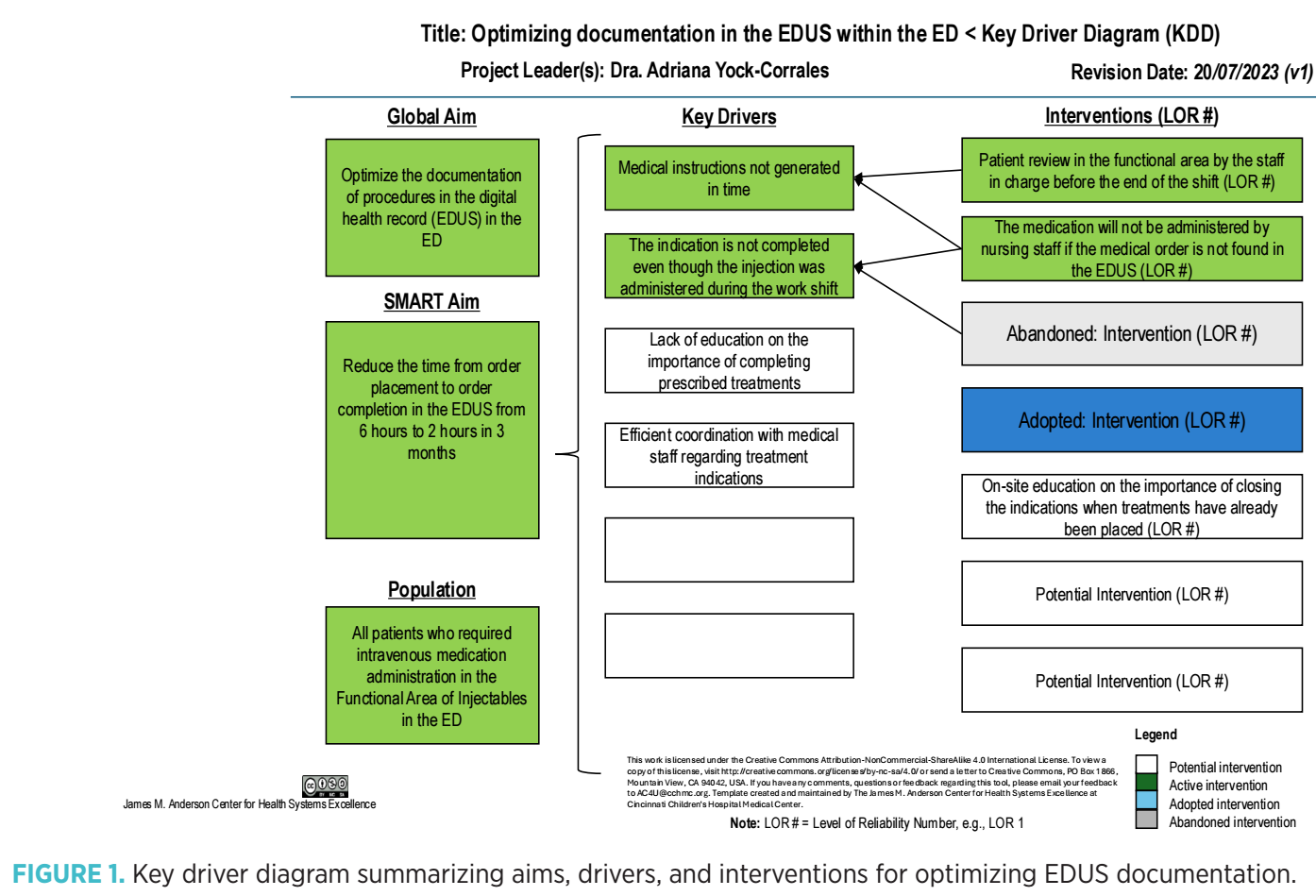
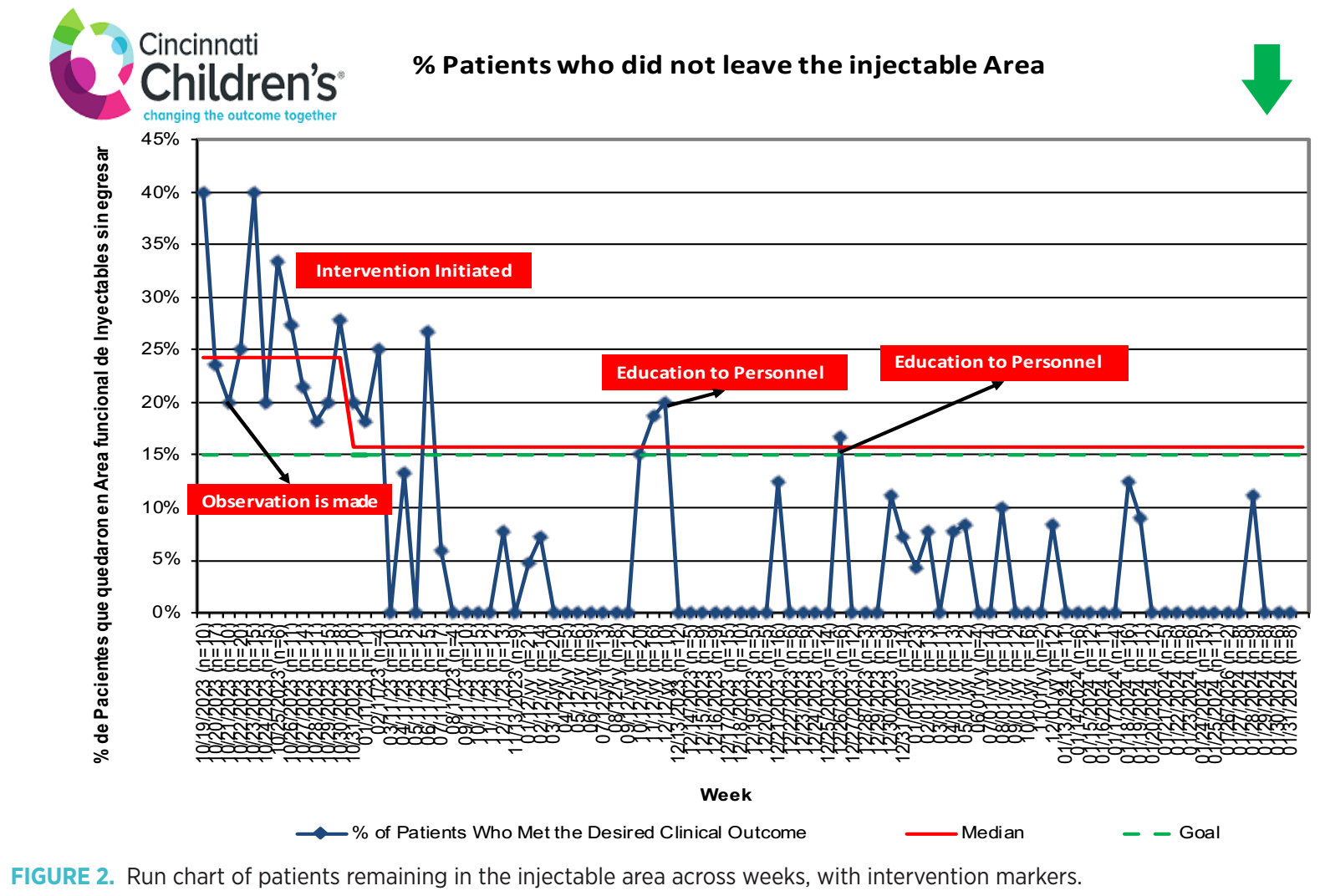
Three interventions were required during the study period to maintain the target reduction in patients remaining on this functional area’s list with unfinished injectable-medication orders—from six hours to two hours over the three-month period.
Subsequently, patients were prospectively identified, and their data were plotted on the run chart shown in Figure 2, allowing visualization of changes over time following the interventions.
Discussion
Digital clinical records are a fundamental tool for the permanent documentation of a patient’s medical history and for ensuring continuity of care. Their use supports safer, evidence-based clinical decisions while improving traceability of actions performed by different healthcare professionals. The transition from paper to electronic systems has brought increased efficiency, fewer errors, improved real-time access to information, and the ability to standardize clinical and administrative procedures. This standardization promotes more consistent, safer, and patient-centered care(5).
This study demonstrates that implementing good practices in the use of electronic clinical records can lead to significant improvements in documentation quality and patient safety. One concrete example is the reduced risk of errors such as duplicate administration of an injectable medication—an event that is potentially preventable through timely, clear, and complete documentation. However, we found that a single, isolated intervention was insufficient to achieve sustained improvement, especially in settings such as our emergency service, where staff rotation is high. This high turnover, combined with fluctuations in patient volume—particularly during periods of high occupancy—creates conditions in which medical orders may remain incomplete or unexecuted(6).
Raising awareness of these issues within the healthcare team is essential for fostering collective responsibility and encouraging change. Promoting shared responsibility in system use—avoiding attributing this task solely to nurses or physicians—facilitates collaboration and strengthens team cohesion. This, in turn, leads to better adherence to new practices and greater sustainability of improvements over time.
Implementing simple interventions alongside practical and continuous training has proven more effective for achieving sustainable results. Consistency in training processes is key, especially given the frequent onboarding of new personnel. It is fundamental that every new team member receives standardized training from the moment they join, and that periodic updates are available for all staff(7).
Quality improvement methodology must be considered a priority and implemented across all emergency services. Understanding the perspectives of frontline personnel can help guide meaningful and sustainable changes in the settings where interventions are applied. Training healthcare workers to identify situations where quality improvement methodology may be applied will enhance the quality of care delivered in our services(8).
Among the study’s limitations is the challenge of providing uniform training to all staff due to rotating schedules and the unavailability of trainers 24 hours a day. Additionally, although data collection was prospective, it only occurred when investigators were present, which may introduce bias in result representativeness.
In conclusion, this study illustrates how applying continuous quality-improvement methodologies within hospital settings can positively impact the quality of care. Although challenges persist, team commitment, ongoing training, and adoption of robust digital systems are essential pillars for advancing toward a safer and more efficient healthcare system.
Funding
This research did not receive any specific grant from public, commercial, or non-profit funding agencies.
Conflicts of Interest
The authors declare no conflicts of interest.
Author Contributions
The authors certify equal contribution to the conception, design, scientific content, intellectual input, and writing of the manuscript.
References
- O’Brien A, Weaver C, Settergren TT, Hook ML, Ivory CH. EHR documentation: the hype and the hope for improving nursing satisfaction and quality outcomes. Nurs Adm Q. 2015;39(4):333–9. Available from: https://doi.org/10.1097/NAQ.0000000000000119
- Nelson R. Nurses’ dissatisfaction with electronic health records remains high. Am J Nurs. 2016;116(11):18–9. Available from: https://doi.org/10.1097/01.NAJ.0000507741.27246.88
- Chartier LB, Cheng AHY, Stang AS, Vaillancourt S. Quality improvement primer part 1: preparing for a quality improvement project in the emergency department. CJEM. 2018;20(1): 104–11. Available from: https://doi.org/10.1017/cem.2017.361
- Lindsay MR, Lytle K. Implementing best practices to redesign workflow and optimize nursing documentation in the electronic health record. Appl Clin Inform. 2022;13(3):711–9. Available from: https://doi.org/10.1055/a-1868-6431
- Koh J, Ahmed M. Improving clinical documentation: introduction of electronic health records in pediatrics. BMJ Open Qual. 2021;10(1):e000918. Available from: https://doi.org/10.1136/bmjoq-2020-000918
- Schmutz T, Le Terrier C, Ribordy V, Guechi Y. No waiting lying in a corridor: a quality improvement initiative in an emergency department. BMJ Open Qual. 2023;12(3):e002431. Available from: https://doi.org/10.1136/bmjoq-2023-002431
- Migita R, Yoshida H, Rutman L, Woodward GA. Quality improvement methodologies: principles and applications in the pediatric emergency department. Pediatr Clin North Am. 2018;65(6):1283–96. Available from: https://doi.org/10.1016/j.pcl.2018.07.011
- DeWulf A, Otchi EH, Soghoian S. Identifying priorities for quality improvement at an emergency department in Ghana. BMC Emerg Med. 2017;17(1):28. Available from: https://doi.org/10.1186/s12873-017-0139-0
Explorar
Artículos
Volúmenes
Sobre la revista
Más leídos
Emergencias Pediátricas
Emergencias Pediátricas
Emergencias Pediátricas
1º Congreso Mundial de Emergencias Pediátricas
Emergencias Pediátricas
Una nueva mirada a la vía aérea pediátrica: secuencia de intubación diferida como alternativa segura en situaciones de urgencias
Emergencias Pediátricas