Artículo de revisión
Vol. 5 Núm. 2 (English)
15 min
Neuroleptic malignant syndrome in the Emergency Department
Síndrome neuroléptico maligno en Urgencias
Carlos-Javier Moreno-Pérez1*, Ángela Pieras-López1, Marta Duero-Adrados1
1Hospital Pharmacy Department, Hospital Sant Joan de Déu, Barcelona, Spain
Correspondencia:
Recepción:
13/11/2025
Aceptación:
10/05/2026
Publicación:
26/06/2026
Métricas
198
Visualizaciones
1
Descargas
Compartir
Compartir
Resumen (EN)
Introduction: Neuroleptic malignant syndrome (NMS) is a severe, rare adverse reaction associated with the use of neuroleptics. Its pathophysiology is related to central dopaminergic blockade, affecting thermoregulation, muscle tone, and the autonomic nervous system.
Epidemiology: More prevalent in adults, pediatric cases have been reported, especially in males treated with typical or atypical antipsychotics. Its incidence is low but might be underestimated.
Risk factors: These include pharmacological aspects (high doses, rapid titration, polypharmacy), intrinsic patient factors (neurological comorbidities, family history), and environmental factors (dehydration, immobilization, infections).
Clinical presentation: Fever, rigidity, altered mental status, and autonomic instability may appear. It can progress to rhabdomyolysis, renal failure, and metabolic disturbances.
Diagnosis: It is clinical, based on criteria such as those of Levenson, Lazarus, and the DSM-5. It requires the exclusion of other entities like serotonin syndrome, malignant catatonia, or meningitis.
Treatment: It requires discontinuation of the neuroleptic, intensive support (hydration, temperature control, ventilation, electrolyte correction), and specific treatment with dantrolene and bromocriptine. Benzodiazepines can be useful as adjuvant therapy.
Neuroleptic reintroduction: It must be done with caution, using low doses and avoiding the parenteral route.
Conclusion: NMS demands early diagnosis and multidisciplinary management. In pediatrics, its presentation may be atypical, so it should be considered following any change in neuroleptic treatment.
Palabras clave (EN):
Resumen (ES)
Introducción: El síndrome neuroléptico maligno (SNM) es una reacción adversa grave, poco frecuente, asociada al uso de neurolépticos. Su fisiopatología se relaciona con el bloqueo dopaminérgico central, afectando la termorregulación, el tono muscular y el sistema autónomo.
Epidemiología: Más prevalente en adultos, se han descrito casos pediátricos, especialmente en varones tratados con antipsicóticos típicos o atípicos. Su incidencia es baja, pero podría estar subestimada.
Factores de riesgo: Incluyen aspectos farmacológicos (dosis altas, escalado rápido, polifarmacia), intrínsecos del paciente (comorbilidades neurológicas, antecedentes familiares) y ambientales (deshidratación, inmovilización, infecciones).
Clínica: Puede aparecer fiebre, rigidez, alteración del estado mental e inestabilidad autonómica. Puede evolucionar a rabdomiólisis, insuficiencia renal y alteraciones metabólicas.
Diagnóstico: Es clínico, basado en criterios como los de Levenson, Lazarus y DSM- 5. Requiere exclusión de otras entidades como síndrome serotoninérgico, catatonia maligna o meningitis.
Tratamiento: Precisa suspensión del neuroléptico, soporte intensivo (hidratación, control térmico, ventilación, corrección electrolítica) y tratamiento específico con dantroleno y bromocriptina. Las benzodiacepinas pueden ser útiles como coadyuvantes.
Reintroducción de neurolépticos: Debe hacerse con precaución, usando dosis bajas y evitando la vía parenteral.
Conclusión: El SNM exige diagnóstico precoz y manejo multidisciplinar. En pediatría, su presentación puede ser atípica, por lo que debe considerarse ante cualquier cambio en tratamiento neuroléptico.
Palabras clave (ES):
Introduction
Neuroleptic malignant syndrome (NMS) is an uncommon but clinically severe condition, usually associated with the use of drugs that act on the central nervous system, mainly neuroleptics(1,2).
The pathophysiology of this entity is not completely clear, but it is associated with the blockade of central dopaminergic receptors, which causes an alteration in their function(3).
The pharmacotherapeutic approach is based on the immediate discontinuation of the drug suspected of being the trigger for the condition, the establishment of supportive measures, and the administration of dantrolene, as well as dopaminergic agonists such as bromocriptine(1,4).
The objective of this work is to review the available evidence on neuroleptic malignant syndrome specifically in the pediatric population, with special attention to its clinical manifestations, diagnosis, and therapeutic options.
Materials and Methods
The literature search strategy included the use of databases such as PubMed/MEDLINE, selecting articles published until December 2025.
Articles in English and Spanish were included that addressed diagnostic, clinical, and therapeutic aspects of NMS in general, prioritizing those that included pediatric patients and relevant clinical guidelines.
The terms “neuroleptic malignant syndrome”, “antipsychotics”, “anticholinergic”, “dantrolene”, “dopaminergic receptors”, and “pediatric” were used, combined with boolean operators (AND/OR).
After the initial identification of articles, a title and abstract review was performed, followed by a full-text evaluation to check for compliance with the selection criteria. Finally, 21 articles were included for analysis.
Epidemiology
Most reported cases correspond to adult patients(5,6), although it has also been described in children and adolescents(2,5). An incidence of between 0.01-3% is estimated in the general population(2,5-7), being considerably lower in pediatrics. The actual incidence could be underestimated given the difficulty in diagnosis and overlap or confusion with other conditions.
The increase in the prescription of antipsychotics in the pediatric population, associated with the increase in the diagnosis of mental health disorders, has caused a rise in the number of NMS cases, despite it being an infrequent adverse reaction(2,5-10).
Most episodes reported in pediatrics have been associated with the use of high-potency typical antipsychotics, such as haloperidol(5-7). Cases have also been published with atypical antipsychotics, such as quetiapine, risperidone, or olanzapine, despite their better safety profile(7).
While it can present at any pediatric age group(5,11,12), a higher frequency of cases has been described in adolescents and young adults(5,8-10,13).
Risk Factors
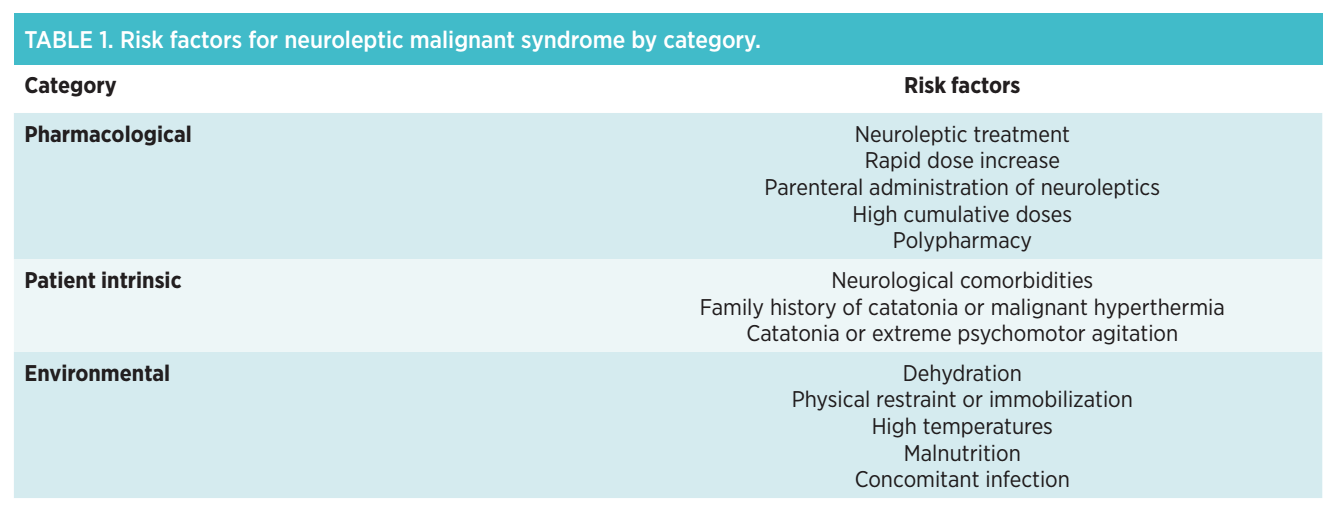
NMS is rare in pediatrics, and, although it is often considered an idiosyncratic reaction to the use of dopaminergic antagonists, some risk factors have been identified that predispose its appearance: pharmacological, patient-intrinsic, and environmental(2,3,5-10,13).
Pharmacological factors
Factors that favor the development of NMS have been identified, including starting treatment with antipsychotics. Additionally, a higher risk has been observed in patients who have undergone rapid dose escalation, even if it is not a dose-dependent reaction(5-7,9).
The concomitant use of several neuroleptics or other compounds such as lithium, treatment with high cumulative doses of one or several drugs, or parenteral administration(2,3,9,14,15) are other indicators that predispose to the appearance of NMS.
Patient-intrinsic factors
Among clinical or patient-intrinsic determinants, neurological comorbidities have been identified, such as epilepsy, cerebral palsy, and autism spectrum disorders (ASD). In these patients, the need to start treatment with neuroleptics and, in many cases, with several drugs, influences this. This situation increases the probability of NMS appearing, as well as the difficulty in the early identification of its symptoms.
It has also been associated with episodes of catatonia or extreme psychomotor agitation(2,5,6,14,15), as well as a family history of such episodes and malignant hyperthermia.
The patient’s intrinsic factors and family history are non-modifiable variables, but they can increase the risk of the syndrome occurring.
Environmental factors
Among environmental determinants are dehydration, physical restraint, high temperatures, or concomitant infections(2,5,9). These can hinder body heat elimination and thereby favor some of the mechanisms that lead to developing symptoms.
Pathophysiology
NMS constitutes a severe and uncommon adverse reaction. Its appearance is associated mainly with the use of dopaminergic antagonist drugs and predisposing factors that favor its development.
Regarding the pathophysiology of NMS, the mechanisms by which it is produced are not completely clear. Several hypotheses exist, although the main two are related to the blockade of the dopaminergic pathway receptors(3,5,11):
1. In the basal ganglia, through the nigrostriatal pathway, producing an increase in muscle tone and rigidity in the same way as extrapyramidal symptoms like tremors.
◦ The increase in muscle tone and maintained muscle rigidity contribute to the development of hyperthermia due to the increase in muscular metabolic activity.
2. In the hypothalamus, altering the thermoregulatory and autonomic systems, favoring hyperthermia and autonomic dysfunction, respectively.
◦ The alteration of the autonomic nervous system translates into an inadequate vasomotor response, which prevents the regulation of vascular tone against metabolic and thermal changes.
Clinical Presentation
The classic clinical presentation of NMS is mainly characterized by four key manifestations: fever, delirium, muscle rigidity, and autonomic instability, which may be associated with other less frequent symptoms. The appearance of these symptoms can be variable and develop progressively in the first few days(1-3,5,6).
Central nervous system alterations
Alteration of mental status is, in most cases, one of the first symptoms of this entity. The nervous system is affected due to dopaminergic blockade in key areas such as the basal ganglia, hypothalamus, and cerebral cortex. Furthermore, in patients with previous psychiatric comorbidities, these mental alterations can go unnoticed, thus hindering the early detection of the syndrome.
Variable and progressive fluctuations in consciousness level can appear, starting as mild drowsiness or confusion and potentially evolving into delirium. The latter may be accompanied by psychomotor agitation, intense anxiety, and catatonic symptoms such as mutism, negativism, catalepsy, or stereotypy. Occasionally, this condition can progress to deep encephalopathy in the form of stupor or coma(2-4).
Neuromuscular Alterations
Regarding neuromuscular alterations, the most frequent symptom is muscle rigidity, derived from dopaminergic blockade in the basal ganglia and the nigrostriatal pathway. This generalized rigidity has been described in the literature as “lead-pipe” or “cogwheel” rigidity(3,13) and is characterized by a stable resistance to all ranges of motion. It is maintained steadily, which allows it to be differentiated from other extrapyramidal symptoms, which may fluctuate.
Another typical manifestation is hypertonia, which is usually diffuse and can lead to catatonic postures. This similarity with catatonia could make it difficult to differentiate from the patient’s underlying disorder, delaying detection and diagnosis.
Tremors can appear in the form of pseudoparkinsonism(3,13,14). Other less frequent symptoms exist, such as focal or generalized dystonias and dyskinesias such as chorea, bradykinesia, or akinesia. The combination of these symptoms highlights the dopaminergic-cholinergic imbalance that occurs.
Secondary to sustained muscle contraction, muscle injury occurs, with breakdown of fibers and release of muscle enzymes and proteins, such as myoglobin. This process manifests with pain, muscle weakness, and dark urine, potentially leading to grave renal damage in the form of acute renal failure(3,11,13).
Autonomic alterations
The alteration of the thermoregulatory system(3,5,11,13,14) manifests as hyperthermia exceeding 38ºC, often exceeding 40ºC. Additionally, manifestations such as rigidity and hypertonia contribute to this increase in temperature, intensifying this situation.
Instability of the sympathetic nervous system, induced by central dopaminergic blockade, typically presents with persistent tachycardia and tachypnea as a response to hyperthermia and increased metabolic and oxygen demand. Blood pressure lability can also appear in the form of hypertensive and hypotensive episodes due to the vasomotor system’s inability to correctly regulate vascular tone during these changes.
Cholinergic sympathetic hyperactivity manifests as profuse diaphoresis. Sialorrhea or dysphagia observed in some cases could be related to rigidity of the oropharyngeal muscles. All of this can favor the patient’s dehydration and malnutrition.
Urinary incontinence can appear due to the alteration of the contraction and relaxation of the urethral sphincter, which can also be favored in cases of altered consciousness and immobility.
Metabolic and laboratory alterations
In NMS, several laboratory alterations can be detected(2,3,8,9,13,14), reflecting the neuromuscular and autonomic dysfunction characteristic of this entity.
The sustained muscle contraction occurring in NMS can cause significant cellular damage leading to secondary rhabdomyolysis. This is reflected by a significant increase in creatine phosphokinase (CPK), being greater than 1000 UI/L(8,9,12,16), even exceeding 100000 UI/L in severe cases. This finding is considered the characteristic biomarker of the syndrome; however, it is not specific, as it can be elevated in other conditions.
Laboratory findings highlight leukocytosis, present in most cases, with counts ranging between 10000-40000/ mm3 as a response to tissue stress and muscle necrosis. Muscle destruction triggers the release of myoglobin and its excretion in urine, causing it to darken. Hydroelectrolytic alterations are also frequent, derived from diaphoresis, rhabdomyolysis, and typical malnutrition of the condition. This translates into hyperkalemia from intracellular potassium release; hypocalcemia from precipitation of released calcium with phosphate from the muscle; hypo- and hypernatremia; and metabolic acidosis from hyperproduction of lactic acid due to the high muscle activity maintained over time.
All these findings are common in NMS but are not specific to the condition and, alongside other variables, can help confirm the diagnosis.
Diagnosis
In NMS, there is no single definitive diagnostic test or criterion. Its diagnosis is based on exclusion and ruling out other entities that might produce symptoms or conditions similar to NMS.
Several systems exist for its diagnosis(3,5,6,17,18):
1. Levenson criteria (1985), in which 3 major criteria, or 2 major and 4 minor criteria, must be met to be considered as a high diagnostic probability:
◦ Major: hyperthermia, rigidity, and elevated CPK (>1000 UI/L).
◦ Minor: altered consciousness level, tachycardia, blood pressure lability, tachypnea, diaphoresis, and leukocytosis.
2. Lazarus criteria (1989), in which 3 major criteria and also 3 minor criteria must be met:
◦ Major: neuroleptic administration within the previous 7 days, hyperthermia, and rigidity.
◦ Minor: altered consciousness, tachycardia, blood pressure lability, tachypnea, elevated CPK or myoglobinuria, and leukocytosis.
Several attempts have been published in the literature to establish and standardize diagnostic criteria for NMS. In the case of these two examples, although similar, they differ in a critical point: the consideration of prior neuroleptic administration.
The latest diagnostic system is from the DSM-5 (Diagnostic and Statistical Manual of Mental Disorders), published in 2013 and revised in 2022.
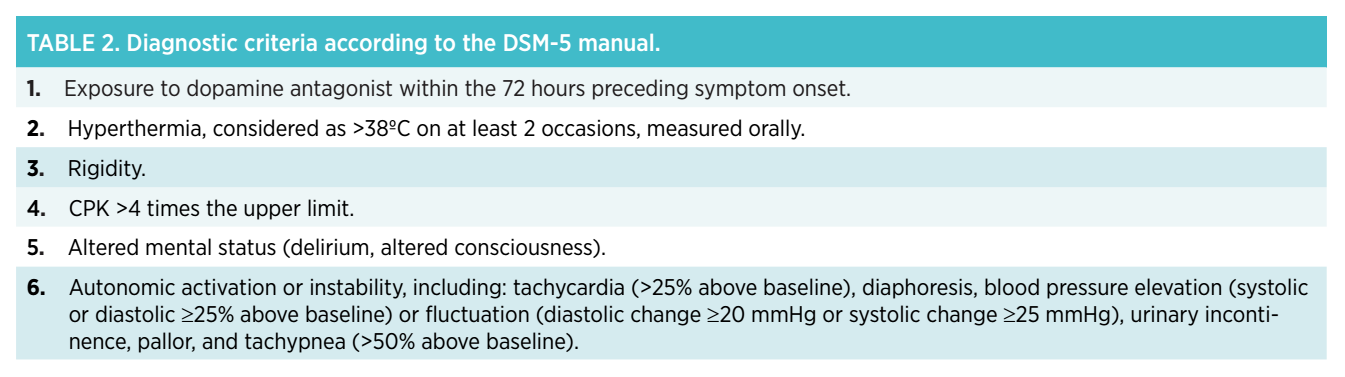
Presentations of the disease that do not meet DSM criteria, especially pediatric cases where symptoms may not appear or may be mild, are typically classified as atypical NMS. In pediatrics, they could also be confused with other pathologies such as infections, epilepsy, or malignant catatonia. In pediatrics, the presence of neurodevelopmental disorders can delay symptom detection; therefore, upon starting or changing neuroleptics, the possibility of NMS must be considered.
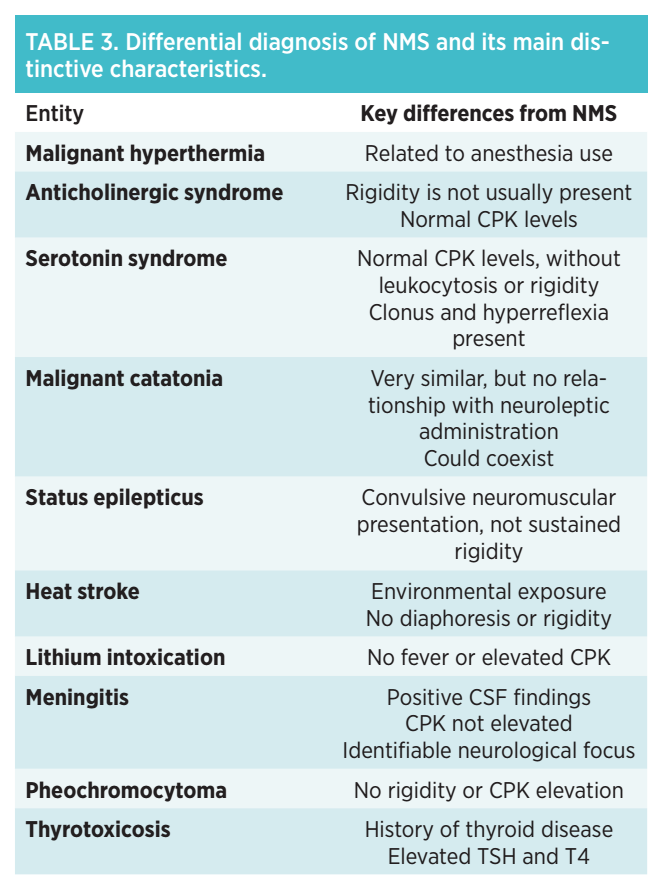
Therefore, it is essential to perform a differential diagnosis against other entities that could simulate it.
Differential Diagnosis
Differential diagnosis with other severe neurological diseases, as well as those induced by drugs or other substances, is fundamental for early diagnosis and appropriate management of this medical emergency(3,5,8,9,14,15,19,20).
Therapeutic Management
General supportive measures
Upon diagnostic suspicion of NMS, the first and most important step is to immediately discontinue the causal agent (neuroleptic or dopaminergic antagonist), without needing to obtain further evidence of the disease(6,9,10,11).
Given the possible and frequent complications in these patients, monitoring and care in an intensive care unit (ICU) should be considered(1,4). Once the drug suspected of causing the syndrome has been discontinued, the strategy should focus on minimizing environmental factors that could predispose to or worsen the patient’s condition. These environmental factors could be controlled through ambient temperature regulation measures. The risk of aspiration pneumonia must also be reduced with appropriate patient positioning.
Supportive measures include heart rate monitoring and management of possible arrhythmias based on the patient’s clinical evolution. Likewise, blood pressure control is fundamental, and antihypertensive treatment may be required. Body temperature control(9,11) can be achieved with the administration of antipyretics and the application of physical measures, such as cold packs or cooling blankets. However, it must be noted that antipyretics are not always effective because the hyperthermia is not febrile. Physical measures are usually more effective.
Adequate monitoring of consciousness level is essential, as well as the use of ventilatory support through mechanical ventilation in case of respiratory compromise.
Proper hydration of the patient via fluid therapy must be guaranteed, and any electrolyte imbalance such as hyperkalemia, hypocalcemia, and metabolic acidosis must be corrected. To prevent renal damage or rhabdomyolysis, diuresis and urine alkalization should be forced. Likewise, thromboembolic prophylaxis with low-molecular-weight heparin (LMWH)(11) should be considered, especially in patients with prolonged immobilization.
Specific treatment
Specific treatment(3,4,6,21) is based on the use of two drugs: dantrolene and bromocriptine. Evidence supporting their use is based on case series and expert consensus.
Dantrolene, a hydantoin derivative, acts as a muscle relaxant by blocking the release of calcium from the sarcoplasmic reticulum, thus reducing intracellular calcium availability. Its use is aimed at reducing muscle rigidity and hyperthermia. It is administered intravenously, preferably via a central line, due to the risk of local necrosis in case of extravasation. The initial dose is 1-2.5 mg/kg in a bolus, which can be repeated every 15 minutes until symptoms are controlled or a maximum cumulative dose of 10 mg/kg is reached. The maintenance dose is 1 mg/kg every 6 hours, with an infusion time of 1 hour. Liver monitoring is essential due to the risk of hepatotoxicity.
Bromocriptine is a dopaminergic agonist used for the restoration of dopaminergic neurotransmission. It is administered orally at doses of 2.5 mg every 6-8 hours, up to a maximum of 40 mg/day.
As useful treatments for muscle relaxation and agitation reduction, benzodiazepines such as diazepam and lorazepam could be used.
Restarting psychotic treatment
Most patients need to resume their chronic neuroleptic treatment that they were receiving prior to the NMS episode. Having suffered an NMS episode makes it a risk factor for recurrence(4,8).
No standardized clinical guideline exists for the reintroduction of neuroleptics in these patients, but it is recommended to follow certain directives: start with low doses of low-potency neuroleptics, gradually increase the dose, and avoid parenteral administration as much as possible.
Conclusions
Although NMS is an uncommon entity, in the pediatric population it requires early and precise diagnosis and management due to the severity of the reaction and possible recognition difficulties. Early detection and close symptom monitoring are fundamental, especially when starting or changing neuroleptic treatment.
As it is a potentially fatal clinical condition, it is important to consider it from the beginning and throughout treatment with drugs capable of triggering it. Furthermore, it is fundamental to encourage healthcare professionals to contribute pediatric cases to the literature to improve understanding of the disease, as well as its diagnosis and management in this patient group. Limitations derived from the scarce evidence available in pediatrics, together with inherent diagnostic difficulties, reinforce the need for greater clinical awareness and additional research. The need for studies in this population to establish more solid and standardized recommendations is evident.
A multidisciplinary approach and coordination between the emergency team, ICU, psychiatry, and hospital pharmacy are essential for the optimal management of NMS in the pediatric population.
Funding
No funding was received for the research, authorship, and/or publication of this article.
Authorship contribution
Carlos Javier Moreno Pérez: Writing - original draft, Writing - review & editing, Supervision.
Ángela Pieras López: Writing - review & editing, Supervision.
Marta Duero Adrados: Writing - review & editing, Supervision.
Conflicts of interest
The authors declare that there is no commercial or financial conflict of interest for this research.
Use of artificial intelligence tools
The authors declare that no artificial intelligence tools (such as ChatGPT, Copilot, Gemini, or others) have been used in the writing, analysis, or review of this article.
References
- Ware MR, Feller DB, Hall KL. Neuroleptic malignant syndrome: diagnosis and management. Prim Care Companion CNS Disord. 2018;20(1):17r02185.
- Croarkin PE, Emslie GJ, Mayes TL. Neuroleptic malignant syndrome associated with atypical antipsychotics in pediatric patients: A review of published cases. J Clin Psychiatry. 2008;69(7):1157-1165.
- Tse L, Barr AM, Honer WG. Neuroleptic malignant syndrome: a review from a clinically oriented perspective. Curr Neuropharmacol. 2015;13(3):395-406.
- Pastó Cardona L, Casals Caus P, Barroso de Fuenmayor E. Dantroleno intravenoso en hipertermia maligna y síndrome neuroléptico maligno: protocolo de utilización. Farm Hosp. 1995;19(2):95-98.
- Ray WA, Fuchs DC, Olfson M, et al. Incidence of Neuroleptic Malignant Syndrome During Antipsychotic Treatment in Children and Youth: A National Cohort Study. Journal of Child and Adolescent Psychopharmacology. 2024;34(9):397-406.
- Wijdicks EFM, Ropper AH. Neuroleptic Malignant Syndrome. N Engl J Med. 2024 Sep 26;391(12):1130-1138.
- Zhang Y, Deng W, Wang M, Luo S, Li S. A real-world pharmacovigilance study of neuroleptic malignant syndrome based on FDA adverse event reporting system. Front Pharmacol. 2024 Dec 11;15:1438661.
- Yıldırım V, Direk MÇ, Güneş S, Okuyaz Ç, Toros F. Neuroleptic Malignant Syndrome Associated with Valproate in an Adolescent. Clin Psychopharmacol Neurosci. 2017 Feb 28;15(1):76-78.
- Berloffa S, Dosi C, Tascini B, Fossati B, Lupetti I, Masi G. Neuroleptic Malignant Syndrome in Children with Autism Spectrum Disorder (ASD): A Case Report and Brief Review of Recent Literature. Children (Basel). 2021 Dec 18;8(12):1201.
- Fan ZK, Yi RQ, Zhang ZR, Shen YY. Case Report: Neuroleptic malignant syndrome in a 15-year-old female following of psychotropic drugs. Front Psychiatry. 2025 May 20;16:1560248.
- Aussedat M, Lavoie A, Bussières JF, Kleiber N. Suspected Overlap Between Serotonin Syndrome and Neuroleptic Malignant Syndrome in a Child Treated With Metoclopramide? J Pediatr Pharmacol Ther. 2020;25(6):552-558.
- Akuamoah-Boateng G, Buttafuoco KA, Sutton CC, Hackett BP. Neuroleptic Malignant Syndrome in a 10-Month- Old Ex-Preterm Infant with Delirium. AJP Rep. 2024 Nov 12;14(4):e259-e261.
- Real Rodríguez B, Ruibal JL, Grande Rodríguez S, Sueiro Pita B. Síndrome neuroléptico maligno en un adolescente. An Esp Pediatr. 1996;44(1):60-62.
- Romero Castro S. Síndrome neuroléptico maligno: un reto diagnóstico en urgencias. NPunto. 2019 Mar 12.
- Taylor MA, Fink M. Catatonia in psychiatric classification: a home of its own. Am J Psychiatry. 2003;160(7):1233-41.
- Cuny V. Síndrome neuroléptico maligno. Anestesia.org.ar. 2019.
- Fraguas D, Merchán-Naranjo J, Arango C. Características diferenciales de eficacia y tolerabilidad de los antipsicóticos atípicos en niños y adolescentes. Rev Psiquiatr Salud Ment. 2010;3(3):147-157.
- Levenson JL. Neuroleptic malignant syndrome. Am J Psychiatry. 1985;142(10):1137-45.
- Lazarus A, Mann SC, Caroff SN. The neuroleptic malignant syndrome and related conditions. Washington (DC): American Psychiatric Press; 1988.
- Kontaxakis VP, Havaki-Kontaxaki BJ, Christodoulou NG, Paplos KG, Christodoulou GN. Olanzapine-associated neuroleptic malignant syndrome: Is there an overlap with the serotonin syndrome? Ann Gen Hosp Psychiatry. 2003;2(1):10.
- Leganés Villanueva C, García Sánchez A, García Sánchez M, et al. Síndrome neuroléptico maligno en la urgencia pediátrica. An Pediatr (Barc). 2021;94(1):e1-e4.
Explorar
Artículos
Volúmenes
Sobre la revista
Más leídos
Emergencias Pediátricas
Emergencias Pediátricas
Emergencias Pediátricas
1º Congreso Mundial de Emergencias Pediátricas
Emergencias Pediátricas
Una nueva mirada a la vía aérea pediátrica: secuencia de intubación diferida como alternativa segura en situaciones de urgencias
Emergencias Pediátricas