Otro
Vol. 5 Núm. 1 (English)
10 min
Infectious diseases working group of the spanish society of pediatric emergencies: Summary of activity over the last four years
Grupo de Trabajo de Enfermedades Infecciosas de la Sociedad Española de Urgencias de Pediatría: resumen de actividad de los últimos cuatro años
Borja Gómez-Cortés1* , Roberto Velasco-Zúñiga2
1Cruces University Hospital, Barakaldo, Bizkaia, Spain 2Parc Taulí University Hospital, Sabadell, Barcelona, Spain
Correspondencia:
Recepción:
03/01/2026
Aceptación:
12/01/2026
Publicación:
11/03/2026
Métricas
63
Visualizaciones
5
Descargas
Compartir
Compartir
Resumen (ES)
Las enfermedades infecciosas constituyen una proporción sustancial de los motivos de consulta en los servicios de urgencias pediátricas. No es de extrañar, por tanto, que el Grupo de Trabajo de Enfermedades Infecciosas (GTEI) de la Sociedad Española de Urgencias de Pediatría (SEUP) fuera uno de los primeros en constituirse. Desde su creación en 2009, ha sido un GT con participación activa de pediatras de diferentes hospitales de todo el país. Esto ha facilitado el desarrollo de múltiples iniciativas dirigidas a estandarizar la práctica clínica, promover la investigación multicéntrica y elaborar materiales formativos para familias y profesionales. En 2022, Borja Gómez y Roberto Velasco asumimos la responsabilidad de continuar el trabajo de coordinación realizado hasta entonces por Susanna Hernández-Bou. En estos cuatro años, el GTEI ha continuado creciendo, desarrollando diferentes proyectos y desplegando nuevas líneas de investigación colaborativas, tanto con otros GT de SEUP como fuera de nuestra sociedad científica. En la actualidad, el GT-EI cuenta con 38 miembros pertenecientes a 28 hospitales de 12 comunidades autónomas diferentes, lo que posibilita una muy buena cobertura geográfica para promover estudios que analicen también la variabilidad epidemiológica o de manejo existente en determinadas patologías infecciosas.
Palabras clave (ES):
Resumen (EN)
Infectious diseases constitute a substantial proportion of the reasons for consultation in pediatric emergency departments. It is therefore not surprising that the Infectious Diseases Working Group (ID-WG) of the Spanish Society of Pediatric Emergencies (SEUP) was one of the first to be established.
Since its creation in 2009, it has been a working group with the active participation of pediatricians from different hospitals throughout the country. This has facilitated the development of multiple initiatives aimed at standardizing clinical practice, promoting multicenter research, and preparing educational materials for families and professionals.
In 2022, Borja Gómez and Roberto Velasco assumed the responsibility of continuing the coordination work carried out until then by Susanna Hernández-Bou. Over these four years, the ID-WG has continued to grow, developing different projects and deploying new collaborative research lines, both with other SEUP working groups and outside our scientific society.
Currently, the ID-WG has 38 members belonging to 28 hospitals in 12 different autonomous communities, which allows for very good geographic coverage to promote studies that also analyze the epidemiological or management variability existing in certain infectious pathologies.
Palabras clave (EN):
Introduction
Infectious diseases constitute a substantial proportion of the reasons for consultation in pediatric emergency departments. It is not surprising, therefore, that the Infectious Diseases Working Group (GT-EI) of the Spanish Society of Pediatric Emergency Medicine (SEUP) was one of the first to be established. Since its creation in 2009, it has been a working group with active participation from pediatricians from different hospitals across the country. This has facilitated the development of multiple initiatives aimed at standardizing clinical practice, promoting multicenter research, and developing training materials for families and professionals. In 2022, Borja Gómez and Roberto Velasco assumed the responsibility of continuing the coordination work previously carried out by Susanna Hernández-Bou. In these four years, the GT-EI has continued to grow, developing different projects and launching new collaborative research lines, both with other SEUP Working Groups and outside our scientific society. Currently, the GT-EI has 38 members belonging to 28 hospitals in 12 different autonomous communities, which allows for excellent geographical coverage to promote studies that also analyze the epidemiological or management variability existing in certain infectious pathologies.
Strategic lines and objectives
The work of the GT-EI has been structured around four axes:
1) Multicenter clinical research on prevalent or high-impact pathologies, also promoting the creation of registries and the development of secondary analyses of previous multicenter studies.
2) Preparation of documents aimed at standardizing practice in emergency departments and reducing variability.
3) Collaboration in continuous training promoted by SEUP through participation in different training activities.
4) Collaboration with other scientific societies and participation in research initiatives proposed at a national level.
Research activity: national multicenter studies and collaboration with other national scientific societies and international research networks
Multiple multicenter studies have been developed in the last four years. Most of them have focused on the analysis of invasive bacterial infections. Despite the decline in the prevalence of bacteremia and bacterial meningitis due to the introduction of new vaccines, these pathologies still have a high impact on clinical practice. Thus, Garrido et al.(1) demonstrated through a retrospective study involving seven hospitals that, after the introduction of the 13-valent pneumococcal conjugate vaccine, Streptococcus pneumoniae remains the leading cause of bacteremia in previously healthy patients between 3 months and 5 years of age, with a predominance of non-vaccine serotypes. In the same study, they observed that, overall, one in three patients in this age range with bacteremia developed some type of complication, including sepsis or meningitis, or sequelae. Other publications have presented the characteristics of bacteremias caused by less common microorganisms. Suárez Bustamante et al.(2) analyzed 229 patients with Staphylococcus aureus bacteremia, and Garrido et al.,(3) 55 patients with Salmonella bacteremia. Both studies were secondary analyses of a previous study that involved 22 Spanish pediatric emergency departments and collected a total of almost 1000 bacteremia cases. These figures highlight the importance of multicenter research for the study of pathologies of high clinical relevance but which require the collaboration of many hospitals to obtain an adequate sample size.
The GT-EI has also continued to participate in collaborative projects involving other national scientific societies regarding potentially less severe but more prevalent infections in the pediatric population. This is the case of the consensus document elaborated on the etiology, diagnosis, and treatment of acute otitis media and sinusitis(4), in which members of our GT-EI participated alongside others from the Spanish Society of Pediatric Infectology (SEIP), the Spanish Association of Outpatient and Primary Care Pediatrics (SEPEAP), and the Spanish Society of Otorhinolaryngology and Head and Neck Surgery (SEORL-CCC). Similarly, the consensus document on the diagnosis and etiologic treatment of acute infectious gastroenteritis was published just a few months ago(5). Representatives from the SEPEAP, the SEIP, the Spanish Association of Primary Care Pediatrics (AEPap), and the Spanish Society of Pediatric Gastroenterology, Hepatology, and Nutrition (SEGHNP) participated in this document, in addition to representatives from the GT-EI. The participation of representatives from different medical specialties involved in the care of certain pathologies is essential for the elaboration of consensus documents that allow optimizing their management and reducing variability.
The GT-EI has not only developed scientific work at a national level but has also carried out projects in collaboration with other international research networks. An example is the multicenter study “Response of acute phase reactants to invasive bacterial infection in infants younger than three months based on the causative bacteria,” carried out in collaboration with the Latin American Society of Pediatric Emergency (SLEPE). This is the first of, hopefully, many projects to be developed with this powerful research network. The article, written by Sorolla-Anglés et al.,(6) demonstrates that, in infants under 3 months of age with an invasive bacterial infection, the values of the different biomarkers vary not only with the type of infection but also depending on the causative bacteria. Some of the GT-EI centers have also participated in a study carried out within the European Pediatric Emergency Medicine Research Network (REPEM) concerning the impact of the SARS-CoV-2 pandemic on visits to pediatric emergency departments and the differences existing among the 17 participating countries(7,8). A secondary analysis of that study showed the impact of different non-pharmacological measures implemented during the pandemic on the reduction of bronchiolitis epidemics(9).
Collaboration in other initiatives of the Spanish Society of Pediatric Emergencies and other training activities
These and other studies have allowed the IE-WG to have a presence in the oral communication sessions of all the annual meetings held in recent years. Furthermore, some of these studies have been presented at international congresses, such as the Pediatric Academic Societies Meeting (PAS Meeting), which several members of our WG attend annually.
Additionally, the IE-WG has also participated in proposals carried out by other WGs of the SEUP and in initiatives proposed by the Society itself:
- Review of the SEUP’s information sheets for families(10), a project coordinated by the WG on Humanization and Patient Experience.
- Review of the SEUP’s quality indicators, an initiative of the Quality Improvement WG.
- Development of the protocol “Central Nervous System Infections: Meningitis and Encephalitis”(11) and its corresponding algorithm, available on the SEUP website along with the rest of the protocols and algorithms developed by our society.
- Drafting of information notes on infectious alerts, such as the monkeypox cases reported from May 2022 or the needle-stick assaults in leisure venues that occurred especially during the summer of 2022.
- Development of two “do not do” recommendations, which have been included in the GuíaSalud list(12).
- Two expert meetings held at two SEUP Annual Meetings, the first on sexually transmitted infections and the second, carried out jointly with the Critical Patient WG, on controversies in the diagnosis and treatment of patients with clinical suspicion of sepsis.
- Digital meetings on the management of sexually transmitted infections and on controversies in high-flow nasal cannula and microbiological tests in respiratory pathologies; the latter delivered jointly with the Respiratory Pathology WG(13).
The activities presented in this section once again highlight the importance of collaboration with other WGs or scientific societies for the improvement of patient care quality.
Finally, we want to highlight that the SEUP, through the IE-WG, joined the National Plan Against Antibiotic Resistance (PRAN) in 2023. Its objective is to reduce the risk of selection and dissemination of antibiotic resistance and, consequently, its impact on the health of people, animals, and the environment, sustainably preserving the effectiveness of existing antibiotics. More than 70 scientific societies, professional organizations, professional associations, and universities participate in it.
Ongoing studies
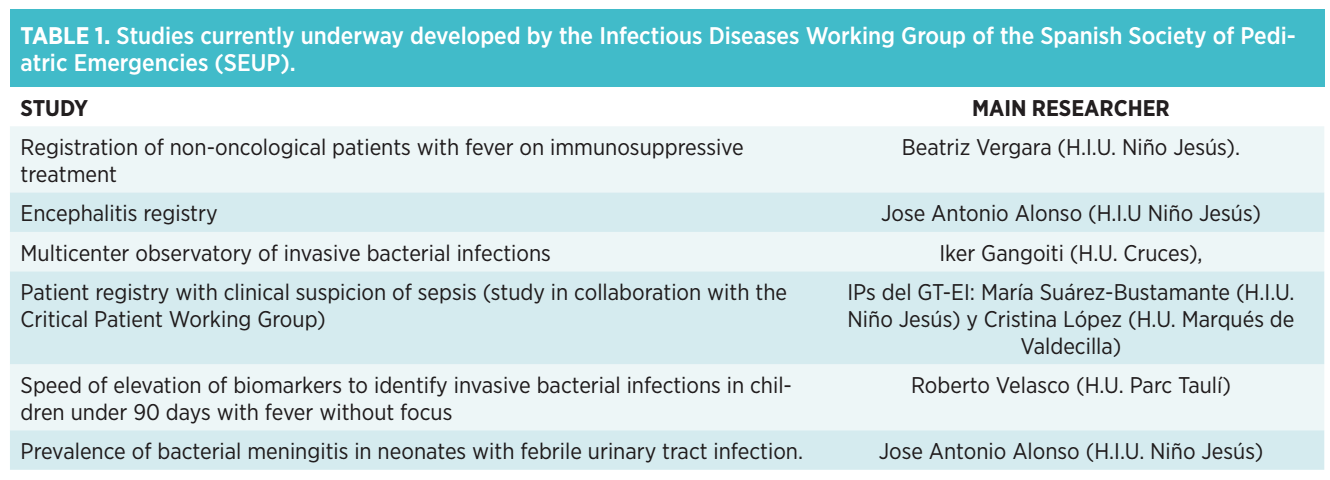
We would like to conclude this document by presenting the studies currently underway or scheduled to begin in the coming months so that any pediatrician interested in participating can do so and thus collaborate in the research carried out by our ID-WG. Interested parties can contact us through the provided correspondence email address. Table 1 lists the studies and the individuals responsible for each of them.
Acknowledgements
To all members of the ID-WG, and especially to Susanna Hernández-Bou for her work as coordinator for over ten years, to the participating pediatric emergency departments, and to the SEUP Board for their continued support.
Funding
No funding was received for the research, authorship, and/or publication of this article.
Author contributions
Borja Gómez: Conceptualization, Writing – review and editing, Writing – original draft.
Roberto Velasco Zúñiga: Conceptualization, Writing – review and editing.
Conflicts of interest
The authors declare that there are no commercial or financial conflicts of interest for this research.
Use of artificial intelligence tools
The authors declare that no artificial intelligence tool (such as ChatGPT, Copilot, Gemini, or others) has been used in the writing, analysis, or review of this article.
References
- Garrido-Rodríguez M, Borrull-Senra AM, Hernández-Bou S, Artetxe-Barroso A, Servitje Verdaguer B, Hurtado-Mingo Á, et al. Bacteremia Study Working Group from the Infectious Diseases Working Group, Spanish Society of Pediatric Emergencies (SEUP). Streptococcus pneumoniae remains leading cause of bacteremia in children despite 13-valent pneumococcal conjugate vaccine introduction. Acta Paediatr. 2025;114(11):3043-3052.
- Suárez-Bustamante Huélamo M, Alonso-Cadenas JA, Cortés BG, Goikoetxea IG, Hernández-Bou S, de la Torre Espí M. Bacteremia Study Working Group from the Infectious Diseases Working Group, Spanish Society of Pediatric Emergencies. Staphylococcus aureus bacteremia in the pediatric emergency department and predictors of poor outcome. Pediatr Infect Dis J. 2023;42(11):954-959.
- Garrido-Rodríguez M, Alonso-Cadenas JA, Gómez B, Gangoiti I, Hernández-Bou S, de la Torre Espí M. Bacteremia Study Working Group from the Infectious Diseases Working Group, Spanish Society of Pediatric Emergencies (SEUP). Salmonella bacteremia in spanish pediatric emergency departments: uncommon but not mild. Pediatr Infect Dis J. 2024;43(9):825-830.
- López-Martín D, Piñeiro-Pérez R, Martínez-Campos L, Ares-Álvarez J, de la Calle Cabrera T, Jiménez-Huerta I, et al. Grupo colaborador del consenso de otitis media aguda y sinusitis en pediatría. Actualización del documento de consenso sobre etiología, diagnóstico y tratamiento de la otitis media aguda y sinusitis. An Pediatr (Barc). 2023;98(5):362-372.
- Berghezan-Suárez A, López-Martín D, Carbajo-Ferreira ÁJ, Khodayar-Pardo P, González LO, González BA, et al. Grupo de Trabajo de Gastroenteritis Aguda en Pediatría. Documento consenso SEIP/AEPap/SEPEAP/SEGHNP/SEUP sobre el diagnóstico y tratamiento etiológico de las gastroenteritis agudas de origen infeccioso. An Pediatr (Barc). 2025;103:503984.
- Sorolla-Anglés A, Gómez B, Alonso-Cadenas J, Hernández-Bou S, Borrull-Senra AM, Camara A. Profile of blood biomarkers in febrile infants under 90 days old with invasive bacterial infection by type of infection and causing bacteria: a multicenter study. Pediatr Infect Dis J. 2025 Epub ahead of print.
- Rose K, Bressan S, Honeyford K, Bognar Z, Buonsenso D, Da Dalt L, et al. in association with the REPEM network (Research in European Paediatric Emergency Medicine) as part of the EPISODES Study. Responses of pediatric emergency departments to the first wave of the COVID-19 pandemic in Europe: a cross-sectional survey study. BMJ Paediatr Open. 2021;5(1):e001269.
- Nijman RG, Honeyford K, Farrugia R, Rose K, Bognar Z, Buonsenso D, et al. in association with the REPEM network (Research in European Pediatric Emergency Medicine) as part of the EPISODES study group. Presentations of children to emergency departments across Europe and the COVID-19 pandemic: a multinational observational study. PLoS Med. 2022;19(8):e1003974.
- Lenglart L, Ouldali N, Honeyford K, Bognar Z, Bressan S, Buonsenso D, et al. EPISODES Study Group. Respective roles of non-pharmaceutical interventions in bronchiolitis outbreaks: an interrupted time-series analysis based on a multinational surveillance system. Eur Respir J. 2023;61(2):2201172.
- Hojas informativas para familias. Available from: https://seup.org/hojas-informativas/.
- Khodayar-Pardo P, Llorens-Córcoles AM. Infecciones del sistema nervioso central: meningitis y encefalitis. En: Sociedad Española de Urgencias de Pediatría. Protocolos diagnósticos y terapéuticos en urgencias de pediatría. 2024, 4ª Ed. Available from: https://seup.org/wp-content/uploads/2025/08/32_Meningitis_ag25.pdf.
- GuiaSalud. Recomendaciones de “no hacer”. Available from: https://portal.guiasalud.es/no-hacer/.
- Encuentro digital “Sesión de controversias: alto flujo y pruebas microbiológicas en urgencias”. Available from: https://seup.org/encuentros-digitales/.
Explorar
Artículos
Volúmenes
Sobre la revista
Más leídos
Emergencias Pediátricas
Emergencias Pediátricas
Emergencias Pediátricas
1º Congreso Mundial de Emergencias Pediátricas
Emergencias Pediátricas
Una nueva mirada a la vía aérea pediátrica: secuencia de intubación diferida como alternativa segura en situaciones de urgencias
Emergencias Pediátricas