Artículo especial
Vol. 5 Núm. 2 (English)
8 min
Improving time to initial assessment for patients classified as triage level III in a pediatric emergency department
Mejora de los tiempos de inicio de la asistencia en los pacientes clasificados como nivel III de triage enun Departamento de Emergencia Pediátrica
Mariana Más1*, Patricia Dall’Orso1, Javier Prego1, Amparo Huguet1
1Pereira Rossell Hospital Center, Montevideo, Uruguay
Correspondencia:
Recepción:
01/09/2025
Aceptación:
10/09/2025
Publicación:
26/06/2026
Métricas
50
Visualizaciones
4
Descargas
Compartir
Compartir
Resumen (EN)
Introduction: The care process at the Pediatric Emergency Department of the Pereira Rossell Hospital Center begins with administrative registration, followed by triage. It has been observed that the time to initial assessment for patients with triage level III is longer than recommended. Currently, 58% of level III patients are assessed by a physician in less than 30 minutes.
Objective: To optimize the time to initial assessment for patients classified as triage level III. To increase the compliance rate from 58% to 70%.
Methods: Quality improvement study. Period: January 2023 to February 2024. Direct observation with recording of wait times. Barriers were identified, and interventions were planned. Interventions: Direct observation: a delay greater than 30 minutes for level III occurs in 91% of patients. Barriers: lunch breaks, shift changes, delayed medical record entries. New interventions: meetings with permanent staff and training for new staff. Informational signage in the waiting room. Addition of a quick-check column for care initiation in the electronic medical record. Informing families about the triage level and wait time.
Results: Observation following the interventions: 64% of level III patients are assessed in less than 30 minutes.
Conclusions: The incorporation of this methodology stands out as a viable management model, identifying small-scale problems, defining measurable objectives, and designing change-oriented actions within a dynamic process.
Palabras clave (EN):
Resumen (ES)
Introducción: El proceso asistencial en el Departamento de Emergencia Pediátrica del Centro Hospitalario Pereira Rossell comienza con el registro administrativo, seguido de un triage. Se observa que el tiempo en iniciar la asistencia en los pacientes con nivel de triage III es mayor al recomendado. El 58% de los pacientes de nivel III son asistidos por el médico en menos de 30 minutos. Objetivo: optimizar el tiempo de inicio de asistencia en los pacientes clasificados como nivel III. Aumentar el porcentaje de cumplimiento de 58% a 70%.
Método: Estudio de metodología de mejora. Período: enero 2023 a febrero 2024. Observación directa con registro de los tiempos de demora. Se identifican barreras y se planifican intervenciones. Intervenciones: Observación directa: el tiempo de demora mayor a 30 minutos en el nivel III se cumple en el 91% de los pacientes. Barreras: horarios de almuerzo, cambios de turno, registros tardíos de las historias. Nuevas intervenciones: reuniones con el personal fijo, capacitaciones al personal nuevo. Cartelería informativa en sala de espera. Incorporación de columna de marcado rápido de inicio de la asistencia en la historia clínica electrónica. Información a la familia de nivel de triage y tiempo de espera.
Resultados: Observación luego de las intervenciones: el 64% de los pacientes de nivel III son asistidos en menos de 30 minutos.
Conclusiones: Se destaca la incorporación de esta metodología como un modelo de gestión posible, identificando problemas a pequeña escala, definiendo objetivos medibles y diseñando acciones de cambio en un proceso dinámico.
Palabras clave (ES):
Introduction
The Pereira Rossell Hospital Center (CHPR) is located in Montevideo and is the national pediatric reference center for the public subsystem in Uruguay. It is formed by the Women’s Hospital and the Pediatric Hospital. The Pediatric Emergency Department (PED) handles 60,000 consultations per year. The care process at the DEP-CHPR begins with administrative registration, followed by a structured triage performed by licensed nurses, using the Andorran triage model combined with the Spanish triage system (MAT-SET, electronic version, web_e-PAT v4.2). The initial assessment in the emergency room allows patients to be classified based on the need to be attended to with a higher or lower priority. This assessment estimates the risk of deterioration or injury that a patient presents and their needs, determining the care priority. This defines 5 levels: levels 1 and 2 are immediately admitted to the resuscitation/emergency room; levels 3, 4, and 5 move to differentiated waiting rooms (yellow room for level 3, green room for levels 4 and 5). The times for the start of care considered safe for the patient differ according to the triage level(1,2).
The management team of the DEP-CHPR observes at various times of the day that the time to initiate care for patients with triage level III is longer than recommended. Delays exceeding 30 minutes can be risky for this population. Compliance with these times between 75-90% of patients is considered a quality standard for pediatric emergency services(3,4). The electronic record of care reports that 58% of level III patients are attended by the doctor in less than 30 minutes. The reason for the delay is not clearly identified.
Objectives
The global objective of the study is to optimize the time of the first contact with the doctor for patients classified as level III. Specific objective: to increase the percentage of patients attended in less than 30 minutes, from 58% to 70%.
Method
The DEP-CHPR, along with 5 other hospitals, participated in the first edition of the Improvement Methodology Course taught by Cincinnati Children’s Hospital through the Latin American Society of Pediatric Emergency (SLEPE) for Latin America. It took place between January 2023 and February 2024.
A team was formed, consisting of the medical chief, nursing chief, general coordinator of the PED, and a member of the teaching team. Based on the recommended methodology, a direct observation is initially carried out, prior to any intervention, in the waiting room with manual recording of the delay times for patients classified as level III (observer external to the working group). The time between the patient and their family leaving the triage office and the moment they are called by the doctor is recorded over a 14-day period.
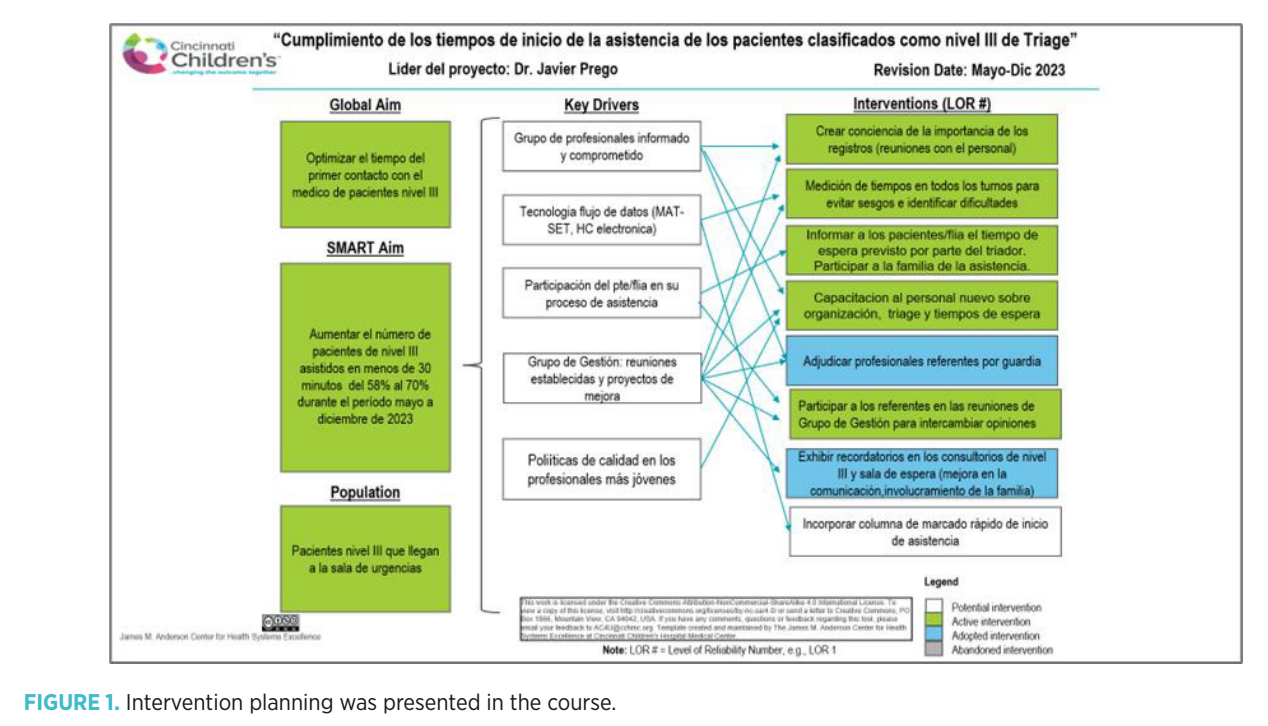
Subsequently, with a new understanding of the problem, barriers were identified and interventions were planned. Authorization was requested from the hospital administration for the implementation of some of the measures. Figure 1 shows the work plan presented in the course.
Interventions
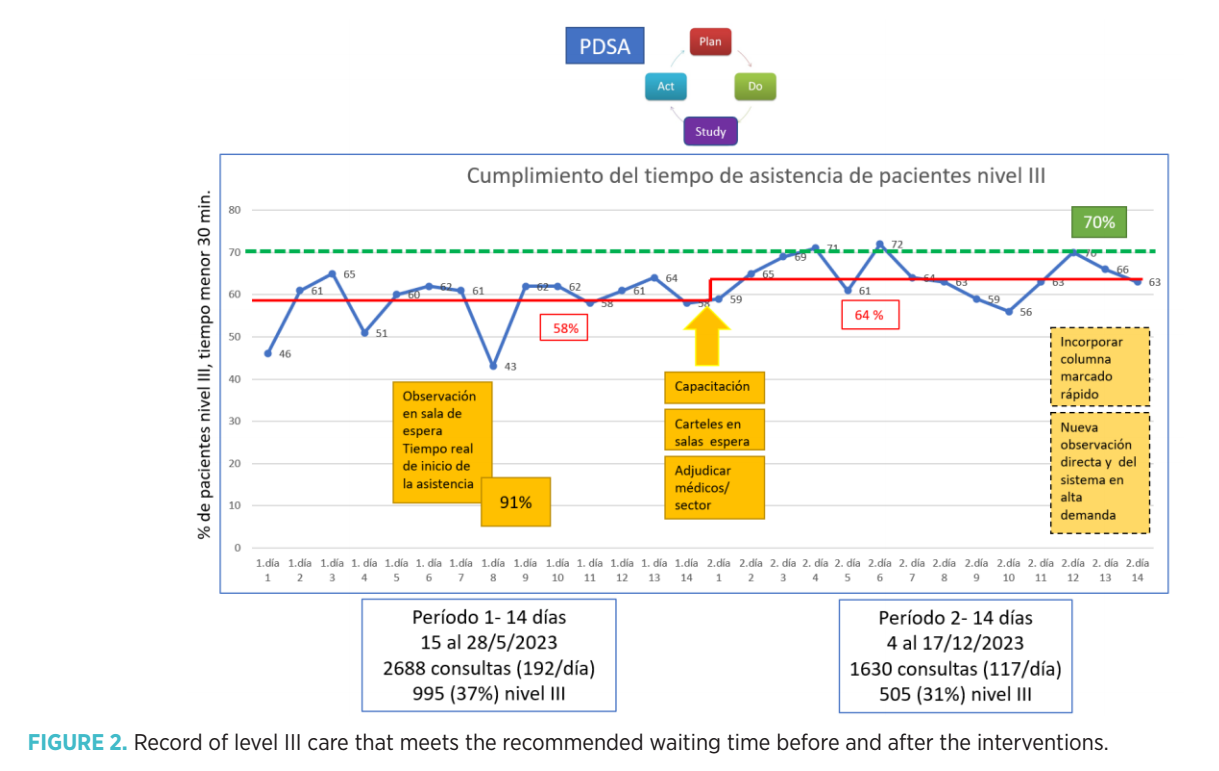
The first PDSA cycle (plan, do, study, and act) was based on the initial direct observation. In that period (May 15 to 28, 2023), there were 2,688 consultations (average of 192/day); 995 (37%) were classified as level III. In the shifts where direct observation was performed, the time of 30 minutes or less for the first contact with the doctor was met in 91% of patients. Consultations where expected times are not met correspond to lunch breaks and doctor shift changes, occasionally exceeding 60 minutes. A delayed registration of medical records is also identified, resulting in a consequently high number of level III consultations attended with a greater delay than admitted.
The interventions carried out between June and August 2023 were:
- Meetings with permanent staff: work is done on raising awareness about the importance of timely recording of all interventions in the electronic medical record. A doctor is designated for each sector, who acts as responsible for proper functioning, compliance with times and processes.
- Meetings with new personnel (incorporated in the last year): the entire care process, triage levels, acceptable waiting times for each level, patient flow, special circuits for some patients (level I and II, specialist consultations, etc.) are explained in detail.
- Posters are prepared for waiting rooms with information about the triage process and waiting times at each level.
- The incorporation of a quick-marking column to record the start of care by the attending physician is managed through the hospital authorities.
- It is established that the family is informed from triage about the waiting time according to the assigned level.
Of the proposed interventions, the incorporation of the quick-marking column could not be carried out. Given that the electronic medical record is shared in its operating system and format with all healthcare centers of this health provider in the country, this exclusive modification for the Pediatric Hospital Emergency Department was not authorized. The other measures were implemented.
The improvement project was presented to the hospital’s pediatric administration, was approved for implementation, and the proposed interventions were supported.
Results
A new observation is carried out after the interventions performed from December 4 to 17, 2023. In that period, 1,630 consultations were attended; 505 (31%) belonged to level III. The electronic record of care reports that 64% of level III patients are attended by the doctor in less than 30 minutes.
At the end of the intervention, there was an improvement from 58% to 64% of patients attended in less than 30 minutes.
Discussion
The improvement project based on the methodology presented in the course had a positive impact on the variable analyzed. The percentage of patients classified as level III attended in less than 30 minutes was successfully increased, measured through computerized record times. The specific objective proposed was not reached, making it necessary to implement other interventions and continue working on those already established.
The measurement of the variable analyzed through direct observation yielded results very different from the electronic record times, allowing for the identification of a delay in the computerized registration. The improvement intervention proposed to address this aspect could not be realized. The management team will seek an alternative computerized solution that does not impact the “country’s” computerized record.
The Emergency Department has a fixed staff of pediatricians and a large list of substitutes with frequent renewal of these resources. Following this improvement intervention, regular meetings and training of new personnel about triage, waiting times, and flowcharts within the service are established. These meetings between the management team and the pediatrician staff have been maintained over time with a monthly frequency.
Informing the patient and their family of waiting times from triage facilitated waiting room management. This aspect was observed but not measured after the intervention. Knowing the waiting times, the functioning of the service, and the care process on the part of users and their families increases their satisfaction. Some works describe the delay in care as the main cause of dissatisfaction (4-6).
It is observed that the second measurement carried out corresponds to the summer months with lower care demand. This may be a weakness of the study, since the lower demand may have contributed to the improvement in times without an intervention arising from this improvement project. The measurement will be repeated in the months of higher demand.
This improvement plan facilitated the development of a joint project with the participation of the supervisory and on-call medical team, nursing, admission, and concierge staff, consolidating a working experience for future improvement plans.
It was a challenge for the management team to maintain the improvement project and comply with the interventions and observations during times of high care demand. Although the proposed objectives were not achieved, possible interventions, new PDSA cycles, and observations maintained over time are being considered.
Conclusions
This is the first experience in improvement methodology carried out by this team. The incorporation of this methodology is highlighted as a possible management model, identifying small-scale problems, defining measurable objectives, and designing actions for change in a dynamic process.
Acknowledgments
To Dra. Gisela Valderrama and Dr. Javier González del Rey for the training and to the Latin American Society of Pediatric Emergency for the encouragement and support.
Funding
No funding was received for the research, authorship, and/or publication of this article.
Authorship contribution
The authors certify that they contributed equally to the conception, design, scientific and intellectual content, and writing of the manuscript.
Conflicts of interest
The authors declare that there is no commercial or financial conflict of interest for this research.
Use of artificial intelligence tools
The authors declare that no artificial intelligence tool (such as ChatGPT, Copilot, Gemini, or others) has been used in the writing, analysis, or review of this article.
References
- Fernández Landaluce A. Triaje de Urgencias de Pediatría. Protoc diagn ter pediatr. 2020;1:1-13. Available from: https://www.aeped.es/sites/default/files/documentos/01_triaje_urgencias.pdf
- Santos García MR, Ruiz JA. El proceso de clasificación. An Pediatr Contin. 2009;7(5):247-59.
- González Hermosa A, Fernández Elías M, González Peris S, Luaces Cubells C, Velasco Zuñiga R. Grupo de Trabajo de Seguridad y Calidad de la Sociedad Española de Urgencias Pediátricas. Indicadores de Calidad SEUP. Revisión 2018. Available from: https://seup.org/pdf_public/gt/mejora_indicadores.pdf
- Marcilly R, van Heerde M, Schiro J, Dusseljee-Peute L. Improving Parents’ Experience in the Pediatric Emergency Waiting Room: Researching the Most Optimal Design for an Information Tool. Studies in Health Technology and Informatics. 2022 Jun;290:814-818. Available from: https://doi.org/10.3233/shti220192.
- Parra C, Vidiella N, Marin I, Trenchs V, Luaces C. Patient experience in the pediatric emergency department: do parents and children feel the same? European Journal of Pediatrics. 2017 Sep;176(9):1263-1267. Available from: https://doi.org/10.1007/s00431-017-2954-4.
- Morilla L, Portillo S, Cardozo N, Cabrera L, Pavlicich. Mejora de la comunicación durante el triage en un Departamento de Emergencias Pediátricas. Emerg Pediatr.2025;4(1):15-19.
Explorar
Artículos
Volúmenes
Sobre la revista
Más leídos
Emergencias Pediátricas
Emergencias Pediátricas
Emergencias Pediátricas
1º Congreso Mundial de Emergencias Pediátricas
Emergencias Pediátricas
Una nueva mirada a la vía aérea pediátrica: secuencia de intubación diferida como alternativa segura en situaciones de urgencias
Emergencias Pediátricas