Otro
Vol. 4 Núm. 3 (English)
4 min
Importance of the material used for insulin dilution in pediatric emergencies
Importancia del material en la dilución de insulina en emergencias pediátricas
María Huguet*
Pediatric Emergency Service, Centro Hospitalario Pereira
Correspondencia:
Recepción:
22/06/2025
Aceptación:
23/09/2025
Publicación:
16/12/2025
Métricas
90
Visualizaciones
15
Descargas
Compartir
Compartir
Resumen (ES)
La cetoacidosis diabética (CAD) constituye una de las emergencias metabólicas más frecuentes y críticas en pediatría, donde la administración intravenosa de insulina representa un pilar terapéutico esencial. Sin embargo, estudios recientes han demostrado que la insulina puede sufrir un fenómeno de adsorción a los materiales utilizados en su preparación y administración, como jeringas, sistemas de infusión y bolsas, lo que reduce significativamente la dosis efectiva recibida por el paciente. Este fenómeno es clínicamente relevante en pacientes pediátricos, especialmente en contextos de dosis bajas y cuadros de alta complejidad, como la CAD. El presente trabajo tiene como objetivo revisar la evidencia científica existente sobre la adsorción de insulina a distintos tipos de materiales —principalmente PVC, polietileno y poliuretano— y resaltar el rol del personal de enfermería en la identificación de este fenómeno, la selección del material más adecuado y la aplicación de estrategias preventivas como el doble cebado del sistema de infusión. Esta técnica, sencilla y efectiva, permite saturar las superficies del sistema antes de comenzar la perfusión al paciente, reduciendo de forma significativa la pérdida inicial del fármaco. La implementación de estas prácticas, junto con la formación continua del equipo de salud, puede mejorar sustancialmente la seguridad y eficacia del tratamiento. Se concluye que la enfermería cumple un papel fundamental en la prevención de errores asociados al uso de insumos, contribuyendo a una atención más segura y basada en evidencia en el ámbito de las emergencias pediátricas.
Palabras clave (ES):
Resumen (EN)
Diabetic ketoacidosis (DKA) is one of the most common and critical metabolic emergencies in pediatrics, where intravenous insulin administration is a cornerstone of therapy. However, recent studies have shown that insulin can undergo adsorption to the materials used in its preparation and administration—such as syringes, infusion systems, and containers—significantly reducing the effective dose delivered to the patient. This phenomenon is clinically relevant in pediatric patients, particularly in scenarios requiring low doses and complex management such as DKA. This review aims to examine the existing scientific evidence regarding insulin adsorption to various materials—mainly PVC, polyethylene, and polyurethane—and to highlight the role of nursing staff in identifying this phenomenon, selecting the most appropriate materials, and applying preventive strategies such as double priming of the infusion system. This simple and effective technique involves saturating the surfaces of the infusion system before starting the administration to the patient, thus significantly reducing initial drug loss. The implementation of such practices, along with continuous professional development of healthcare staff, can significantly enhance treatment safety and efficacy. It is concluded that nursing professionals play a fundamental role in preventing errors related to the use of supplies, contributing to safer and evidence-based care in pediatric emergency settings.
Palabras clave (EN):
Introduction
Diabetic ketoacidosis (DKA) is one of the most frequent and potentially severe metabolic emergencies in pediatrics, with high prevalence among children with type 1 diabetes. Treatment is based on careful fluid replacement and intravenous insulin administration, in which precise dosing is essential to avoid hypoglycemia and insufficient response to initial therapy.
In clinical practice, insulin has been shown to undergo a physicochemical phenomenon known as adsorption, through which drug molecules adhere to the surfaces of the materials used for its dilution and administration. This interaction can significantly reduce the concentration of insulin effectively received by the patient, a particularly relevant issue in pediatrics, where small dosing variations can have a substantial clinical impact.
This article reviews the available evidence on insulin adsorption to different materials and highlights the relevance of this phenomenon in the management of diabetic ketoacidosis in pediatric emergency settings.
Development
Insulin is a protein with a complex structure, whose stability and availability can be compromised by physical and chemical factors. One mechanism that affects its bioavailability during intravenous administration is adsorption, a process by which drug molecules adhere to the internal surfaces of devices used for dilution and perfusion(1).
Studies have shown that materials such as polyvinyl chloride (PVC) and polyethylene (PE) have a high adsorption capacity, especially during the initial minutes of contact, which may translate into a significant reduction in the administered dose. Losses of up to 24% of insulin have been observed in the first 30 minutes in PVC systems, whereas systems made of polyurethane (PUR) or glass show significantly lower losses(2,3).
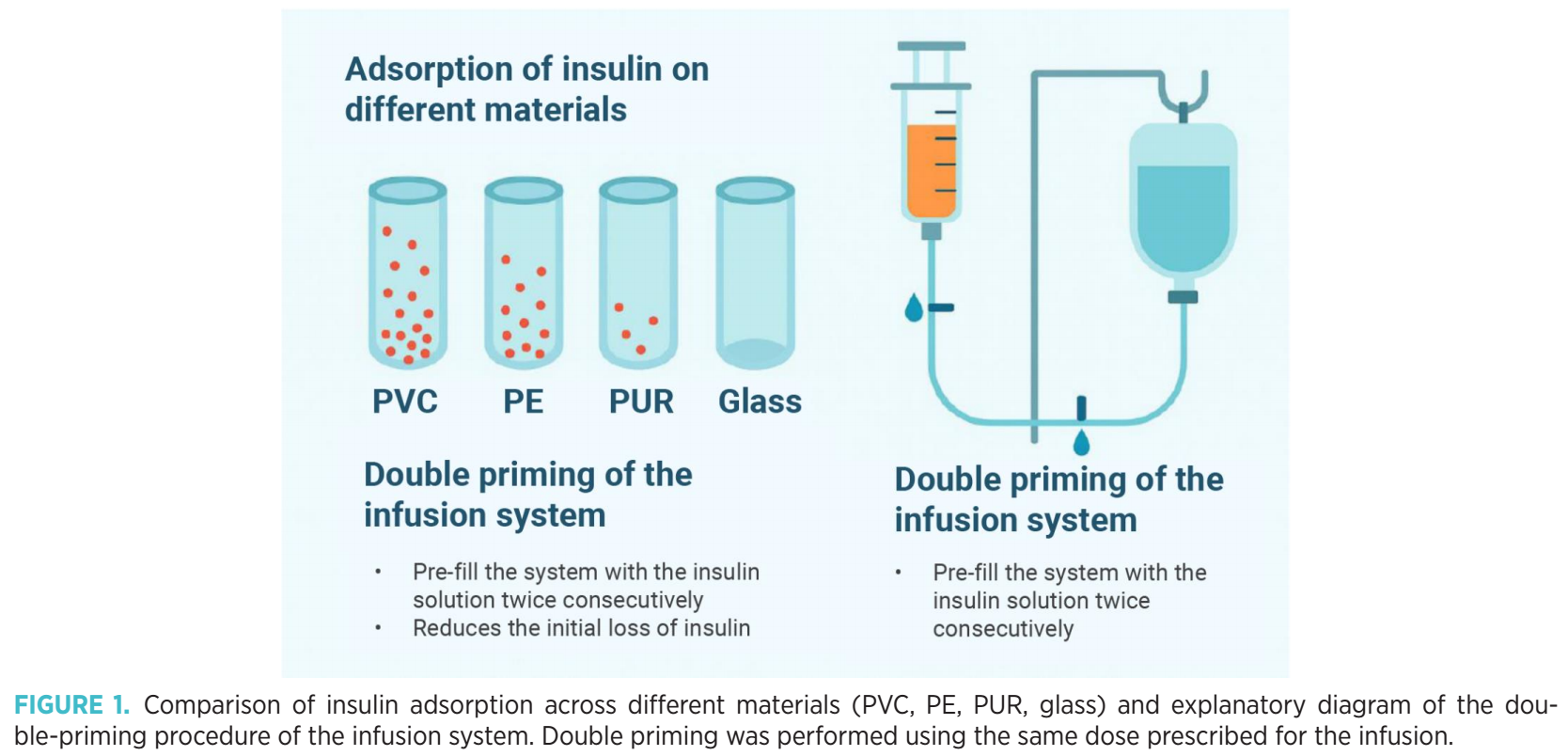
From a nursing perspective, double priming of the infusion system with the diluted insulin solution has been identified as an effective procedure to reduce drug adsorption to system materials(4,5). This procedure consists of filling the infusion system twice consecutively before initiating perfusion to the patient, ensuring saturation of surfaces and reducing the initial loss of active substance. Double priming is performed using the same prepared insulin solution. This practice is recommended when using materials with high adsorption such as PVC or PE.
Discussion
The phenomenon of insulin adsorption to plastic materials is a subtle yet clinically meaningful challenge in the management of pediatric diabetic ketoacidosis. Although DKA treatment is protocolized, the choice of infusion material and preparation procedures may substantially alter the effective dose administered to the patient(1,2).
In this context, nursing staff play a crucial role not only in executing medical indications but also in preventing errors related to the use of inadequate materials. The use of double priming is an accessible, safe, and effective measure that can significantly reduce the initial loss of insulin within the infusion system.
Implementing strategies such as double priming and evaluating the type of material used requires an integrated care perspective that includes both technical and scientific aspects, reinforcing the role of nursing professionals as key contributors to quality of care in critical contexts.
Conclusion
Precision in intravenous insulin administration for the treatment of pediatric diabetic ketoacidosis depends not only on dose calculation but also on understanding and correctly using the materials involved in its preparation and administration. Adsorption to materials such as PVC or PE can compromise therapeutic effectiveness.
From a nursing practice standpoint, implementing double priming of the infusion system is a safe, effective, and low-cost strategy to minimize drug loss. Appropriate material selection, use of double priming, and adherence to updated protocols are essential measures to ensure treatment efficacy.
Funding
This research did not receive any specific grant from public, commercial, or nonprofit funding agencies.
Conflict of interest
The author declares no conflicts of interest.
References
- Zahid N, et al. Diabetes Res Clin Pract. 2008;80(3):e11–3. Available from: https://doi.org/10.1016/j.diabres.2007.11.014
- Masse M, et al. PLoS One. 2018;13(8):e0201623. Available from: https://doi.org/10.1371/journal.pone.0201623
- Ley SC, et al. Open Crit Care Med J. 2014;7:1–6. Available from: https://doi.org/10.2174/1874828701407010001
- Wolfsdorf JI, et al. Pediatric Diabetes. 2022;23(7):758–74. Available from: https://doi.org/10.1111/pedi.13365
- Mian P, et al. Mol Cell Pediatr. 2022;9(1):20. Available from: https://doi.org/10.1186/s40348-022-00144-4
- Genay S, et al. Pharm Technol Hosp. 2019;54(2):92–6. Available from: https://doi.org/10.1016/j.phart.2019.03.001
- Macías-Muñoz R, et al. Enferm Intensiva. 2021;32(1):40–6. Available from: https://doi.org/10.1016/j.enfi.2019.06.002
- Spada C, et al. Eur J Clin Pharmacol. 2013;69(6):1237–43. Available from: https://doi.org/10.1007/s00228-012-1424-1
- Thomas S, et al. JPEN J Parenter Enteral Nutr. 2017;41(4):625– 30. Available from: https://doi.org/10.1177/0148607115600502
- Bhutani VK, et al. Pediatr Clin North Am. 1993;40(6):1139–67. Available from: https://doi.org/10.1016/s0031-3955(16)38773-5
- Sautou V, et al. Ann Pharm Fr. 2007;65(1):26–33. Available from: https://doi.org/10.1016/S0003-4509(07)89409-1
- Fernández M, et al. Rev Latinoam Enferm. 2020;28:e3320. Available from: https://doi.org/10.1590/1518-8345.3316.3320
- Ennis FA, et al. N Engl J Med. 1960;263:1184–5. Available from: https://doi.org/10.1056/NEJM196012082632408
- Bizzarri C, et al. Neonatology. 2010;97(1):40–6. Available from: https://doi.org/10.1159/000226602
- World Health Organization. Pocket book of hospital care for children. Geneva: WHO; 2013. Available from: https://apps.who.int/iris/handle/10665/81170
Explorar
Artículos
Volúmenes
Sobre la revista
Más leídos
Emergencias Pediátricas
Emergencias Pediátricas
Emergencias Pediátricas
1º Congreso Mundial de Emergencias Pediátricas
Emergencias Pediátricas
Una nueva mirada a la vía aérea pediátrica: secuencia de intubación diferida como alternativa segura en situaciones de urgencias
Emergencias Pediátricas