Artículo de revisión
Vol. 5 Núm. 1 (English)
20 min
High-flow therapy controversies
Controversias del alto flujo
Sandra Bustamante-Hernández1*, Alberto Medina-Villanueva2
1Respiratory Pathology Working Group, Spanish Society of Pediatric Emergency Medicine (SEUP). Granollers General Hospital, Granollers, Barcelona, Spain. 2Central University Hospital of Asturias (HUCA), Oviedo, Spain
Correspondencia:
Recepción:
18/09/2025
Aceptación:
22/09/2025
Publicación:
11/03/2026
Métricas
132
Visualizaciones
17
Descargas
Compartir
Compartir
Resumen (ES)
Siempre resulta difícil saber cuál es la mejor decisión. Esta frase la podemos aplicar a nuestra vida en general, pero resulta trascendente en nuestro ámbito profesional. Sería interesante saber cómo tomamos una decisión médica, y aún más importante saber lo que esperan nuestros pacientes (y padres) de nosotros cuando tomamos una decisión.
En el momento actual se habla mucho de “individualizar” tratamientos y métodos diagnósticos. Pero, ¿sabemos lo que significa “individualizar”? ¿Es algo nuevo o ya lo hacía Hipócrates o Galeno?
La individualización, si no parte de un conocimiento general, lleva sin ninguna duda a cometer una “falacia por inducción”. Por ello, es importante saber cómo tenemos que tomar una buena decisión tanto diagnóstica como terapéutica.
Palabras clave (ES):
Resumen (EN)
It is always difficult to determine which decision is best. While this statement applies to life in general, it is of paramount importance in our professional sphere. It would be interesting to understand how we make medical decisions, and even more importantly, to know what our patients (and parents) expect of us when we make them.
Nowadays, there is much discussion about ‘individualizing’ treatments and diagnostic methods. But do we truly know what ‘individualizing’ means? Is it a novel concept, or was it already practiced by Hippocrates or Galen?
Individualization, if not based on general knowledge, undoubtedly leads to committing an ‘inductive fallacy.’ Therefore, it is crucial to understand how to make sound decisions, both diagnostic and therapeutic.
Palabras clave (EN):
Introduction
High-flow oxygen therapy (HFOT) is a non-invasive respiratory support modality that involves the administration of a high flow of oxygen, either alone or mixed with air, exceeding the patient’s peak inspiratory flow, which is delivered heated and humidified through a nasal cannula, favoring its tolerance. Regarding its mechanism of action, it provides a flow adequate to the patient’s inspiratory demand with an inspired oxygen fraction. This fraction is neither constant nor predictable. It conditions the inspired gas to body temperature and 100% relative humidity. It washes out the nasopharyngeal dead space and, to a lesser extent, generates continuous positive airway pressure. However, this latter mechanism is being questioned due to its low pressurization capacity and irregularity in maintaining said pressure(1,2).
The use of HFOT in pediatrics began to gain relevance in the 2000s. However, it was from 2007 onwards that several studies and clinical trials began to be published with favorable results, describing the benefits in the treatment of acute respiratory failure in terms of improved oxygenation and reduced need for intubation compared to standard oxygen therapy. Furthermore, the perception of greater tolerance and ease of management compared to other modalities favored its rapid expansion in the pediatric field, consolidating it as a standard therapeutic tool in many hospitals, initially in intensive care and later in emergency and hospitalization settings.
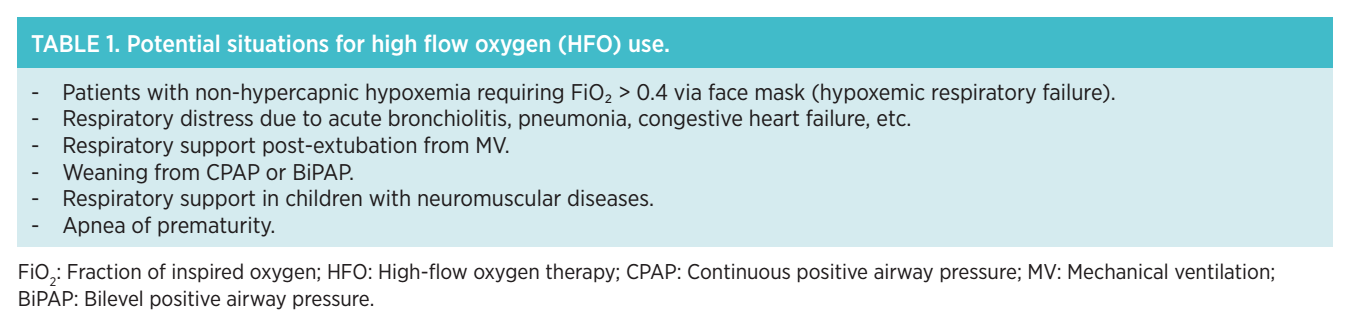
Despite the variability in results across different randomized controlled trials (RCTs) and systematic reviews published to date, and although the indications for HFOT are not completely standardized, this therapy is applied in a multitude of clinical situations (Table 1), with acute bronchiolitis (AB) being the best-known indication.
In addition to this variability, the economic evidence on the cost-effectiveness of this therapy in the treatment of respiratory distress in the pediatric population has recently been evaluated. The report, gathered from the Spanish Ministry of Health(3), has concluded that the evidence analyzed to date seems to indicate that the routine initial application of oxygen therapy using HFOT as first-line therapy versus low-flow oxygen therapy (LFOT) or continuous positive airway pressure (CPAP) is not cost-effective for the treatment of infants with AB and premature infants requiring respiratory assistance. This statement regarding the non-profitability of HFOT compared to LFOT was also concluded in the study by Gc et al.(4) and Gannon et al.(5), which evaluated the cost-effectiveness relationship of these support methods in children with AB and with acute hypoxemic respiratory failure, respectively.
In this review, we will analyze the RCTs and systematic reviews published in recent years on HFOT with the aim of translating this literature to the clinical setting.
Current Evidence
Bronchiolitis
The world’s first RCT in the field of bronchiolitis (BA) was conducted in Spain in 2014, and 27 RCTs have been published since then. Among the most recent ones, several studies have demonstrated benefits of HFNO in BA, such as a reduction in cardiorespiratory rate and a lower treatment failure rate compared to LFO (Eski 2022)(6), bubble CPAP (Maya 2024)(7), or bilevel positive airway pressure (BiPAP) (Santos 2024)(8). Regarding trials against this therapy, some state that HFNO may be inferior to CPAP in certain scenarios, such as weaning from invasive mechanical ventilation (IMV) in hypoxemic infants (Ramnarayan P 2022)(9), that it has a higher treatment failure rate (Borgi 2021)(10), and others state that they find no differences compared to LFO (O’Brien 2022)(11).
In the RCT by Eski et al.(6), published in Pediatric Pulmonology, the efficacy of HFNO was evaluated compared to LFO in infants aged 1 to 24 months with moderate-to-severe BA. Eighty-seven patients were included, randomly assigned to receive LFO (n = 48) and HFNO (n = 39). The results showed that the HFNO group experienced a faster improvement in heart and respiratory rate, as well as in the clinical severity score, compared to the LFO group. Furthermore, the duration of oxygen requirement and the treatment failure rate were lower in the HFNO group.
The study by Maya et al.(7), published in Pediatric Critical Care Medicine, included 118 infants between 1 and 23 months old who attended the emergency department of a tertiary care center in India with moderate-to-severe BA. Fifty-nine were randomized to the HFNO group and 59 to the bubble CPAP (b-CPAP) group, and HFNO was associated with a lower treatment failure rate and lower risk of escalation to invasive mechanical ventilation (IMV) compared to b-CPAP for early respiratory support, contradicting some previous trials that favored CPAP over HFNO. However, after a Bayesian analysis was performed—which integrates the prior probability with the observed data to obtain a posterior probability—relevant statistical uncertainty was evidenced. This analysis yielded a probability of 0.88 that b-CPAP was superior to HFNO. This figure suggests that, although the observed results favor HFNO in terms of lower failure and need for IMV, a reasonable doubt persists about its superiority over b-CPAP. Consequently, the results of this study should be interpreted with caution, and further research is required to confirm the relative efficacy of HFNO and b-CPAP in this pediatric population.
Santos’ study(8) is the most recent among those positioned in favor, published in BMC Pediatrics. Two hundred and fifty-two children under 2 years old with mild-moderate bronchiolitis (BA) from a third-level tertiary hospital in Brazil were randomized, 126 in a BiPAP group and 126 in the HAFO group. The primary objective was to evaluate the non-inferiority of HAFO compared to BiPAP in relation to the need for invasive mechanical ventilation (IMV). The results showed that HAFO was not inferior to BiPAP regarding the need for IMV and was also associated with a lower requirement for sedation and a shorter hospital stay.
Regarding the RCTs that have concluded against HAFO in patients with bronchiolitis, we find the British trial led by Ramnarayan P(9), published in JAMA. Two RCTs were conducted in a PICU, including infants undergoing non-invasive ventilatory support. In the first RCT, the FirstABC “Step down”, the efficacy of HAFO versus CPAP in the process of weaning from invasive mechanical ventilation in hypoxemic infants was evaluated. HAFO did not reach the predefined limit of “non-inferiority”, concluding that CPAP is superior to HAFO in the process of weaning from IMV in hypoxemic infants. In the second, First ABC “Step up”, HAFO was compared with CPAP in the prevention of the need for IMV in hypoxemic infants. Although the difference favored CPAP, it was concluded that there was no evidence of inferiority of HAFO compared to CPAP for preventing IMV. Following the Bayesian analysis performed, the two “First ABC” trials indicate that HAFO is no better than CPAP as initial support and is worse than CPAP for preventing reintubation.
Borgi’s RCT(10), published in Pan Afr Med J, was carried out in the PICU of a third-level pediatric hospital for 3 years and compared CPAP and HAFO in children aged between 7 days and 6 months admitted for severe bronchiolitis. 255 patients were included, and 130 were assigned to the HAFO group and 125 to the CPAP group. It was concluded that treatment success was significantly better in the CPAP group compared to the HAFO group. Furthermore, if HAFO failed, switching to CPAP avoided intubation in 54% of cases.
Finally, in O’Brien’s study(11), published in J Paediatr Child Health, data from infants with bronchiolitis from 26 hospitals in Australia and New Zealand were collected between 2014 and 2017, and 3392 infants were included, 1817 in the HAFO group and 1575 in the LFO group. Among the results, they stated that the proportion of infants who received HAFO during the four seasons increased significantly and that those who received HAFO did not show substantial differences compared to LFO. However, the use of HAFO was associated with an increase in the duration of hospital stay and PICU admissions.
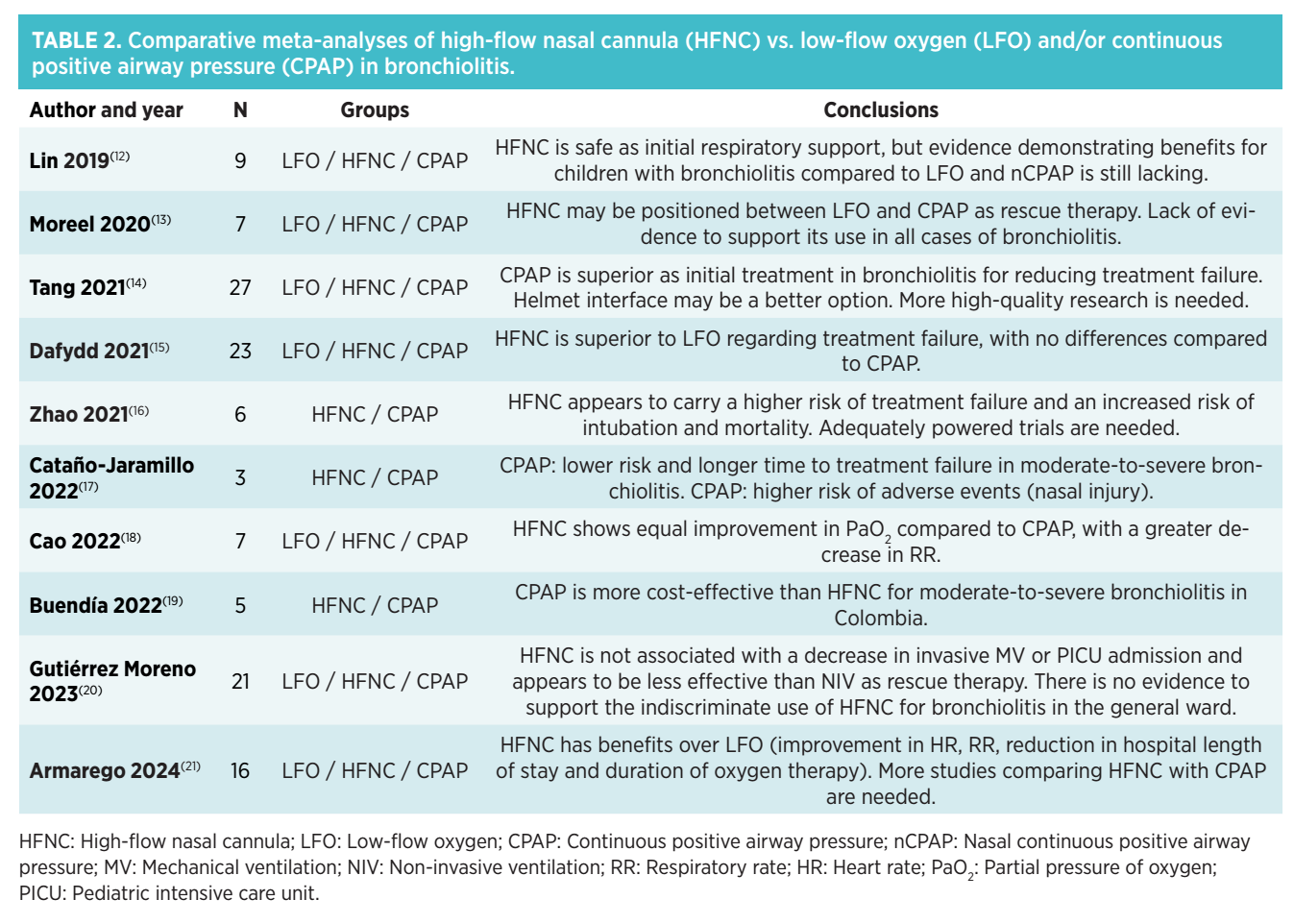
Regarding the 10 meta-analyses published to date that compare HFO with LFO and/or CPAP (Table 2), it can be concluded, by way of summary, that HFO represents a safe alternative with certain benefits compared to LFO. However, it has not demonstrated clear, consistent superiority over CPAP, which continues to be the best alternative in cases of moderate to severe BA. The considerable heterogeneity among the studies included in these meta-analyses should be highlighted, which is reflected in the variability of the results regarding the efficacy and consistency of the available evidence on HFO. Therefore, the conduction of more robust clinical trials, with homogeneous methodologies and relevant clinical outcomes, is necessary to more clearly define the role of HFO in the management of respiratory diseases, especially in the context of BA.
Asthma
In status asthmaticus, there is scarce evidence, and it comes mainly from observational and retrospective studies. Regarding the use of HFO in asthmatic patients, two RCTs stand out, which compare the use of HFO with LFO, one concluding in favor due to the reduction of respiratory distress exclusively in the HFO group (Ballesteros 2018)(22), and another that finds no significant differences compared to LFO (Gauto 2019)(23).
In the first RCT, by Ballestero et al.(22), published in 2018 in J. Pediatr, 62 children between 1-14 years with moderate-severe asthma who attended a third-level pediatric emergency department were included, 30 randomized to the HFO group and 32 to the LFO group. They affirmed that HFO was capable of reducing respiratory distress within the first 2 hours of treatment in children with an exacerbation of moderate-severe refractory asthma used as first-line treatment exclusively in the HFO group, a very problematic issue from a methodological point of view, since it invalidates the randomization. The RCT is set up to demonstrate differences between HFO and the control group (LFO). That is the “causal” response, without confounding factors, because it is the randomized treatment. There were no differences between the two groups referred to the score at any of the collected moments. However, they could not demonstrate that HFO was superior to LFO in reducing PICU admissions. Methodologically, the use of two-way ANOVA or ANCOVA could provide a more precise evaluation of the differences between the treatment groups, controlling for confounding variables and improving the causal validity of the results.
The second published to date is by Gauto Benitez et al.(23), in the Revista Chilena de Pediatría. In this, 65 children over 2 years with moderate-severe asthma exacerbations who did not respond to initial treatment were randomized, 32 to the HFO group and 33 to the LFO group. Contrary to the previous trial, the study concluded that the introduction of HFO in the treatment of patients with asthma exacerbation in the pediatric emergency department did not show significant benefits in clinical improvement or in the length of stay compared to LFO. Furthermore, no differences were observed in the need for escalation to invasive MV between the two groups.
This contradiction between the published RCTs in the asthmatic patient suggests the need for more studies evaluating the relative efficacy of HFO in this population.
Hypoxemic respiratory failure: pneumonia and acute respiratory distress syndrome
Studies on HFNC in hypoxemic respiratory failure have also shown diverse results.
The PARIS-2 study(24), published in JAMA in 2023, was an RCT that evaluated the efficacy of HFNC compared to LFNC in children aged 1 to 4 years with acute hypoxemic respiratory failure. 1567 hospitalized patients across 14 hospitals in Australia and New Zealand were included, randomly assigned to receive HFNC (n = 753) or LFNC (n = 764). The results showed that the group receiving HFNC had a longer hospital stay and a higher rate of PICU admissions compared to the LFNC group.
The study by Kopp et al.(25), published in 2021 in the journal Critical Care Medicine, evaluated the impact of using non-invasive ventilation (NIV) before intubation in children with pediatric acute respiratory distress syndrome (pARDS). 2427 children were included, of whom 995 received NIV before intubation and 1432 did not receive NIV. The results showed that the use of NIV before intubation in patients with severe pARDS was associated with a longer duration of mechanical ventilation (MV), longer stays in the PICU and in the hospital, as well as an increase in mortality, especially in those who received NIV for more than 24 hours before intubation. However, a significant limitation of the study was that NIV was defined as BiPAP, CPAP, and HFNC, without differentiating between these types of non-invasive respiratory support. It is therefore crucial, to avoid worse clinical outcomes in children with pARDS, not to prolong the use of NIV beyond 1-2 hours if oxygenation parameters do not improve significantly, i.e., if a PaO2/FiO2 (PF) ratio above 175 or an SpO2/FiO2 (SF) ratio above 200 is not maintained.
The RCT by Chisti et al.(26), published in The Lancet in 2015, compared the effectiveness of different respiratory support modalities in children under 5 years old with severe pneumonia and hypoxemia in Bangladesh. 225 children were included, randomly assigning 79 to the b-CPAP group, 67 to the LFNC group, and 79 to the HFNC group. The results indicated that both treatment failure and mortality were significantly lower in the b-CPAP group compared to LFNC and HFNC. Due to the clear superiority of b-CPAP, the study was prematurely stopped. Nevertheless, independent conclusions on the efficacy of HFNC could not be drawn due to the lack of differentiation in the results. For this reason, Modesto et al. subsequently conducted a Bayesian analysis that showed clear benefits of CPAP compared to HFNC and LFNC, especially in terms of reducing treatment failure and mortality, with a 98% probability of greater mortality with HFNC compared to CPAP.
The RECOVERY-RS study(27) evaluated the efficacy of different respiratory support modalities in patients with hypoxemic respiratory failure due to COVID-19. This RCT was conducted across 48 hospitals in the United Kingdom and Jersey, including 1273 patients assigned to receive CPAP (n = 380), HFNC (n = 418), or LFNC (n = 475). The results showed that the need for tracheal intubation or mortality within 30 days was significantly lower with CPAP compared to LFNC. However, there was no significant difference between HFNC and LFNC. An additional Bayesian analysis indicated a 98.8% probability that CPAP was superior to reduce the need for intubation or mortality in these patients.
Conclusions
In the context of bronchiolitis (BA), high-flow oxygen therapy (HFO) has demonstrated benefits over conventional low-flow oxygen therapy (LFO), such as a reduction in the duration of oxygen therapy, hospital stay, and the need for therapeutic escalation. However, cost-effectiveness analyses suggest that HFO is not the optimal strategy as first-line treatment, which underscores the importance of careful patient selection to avoid its overutilization. Its use should be limited to infants with hypoxemia in whom conventional oxygen therapy has failed. Furthermore, once initiated, close evaluation of the treatment response is essential, as a delay in transitioning to superior support modalities can increase morbidity and mortality.
In the management of status asthmaticus, the evidence regarding the use of HFO is limited and contradictory. Although some trials have suggested that HFO may offer short-term benefits in terms of improvement in respiratory symptoms, a significant impact on reducing PICU admissions or hospitalization duration has not been demonstrated. This means it does not meet the “WHO indication” criteria (being effective and efficient) for this pathology.
In pediatric patients with hypoxemic respiratory failure, HFO has become a widely used non-invasive respiratory support modality, as its safety profile has favored its initial use in certain cases. Nevertheless, in more severe scenarios, such as pediatric acute respiratory distress syndrome (pARDS) or severe hypoxemic pneumonia or respiratory failure due to COVID-19, the evidence indicates greater efficacy of CPAP over HFO in terms of reducing therapeutic failure and mortality. Moreover, prolonged use of HFO without an adequate response can delay intubation and worsen clinical outcomes, increasing morbidity and mortality in these patients. Therefore, HFO must be applied carefully, with close monitoring and clear criteria for escalation.
In conclusion, HFO is a safe respiratory support modality with benefits in certain clinical contexts. However, its efficacy varies according to the pathology and patient profile. The comparative evidence between HFO and CPAP remains limited and inconclusive, which highlights the need for additional studies to establish the superiority of one modality over the other, as well as protocols that compare their efficacy and cost. In scenarios of severe respiratory failure, the initiation of other non-invasive supports such as CPAP or BiPAP should not be delayed, given their greater effectiveness in preventing intubation and reducing morbidity and mortality.
Ultimately, a good therapeutic decision must be based on the efficacy, effectiveness, and efficiency of each treatment. Although treatment should be individualized according to the characteristics of each patient, we must not forget—as Richard Feynman said—that “the test of all knowledge is experiment. Experiment is the sole judge of scientific truth.”
Funding
This research did not receive any specific grant from funding agencies in the public, commercial, or not-for-profit sectors.
Author contributions
All authors contributed equally to the preparation of this manuscript.
All authors have read and accepted the final version of the manuscript.
Conflict of interest
The authors declare no conflict of interest.
Use of AI
The authors declare that artificial intelligence tools were not used in any phase of the manuscript preparation.
References
- Guglielmo RD, Hotz JC, Ross PA, Deakers TW, Diep JEL, Newth CJL, et al. High-flow nasal cannula reduces effort of breathing but not consistently via positive end-expiratory pressure. Chest. 2022 Oct;162(4):861-871.
- Born P, Castro R. A combination of Bohr and Haldane effects provide a physiologic explanation for the increase in arterial oxygen saturation when a face mask is added to a high-flow nasal cannula in severely hypoxemic COVID-19 patients. Crit Care. 2021 Nov 16;25(1):395.
- Bayón Yusta JC, Gutiérrez Iglesias A, Galnares Cordero L. Eficiencia de la oxigenoterapia de alto flujo para el tratamiento de dificultades respiratorias en pediatría. Ministerio de Sanidad. Servicio de Evaluación de Tecnologías Sanitarias del País Vasco; 2021. Informes de Evaluación de Tecnologías Sanitarias: OSTEBA [en línea]. Available from: www.euskadi.eus/contenidos/informacion/osteba_publicacion/eu_def/adjuntos/Eficiencia_de_la_oxigenoterapia_de_alto_flujo.pdf.
- Gc VS, Franklin D, Whitty JA, et al. First-line oxygen therapy with high-flow in bronchiolitis is not cost saving for the health service. Archives of Disease in Childhood. 2020;105(10):975-980. Available from: https://pubmed.ncbi.nlm.nih.gov/32276987.
- Gannon B, Franklin D, Vo V, Babl FE, Schibler A. Cost-effectiveness of nasal high-flow in children with acute hypoxaemic respiratory failure. Journal of Paediatrics and Child Health. 2024;60(6):229-239.
- Eşki A, Öztürk GK, Turan C, Özgül S, Gülen F, Demir E. High-flow nasal cannula oxygen in children with bronchiolitis: a randomized controlled trial. Pediatr Pulmonol. 2022 Jun;57(6):1527-1534.
- Maya M, Rameshkumar R, Selvan T, Delhikumar CG. High-flow nasal cannula versus nasal prong bubble continuous positive airway pressure in children with moderate to severe acute bronchiolitis: a randomized controlled trial. Pediatr Crit Care Med. 2024 Aug 1;25(8):748-757.
- Santos ACEZ, Caiado CM, Lopes AGD, de França GC, Eisen AKA, Oliveira DBL, et al. Comparison between high-flow nasal cannula (HFNC) therapy and noninvasive ventilation (NIV) in children with acute respiratory failure by bronchiolitis: a randomized controlled trial. BMC Pediatr. 2024 Sep 19;24(1):595.
- Ramnarayan P, Richards-Belle A, Drikite L, Saull M, Orzechowska I, Darnell R, et al. Effect of high-flow nasal cannula therapy vs continuous positive airway pressure following extubation on liberation from respiratory support in critically ill children: a randomized clinical trial. JAMA. 2022 Apr 26;327(16):1555-1565.
- Borgi A, Louati A, Ghali N, Hajji A, Ayari A, Bouziri A, et al. High flow nasal cannula therapy versus continuous positive airway pressure and nasal positive pressure ventilation in infants with severe bronchiolitis: a randomized controlled trial. Pan Afr Med J. 2021 Nov 3;40:133.
- O’Brien S, Haskell L, Schembri R, Gill FJ, Wilson S, Borland ML, et al. Prevalence of high flow nasal cannula therapy use for management of infants with bronchiolitis in Australia and New Zealand. J Paediatr Child Health. 2022 Dec;58(12):2230-2235. Available from: https://doi.org/10.1111/jpc.16199. Epub 2022 Sep 6.
- Lin J, Zhang Y, Xiong l, Liu S, Gong C, Dai J. High-flow nasal cannula therapy for children with bronchiolitis: a systematic review and meta-analysis. Arch Dis Child. 2019;104:564-76. Available from: https://pubmed.ncbi.nlm.nih.gov/30655267/.
- Moreel l, Proesmans M. High flow nasal cannula as respiratory support in treating infant bronchiolitis: a systematic review. Eur J Pediatr. 2020 May;179:711-8. Available from: https://pubmed.ncbi.nlm.nih.gov/32232547/.
- Tang G, Lin J, Zhang Y, Shi Q. The effects and safety of continuous positive airway pressure in children with bronchiolitis: a systematic review and meta-analysis. J Trop Pediatr. 2021 May 17;67:fmaa128.Available from: https://pubmed.ncbi.nlm.nih.gov/34037790/.
- Dafydd C, Saunders BJ, Kotecha SJ, Edwards MO. Efficacy and safety of high flow nasal oxygen for children with bronchiolitis: systematic review and meta-analysis. BMJ Open Respir Res. 2021 Jul;8:e000844. Available from: https://pubmed.ncbi.nlm.nih.gov/34326153/.
- Zhao X, Qin Q, Zhang X. Outcomes of high-flow nasal cannula vs. nasal continuous positive airway pressure in young children with respiratory distress: a systematic review and meta-analysis. Front Pediatr. 2021 Nov 5;9:759297. Available from: https://pubmed.ncbi.nlm.nih.gov/34805049/.
- Cataño Jaramillo ML, Jaramillo Bustamante JC, Florez ID. Continuous positive airway pressure vs. high flow nasal cannula in children with acute severe or moderate bronchiolitis. A systematic review and meta-analysis. Med Intensiva (Engl Ed). 2020:S0210-5691(20)30324-7. Available from: https://pubmed.ncbi.nlm.nih.gov/33168328/.
- Cao J, Cai Q, Xing Y, Zhong l, Wen C, Huang H. Efficacy and safety analysis of high-flow nasal cannula in children with bronchiolitis: a systematic review and meta-analysis. Transl Pediatr. 2022;11:547-55. Available from: https://pubmed.ncbi.nlm.nih.gov/35558971/.
- Buendía JA, Feliciano Alfonso JE, Florez ID. Systematic review and cost-utility of high flow nasal cannula versus continuous positive airway pressure in children with acute severe or moderate bronchiolitis in Colombia. Pediatr Pulmonol. 2022;57:3111-8. Available from: https://pubmed.ncbi.nlm.nih.gov/36100558/.
- Gutiérrez Moreno M, Del Villar Guerra P, Medina A, Modesto i Alapont V, Castro Bournissen l, Mirás Veiga A, et al. High-flow oxygen and other noninvasive respiratory support therapies in bronchiolitis: systematic review and network meta-analyses. Pediatric Critical Care Medicine. 2023;24:133-42. Available from: https://journals.lww.com/pccmjournal/Fulltext/2023/02000/High_Flow_Oxygen_and_Other_Noninvasive_Respiratory.7.aspx.
- Armarego M, Forde H, Wills K, Beggs SA. High-flow nasal cannula therapy for infants with bronchiolitis. Cochrane Database Syst Rev. 2024 Mar 20;3(3):CD009609.
- Ballestero Y, De Pedro J, Portillo N, Martinez-Mugica O, Arana-Arri E, Benito J. Pilot clinical trial of high-flow oxygen therapy in children with asthma in the emergency service. J Pediatr. 2018 Mar;194:204-210.e3.
- Gauto Benítez R, Morilla Sanabria LP, Pavlicich V, Mesquita M. High flow nasal cannula oxygen therapy in patients with asthmatic crisis in the pediatric emergency department. Rev Chil Pediatr. 2019 Dec;90(6):642-648. English, Spanish.
- Franklin D, Shellshear D, Babl FE, Schlapbach LJ, Oakley E, Borland ML, et al. Multicentre, randomised trial to investigate early nasal high-flow therapy in paediatric acute hypoxaemic respiratory failure: a protocol for a randomised controlled trial-a paediatric acute respiratory intervention study (PARIS 2). BMJ Open. 2019 Dec 18;9(12):e030516.
- Kopp W, Gedeit RG, Asaro LA, McLaughlin GE, Wypij D, Curley MAQ; Randomized Evaluation of Sedation Titration for Respiratory Failure (RESTORE) Study Investigators. The impact of preintubation noninvasive ventilation on outcomes in pediatric acute respiratory distress syndrome. Crit Care Med. 2021 May 1;49(5):816-827.
- Chisti MJ, Salam MA, Smith JH, Ahmed T, Pietroni MA, Shahunja KM, et al. Bubble continuous positive airway pressure for children with severe pneumonia and hypoxaemia in Bangladesh: an open, randomised controlled trial. Lancet. 2015 Sep 12;386(9998):1057-65.
- Perkins GD, Ji C, Connolly BA, Couper K, Lall R, Baillie JK, et al. Effect of noninvasive respiratory strategies on intubation or mortality among patients with acute hypoxemic respiratory failure and COVID-19: the RECOVERY-RS randomized clinical trial. JAMA. 2022 Feb 8;327(6):546-558.
Explorar
Artículos
Volúmenes
Sobre la revista
Más leídos
Emergencias Pediátricas
Emergencias Pediátricas
Emergencias Pediátricas
1º Congreso Mundial de Emergencias Pediátricas
Emergencias Pediátricas
Una nueva mirada a la vía aérea pediátrica: secuencia de intubación diferida como alternativa segura en situaciones de urgencias
Emergencias Pediátricas