Caso clínico
Vol. 5 Núm. 2 (English)
5 min
False hematuria due to pitaya: diagnostic reassurance amidst the increase of beeturia cases in pediatric emergencies
Falsa hematuria por pitaya: la tranquilidad del diagnóstico ante el aumento de casos de beeturia en Urgencias Pediátricas
Javier Sánchez-Salgado1* , Ana Molina-Prado1, Alicia Calvo-Cillán2, Rafael Martín-Masot3
1Pediatric Clinical Management Unit (UGC), Regional University Hospital of Malaga, Malaga, Spain. 2Pediatric Critical Care and Emergency Clinical Management Unit (UGC), Regional University Hospital of Malaga, Malaga, Spain. 3Pediatric Gastroenterology and Nutrition Section, Pediatric Clinical Management Unit (UGC), Regional University Hospital of Malaga, Malaga, Spain
Correspondencia:
Recepción:
07/05/2026
Aceptación:
19/05/2026
Publicación:
26/06/2026
Métricas
70
Visualizaciones
3
Descargas
Compartir
Compartir
Resumen (EN)
False hematuria secondary to pitaya consumption is a benign, self-limiting, and likely underdiagnosed entity in pediatrics. A targeted clinical history and a normal physical examination help guide the diagnosis and avoid unnecessary testing. The urine dipstick can be useful, bearing in mind the possibility of false positives. In the absence of evidence, in pediatric patients without warning signs, beeturia associated with pitaya consumption does not justify additional complementary studies. The growing availability and consumption of pitaya in our setting make it necessary to include it in the differential diagnosis of red urine in Pediatric Emergency Departments.
Palabras clave (EN):
Resumen (ES)
La falsa hematuria secundaria al consumo de pitaya es una entidad benigna, autolimitada y probablemente infradiagnosticada en Pediatría. Una anamnesis dirigida y una exploración física normal permiten orientar el diagnóstico y evitar pruebas innecesarias. La tira reactiva de orina puede ser útil, teniendo en cuenta la posibilidad de falsos positivos. Ante la ausencia de evidencia, en pacientes pediátricos sin signos de alarma, la beeturia asociada al consumo de pitaya no justifica estudios complementarios adicionales. La creciente disponibilidad y consumo de pitaya en nuestro medio hace necesario incluirla en el diagnóstico diferencial de orinas rojizas en las Urgencias Pediátricas.
Palabras clave (ES):
Dear Editor,
Reddish coloration of urine is an alarming condition for patients and their families. However, it is often a benign and self-limited entity due to the excretion of pigments contained in certain foods. Adequate anamnesis and physical examination are essential for its diagnosis and management, avoiding unnecessary complementary tests and treatments.
A case series of false hematuria due to pitaya consumption in pediatric patients is presented, justified by the increase in cases consulting pediatric emergency units.
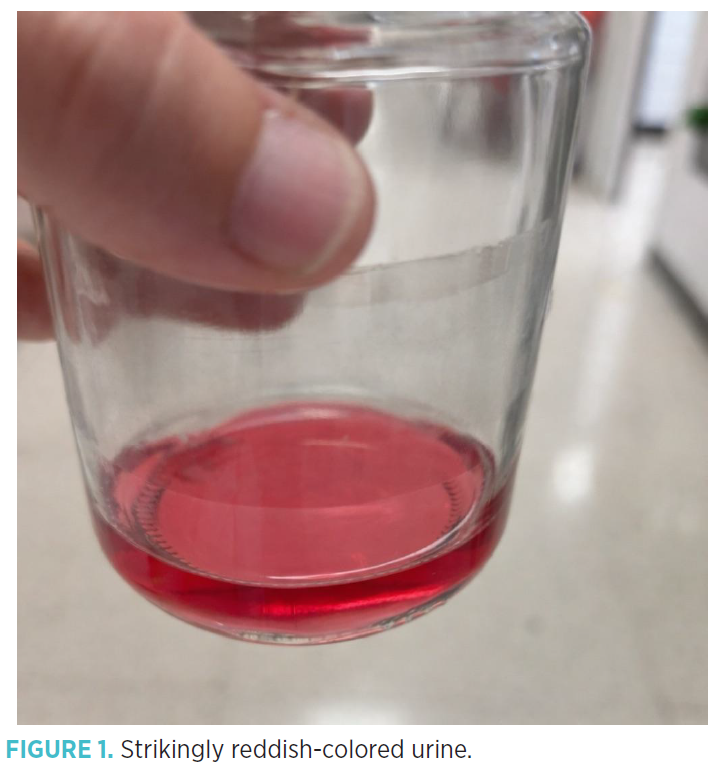
Between the months of July and September 2025, seven cases of false hematuria due to pitaya were recorded. All were attended in a third-level hospital center, and in summer, probably related to seasonal consumption. All presented common characteristics: strikingly reddish coloration of the urine (Figure 1), normal physical examination, and a recent history of consuming the fruits of the aforementioned cactus.
Among the key data from the anamnesis, questions were asked about urinary symptoms, abdominal pain, recent infection, intense physical exercise, drug consumption, or family history of nephro-urological pathology. The examination was directed towards alarm signs such as hepatosplenomegaly, abdominal mass, or petechial lesions, being unremarkable in all cases. Table 1 summarizes the main characteristics of this case series.
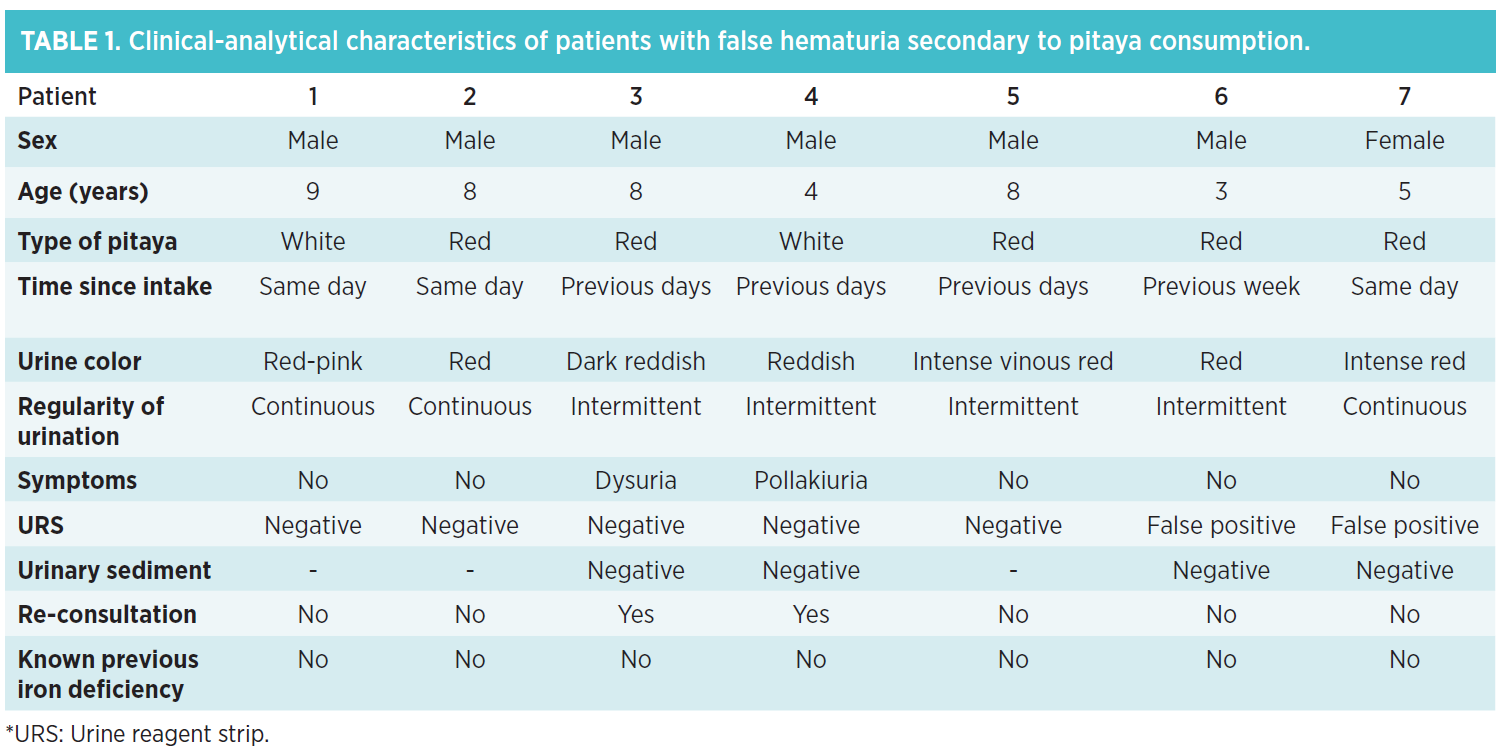
All patients underwent a urine reagent strip (URS). Initially, this presented a falsely positive result for leukocytes and nitrites in two cases, leading to a urine sediment analysis, where no red or white blood cells were visualized.
Families were informed about the benign nature of the condition and the absence of complications. Resolution was spontaneous within 48 hours of the onset of symptoms, requiring no additional complementary tests or treatment.
Pitaya (also known as pitahaya or dragon fruit) comes from cacti of the genus Selenicereus (formerly Hylocereus). Its origin is in Central America, where it was already known and used by pre-Columbian peoples. Currently, commercial cultivation has spread globally, including the Mediterranean area and Spain. Appreciated for its exotic appearance, mild flavor, and nutritional interest, pitaya has become a common food in the diet of the Spanish population.
Beeturia, or betacyanuria, is the abnormal coloration of urine after the ingestion of colored foods such as beets, blackberries, mushrooms, or pitaya, with a high content of reddish pigments known as betacyanins. The typical color can range from pink to intense red(1). Current literature maintains that red-pulp pitaya has the highest content of betacyanins (compared to white or yellow pulp)(2). However, there are no studies that confirm a higher prevalence of beeturia associated with the type of pitaya consumed.
The only study that evaluated this phenomenon, published in 1963 by Watson et al.(3), reported an incidence of beeturia of 13.8% in the normal population after beet ingestion, increasing to 48.6% in patients with iron deficiency anemia and up to 80% in iron-deficient patients without treatment. They also observed a higher incidence in patients with malabsorption syndromes and pernicious anemia.
Subsequently, other groups proposed using the appearance of beeturia as a screening method for iron deficiency(4) or hemochromatosis(5). The pathophysiological mechanism is not clearly defined, but the classic hypothesis proposed by Watson et al. and supported by subsequent literature is that, in states of iron deficiency, the intestine enters an adaptive state of hyperabsorption so that compounds such as betacyanin better cross the intestinal mucosa and reach systemic circulation, later to be eliminated in urine(3,4). However, the association with situations such as iron deficiency, malabsorption, or gastrointestinal alterations in the pediatric population is poorly described in the literature.
Although some of these works included pediatric patients, this association has been described fundamentally in adult patients. Likewise, screening for these pathologies is recommended in adult patients(2,6). There is insufficient evidence to recommend performing an expanded study in pediatric patients with beeturia.
The URS can be useful to differentiate from true hematuria. However, it can have false positives due to its instability in basic pH or high temperatures (>37.7ºC)(2,6). In our patients, the intense pigmentation of the urine altered the leukocyte and nitrite results (given the similarity in color in case of positivity). In doubtful cases, microscopic urinalysis would be the ideal test for diagnosis.
Beeturia does not require specific treatment or management, although in those patients where the situation generates anxiety in caregivers, dietary modification and abundant hydration are recommended. Two patients consulted their primary care pediatrician again for another reason, confirming its disappearance after abandoning pitaya intake.
In conclusion, false hematuria secondary to pitaya consumption is a benign, self-limited, and probably underdiagnosed entity in pediatrics that should be included in the differential diagnosis of reddish urine in pediatric emergency departments.
Funding
No funding was received for the research, authorship, and/or publication of this article.
Authorship contribution
Ana Molina Prado: Writing - review and editing
Alicia Calvo Cillán: Writing - review and editing, Supervision
Javier Sánchez Salgado: Investigation, Data collection, Conceptualization, Writing review and editing, Writing - original draft
Rafael Martín Masot: Writing - review and editing, Supervision
Conflict of interest
The authors declare that there is no commercial or financial conflict of interest regarding this research.
Data availability
The dataset supporting the results of this study is available upon reasonable request to the corresponding author.
Use of artificial intelligence tools
I declare that no artificial intelligence tool (such as ChatGPT, Copilot, Gemini, or others) has been used in the writing, analysis, or review of this article.
REFERENCES
- Sauder HM, Rout P. Beeturia. In: StatPearls [Internet]. Treasure Island (FL): StatPearls Publishing; 2023.
- Khoo HE, He X, Tang Y, Li Z, Li C, Zeng Y, et al. Betacyanins and anthocyanins in pulp and peel of red pitaya (Hylocereus polyrhizus cv. Jindu), inhibition of oxidative stress, lipid reducing, and cytotoxic effects. Front Nutr. 2022;9:894438.
- Watson WC, Luke RG, Inall JA. Beeturia: Its incidence and a clue to its mechanism. Br Med J. 1963;2:971-3.
- Tunnessen WW, Smith C, Oski FA. Beeturia. A sign of iron deficiency. Am J Dis Child. 1969;117:424-6.
- Sotos JG. Beeturia and iron absorption. Lancet. 1999;354:1032.
- Comanda Guglielmi M, Castro Barrio M, Sierra Santos L, Barceló Bazal B, Castro Martinez H. El tinte del dragón: un caso de betacianuria. Médicos de Familia. 2024;26(3):104-5.
Explorar
Artículos
Volúmenes
Sobre la revista
Más leídos
Emergencias Pediátricas
Emergencias Pediátricas
Emergencias Pediátricas
1º Congreso Mundial de Emergencias Pediátricas
Emergencias Pediátricas
Una nueva mirada a la vía aérea pediátrica: secuencia de intubación diferida como alternativa segura en situaciones de urgencias
Emergencias Pediátricas