Carta científica
Vol. 5 Núm. 2 (English)
7 min
Evaluation of the management of gastroenteritis and bronchiolitis in the emergency department: do-not-do recommendations and quality indicators
Evaluación del manejo de la gastroenteritis y la bronquiolitis en urgencias: Recomendaciones qué no hacere indicadores de calidad
Francesc Ros-Córdoba1*, Laura Fernández-Vallespín2, Clàudia Alcaraz-Soler1, Victoria Trenchs-Sainz-de-la-Maza1,3,4, Carles Luaces-Cubells1,3,4, Araceli Domingo-Garau1
1Pediatric Emergency Department, Hospital Sant Joan de Déu, Esplugues de Llobregat, Barcelona, Spain. 2Pediatric Intensive Care Unit, Hospital Sant Joan de Déu, Esplugues de Llobregat, Barcelona, Spain. 3Research Group "Influence of the environment on child and adolescent well-being", Institut de Recerca Sant Joan de Déu, Esplugues de Llobregat, Barcelona, Spain. 4University of Barcelona, Barcelona, Spain
Correspondencia:
Recepción:
21/07/2025
Aceptación:
15/09/2025
Publicación:
26/06/2026
Métricas
51
Visualizaciones
3
Descargas
Compartir
Compartir
Resumen (EN)
Introduction: To evaluate adherence to the SEUP "Do not do" recommendations and quality indicators in acute gastroenteritis (AGE) and acute bronchiolitis in a Pediatric Emergency Department.
Methods: A single-center, descriptive-observational study in patients under 18 years of age without comorbidities during high-incidence periods (AGE: summer 2022; bronchiolitis: winter 2023).
Results: A total of 1,078 episodes of AGE and 362 of bronchiolitis were included. In AGE, oral rehydration was the first choice in 83.9% of mild-to-moderate cases. In bronchiolitis, routine tests (81.8%) and unnecessary therapies (97%) were avoided, although 25.1% of infants under 6 months received bronchodilators.
Conclusions: Adherence to recommendations is variable. In AGE, therapeutic management is adequate, but clinical documentation must be improved. In bronchiolitis, the main area for improvement is avoiding the unjustified use of bronchodilators through continuous training and protocol updates.
Palabras clave (EN):
Resumen (ES)
Introducción: Evaluar la adherencia a las recomendaciones de "No hacer" de la SEUP y a los indicadores de calidad en gastroenteritis aguda (GEA) y bronquiolitis (BQL) en Urgencias Pediátricas.
Métodos: Estudio unicéntrico descriptivo-observacional en menores de 18 años sin comorbilidades durante periodos de alta incidencia (GEA: verano 2022; BQL: invierno 2023).
Resultados: Se incluyeron 1078 episodios de GEA y 362 de BQL. En GEA, la rehidratación oral fue la primera opción en el 83,9% de casos leves-moderados. En BQL, se evitaron pruebas rutinarias (81,8%) y terapias innecesarias (97%), aunque un 25,1% de los lactantes menores de 6 meses recibió broncodilatadores.
Conclusiones: La adherencia a las recomendaciones es variable. En GEA el manejo terapéutico es adecuado, pero debe mejorarse el registro clínico. En BQL, el principal área de mejora es evitar el uso injustificado de broncodilatadores mediante formación y actualización de protocolos.
Palabras clave (ES):
In recent years, optimizing the quality of care in Pediatric Emergency Services (SUP, by its Spanish acronym) has gained increasing relevance, especially in the management of frequent pathologies such as acute gastroenteritis (AGE) and acute bronchiolitis (BQL). The Spanish Society of Pediatric Emergencies (SEUP) has published the “Actions not to do” recommendations(1), aimed at avoiding unnecessary interventions that could lead to an inefficient use of resources and potential adverse effects. However, the implementation of these recommendations in clinical practice remains a challenge.
The purpose of this study is to evaluate the degree of adherence to the “Actions not to do” recommendations(1) and compliance with the selected quality indicators(2) in the care of children with AGE and BQL in a SUP. These results are intended to identify opportunities for improvement to contribute to more efficient care aligned with scientific evidence.
A descriptive-observational single-center study is presented in which, through the computerized clinical record, sociodemographic variables and variables related to the assessment and management of the two pathologies under study in the emergency department are collected to determine if the “Actions not to do” and the quality indicators defined below are met. These variables are analyzed in two periods of high incidence of these pathologies, including patients diagnosed with AGE from June 21 to September 20, 2022, and subsequently, patients diagnosed with BQL from December 1 to December 31, 2023.
Patients under 18 years of age with an SUP discharge diagnosis of AGE (ICD-10-ES CODE A09) or BQL (ICD-10- ES CODE J21.0 and J21.8) were included, excluding those with comorbidities that could justify the use of specific treatments evaluated in the study.
The “Actions not to do” recommendations (R)(1) are defined as:
- R_1 (AGE): Performing rehydration, orally or intravenously, without prior estimation of the patient’s degree of dehydration by weight loss or validated scales.
- R_2 (AGE): Initiating intravenous rehydration without having attempted oral rehydration in cases with mild or moderate dehydration when there are no contraindications for the oral route.
- R_1 (Bronchiolitis): Using the diagnosis of BQL in children older than 2 years.
- R_2 (Bronchiolitis): Routinely requesting complementary tests when treating patients with BQL.
- R_3 (Bronchiolitis): Administering oral/inhaled corticosteroids or antibiotics to infants with BQL (unless concomitant bacterial infection is suspected).
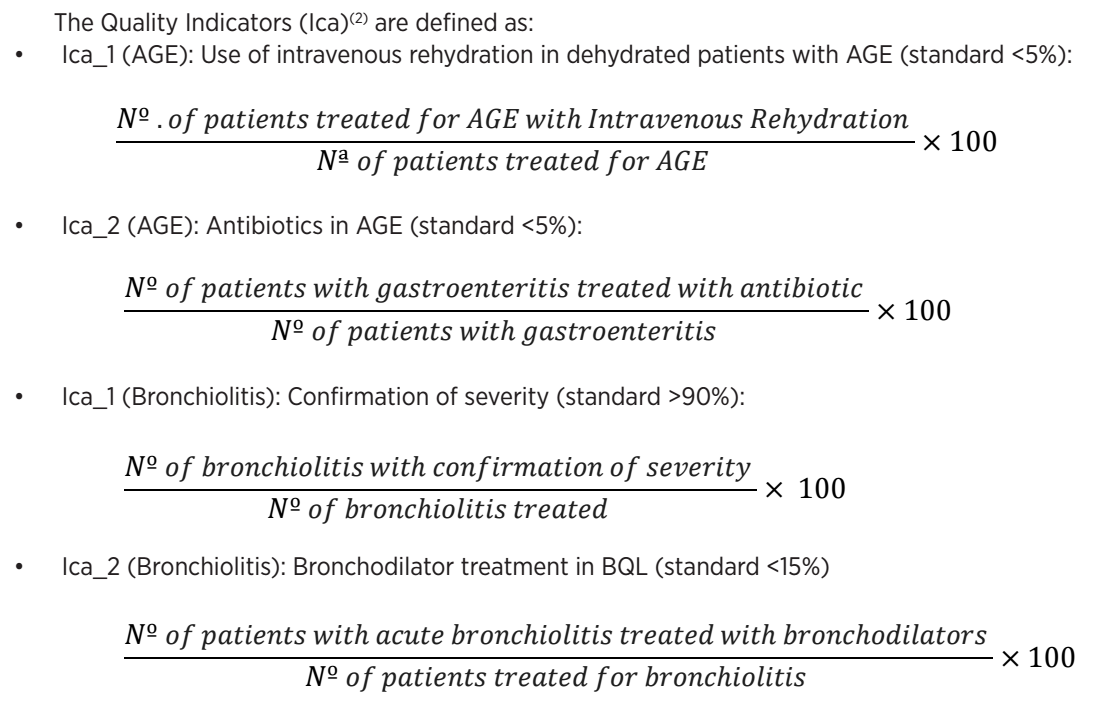
For the assessment of Ica_2 in BQL, patients older than 6 months are excluded, given that the study center’s protocol(3) accepts the bronchodilator therapeutic trial from this age or in the presence of predominant wheezing on auscultation.
The SPSS v25.0 software is used for the statistical analysis. The SEUP quality indicators are calculated according to the described formulas. The study has the approval of the Ethics Committee of the center where it is carried out (PIC-49-23).
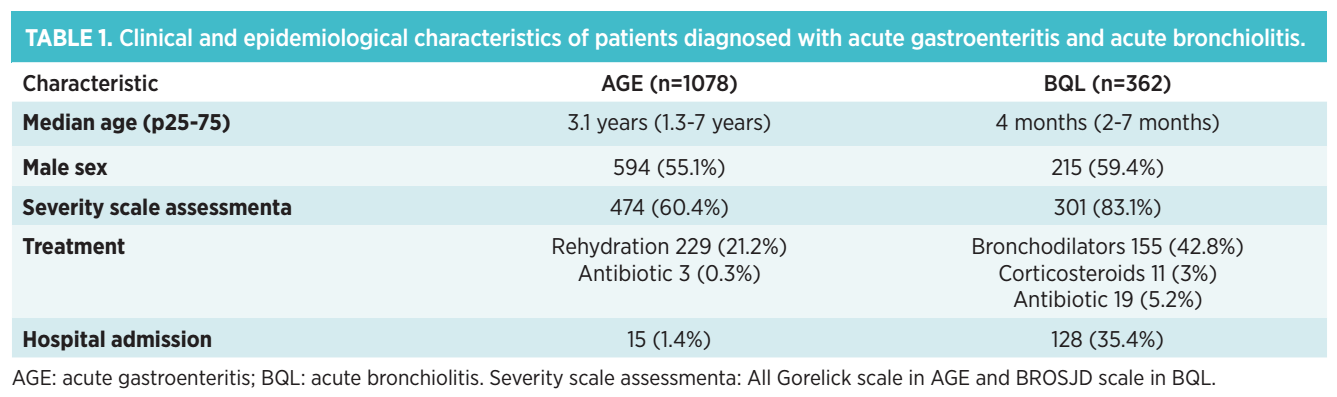
1078 AGE episodes and 362 BQL episodes are included. Table 1 shows the clinical and epidemiological characteristics of the patients with both pathologies.
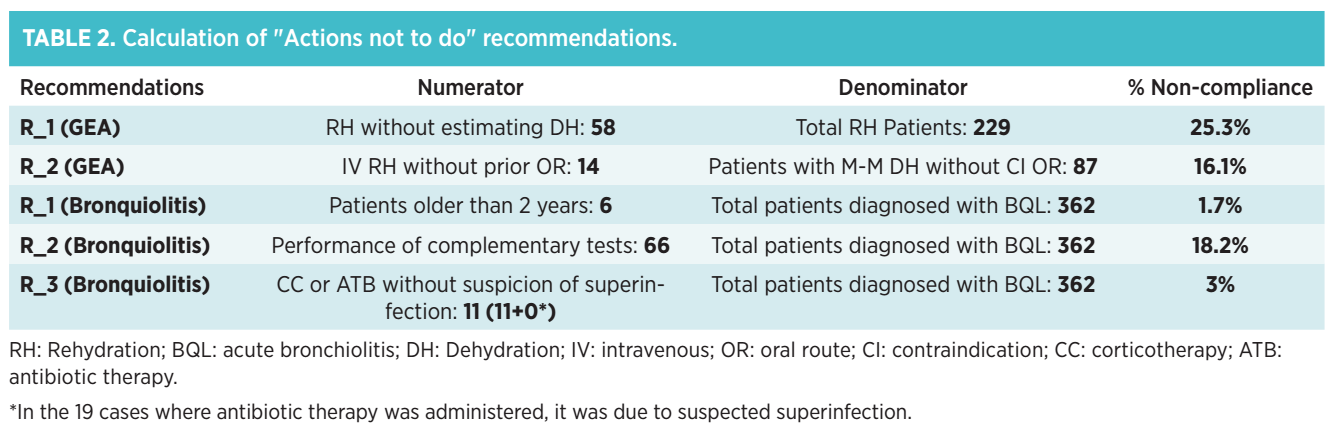
Regarding the “Actions not to do” recommendations for AGE episodes: R_1 is met in 74.7% of cases (among the 229 cases that are rehydrated, the degree of dehydration is not estimated in 58 (25.3%)) and R_2 is met in 83.9% (among the 87 patients with mild-moderate dehydration who are rehydrated, 14 (16.1%) receive intravenous hydration without trying oral rehydration). Regarding the quality indicators, Ica_1 is 2.9% and Ica_2 is 0.3%.
On the other hand, regarding the “Actions not to do” recommendations for BQL episodes: R_1 is met in 98.4% of cases (6 episodes correspond to patients older than 2 years), R_2 in 81.8% (one or more complementary tests are performed in 18.2% of episodes: urinary sediment (9.7%), chest X-ray (6.9%), and blood test (6.1%)), and R_3 in 97% (corticosteroids are used in 3% and antibiotics in 5.2%, always due to suspicion of concomitant bacterial infection). Regarding the quality indicators, Ica_1 is 83.1% (a scale is applied in 301 cases, BROSJD(4) in all cases), and Ica_2 is 25.1% (bronchodilators are administered in 57 of the 227 BQL episodes in infants under 6 months).
The results obtained show variable adherence to the “Actions not to do” recommendations in the management of AGE and BQL in the emergency department. In AGE, quality objectives are met regarding the use of intravenous rehydration and antibiotics, but opportunities for improvement persist in documenting the degree of dehydration and in reducing the use of intravenous rehydration without a previous oral trial. In BQL, the unnecessary indication of complementary tests and antibiotics to those with suspected associated bacterial infection is low. However, deficiencies are identified in the evaluation of severity and in the use of bronchodilators in infants under 6 months. The frequency of bronchodilator administration in this age group could be explained by the generalization by emergency pediatricians of the salbutamol therapeutic trial indicated in those older than 6 months in the study center’s protocol(3). However, the lack of evidence supporting this decision does not justify its generalization. It is essential to update the BQL protocol applied with the objective of adhering to evidence-based clinical decision-making(5), minimizing the use of bronchodilators in BQL regardless of age, and insisting on adherence to the protocol.
This study presents the limitations inherent to a retrospective work, and there is a possibility that compliance with some of the recommendations and quality indicators has been underestimated due to the required data not being well recorded.
We conclude that our study evidences a variable adherence to the “Actions not to do” recommendations and disparate compliance with the quality indicators in the care of AGE and BQL in our SUP. It is necessary to implement strategies that reinforce their implementation, such as continuous training of personnel with periodic review sessions, feedback on clinical performance, and optimization of documentation in clinical records. In this regard, periodic review sessions aimed at medical staff have been incorporated into our SUP, with the objective of fostering clinical practice aligned with scientific evidence. Likewise, conducting periodic reviews could facilitate the identification of barriers and the implementation of timely corrective measures.
Funding
No funding was received for the research, authorship, and/or publication of this article.
Authorship contribution
Francesc Ros-Córdoba, Victoria Trenchs-Sainz-de-la-Maza, Araceli Domingo-Garau: Conceptualization, Methodology, Writing - original draft.
Francesc Ros-Córdoba, Laura Fernández-Vallespín, Clàudia Alcaraz-Soler: Data curation, Formal analysis, Visualization.
Carles Luaces-Cubells, Victoria Trenchs-Sainz-de-la-Maza: Supervision, Project administration, Funding acquisition.
All authors critically reviewed the manuscript, approved the final version, and take responsibility for its content..
Conflicts of interest
The authors declare that there are no commercial or financial conflicts of interest for this research.
Use of artificial intelligence tools
The authors declare that no artificial intelligence tool (such as ChatGPT, Copilot, Gemini, or others) has been used in the writing, analysis, or review of this article.
References
- Spanish Society of Pediatric Emergencies (SEUP): Do not do. Actions not to do from the SEUP Working Groups. [Consulted: January 20, 2022]. Available at: https://seup.org/wp-content/uploads/2022/06/PosterSeup.pdf
- González Hermosa A, Benito Fernández FJ, Fernández Elías M, González Peris S, Luaces Cubells C, Velasco Zúñiga R and the SEUP Safety and Quality Working Group. SEUP Quality Indicators Review 2018. [Consulted: January 20, 2022]. Available at: https://seup.org/pdf_public/gt/mejora_indicadores.pdf
- Iriondo Muruzábal M, Claret Teruel G, Simó Nebot M.Bronquiolitis aguda. En: Luaces Cubells C, editor. Urgencias en Pediatría. Madrid: Ergon; 2022. p. 112-20.
- Balaguer M, Alejandre C, Vila D, Esteban E, Carrasco JL, Cambra FJ, et al. Bronchiolitis Score of Sant Joan de Déu: BROSJOD Score, validation and usefulness. Pediatr Pulmonol. 2017; 52:533-9.
- Benito Fernández, J, Paniagua Calzón N. Diagnosis and treatment of acute bronchiolitis in the emergency department. In: Diagnostic and therapeutic protocols in pediatric emergencies Spanish Society of Pediatric Emergencies (SEUP) 4th edition, 2024. [Consulted: June 20, 2025]. Available at: https://seup.org/wp-content/uploads/2024/04/5_Bronquiolitis_4ed.pdf
Explorar
Artículos
Volúmenes
Sobre la revista
Más leídos
Emergencias Pediátricas
Emergencias Pediátricas
Emergencias Pediátricas
1º Congreso Mundial de Emergencias Pediátricas
Emergencias Pediátricas
Una nueva mirada a la vía aérea pediátrica: secuencia de intubación diferida como alternativa segura en situaciones de urgencias
Emergencias Pediátricas