Artículo original
Vol. 4 Núm. 3 (English)
11 min
Evaluation of a teaching project on emergency situations for 4 to 6-year-old girls and boys in Montevideo, Uruguay. RCPequesUY
Evaluación de un proyecto de enseñanza sobre situaciones de emergencia para niñas y niños de 4 a 6 años en Montevideo, Uruguay. RCPequesUY
Sergio Paz-Bravo* , Gastón Farías, Soledad Guillermoni, Stella Gutiérrez
¹Department of Pediatrics, CASMU-IAMPP, Montevideo, Uruguay
Correspondencia:
Recepción:
20/05/2025
Aceptación:
08/06/2025
Publicación:
16/12/2025
Métricas
54
Visualizaciones
9
Descargas
Compartir
Compartir
Resumen (ES)
El reconocimiento y la respuesta ante una situación de emergencia por parte de testigos presenciales son fundamentales para disminuir la mortalidad de la población adulta en escenarios extrahospitalarios. Los niños y niñas también pueden capacitarse.
El objetivo de este trabajo fue implementar una experiencia piloto de un proyecto educativo sobre conceptos y técnicas de Soporte Vital Básico, con niñas y niños de 4 a 6 años, basados en el programa “RCP desde mi cole”, creado en España en 2014 por la Dra. Marta Nonide.
La intervención se realizó con preescolares de niveles 4 y 5 cuyos padres firmaron el consentimiento, entre marzo y noviembre de 2023.
Se realizó la evaluación de conocimientos de los niños en opinión de los padres. La intervención consistió en cuatro talleres lúdicos. Posteriormente, se evaluaron los conocimientos de los preescolares aplicando la “Escala Nonide” adaptada a Uruguay (Escala NonideUY). Se evaluó la aceptación y repercusión del proyecto en las familias y se valoró el impacto físico y emocional en los preescolares.
La enseñanza de Soporte Vital Básico en preescolares es factible y cuenta con el apoyo de los padres. La adquisición de conocimientos mostrada por la escala NonideUY, demuestra que los niños, en particular a partir de los 5 años, son capaces de actuar adecuadamente.
Los padres y docentes manifestaron que los talleres son útiles y que deberían repetirse, no habiéndose detectado ningún impacto emocional ni físico en los preescolares.
Palabras clave (ES):
Resumen (EN)
Recognition and response to an emergency situation by eyewitnesses are essential to reduce mortality in the adult population in extra-hospital settings. Boys and girls can also train.
The objective of this work was to implement a pilot experience of an educational project on Basic Life Support concepts and techniques, with girls and boys from 4 to 6 years old, based on the “CPR from my school” program created in Spain in 2014 by Dr. M. Nonide.
The intervention was carried out with preschoolers of levels 4 and 5 whose parents signed the consent, between March and November 2023.
An evaluation of the children’s knowledge was carried out in the parents’ opinion. The intervention consisted of four recreational workshops. Subsequently, the preschoolers’ knowledge was evaluated by applying the “Nonide Scale” adapted to Uruguay (NonideUY Scale). The acceptance and impact of the project on families and the physical and emotional impact on the preschoolers were evaluated.
Teaching Basic Life Support in preschoolers is feasible and has the support of parents. The acquisition of knowledge shown by the NonideUY scale demonstrates that children, particularly from the age of 5, are capable of acting appropriately.
Parents and teachers stated that the workshops are useful and that they should be repeated, and no emotional or physical impact on the preschoolers was detected.
Palabras clave (EN):
Introduction
In Uruguay, cardiovascular diseases are the leading cause of death in adults. When analyzing their causes, two people die each day in traffic accidents and 24 from cardiovascular causes. Half of these present as “sudden death”(1). In the face of such events, a rapid and systematic response is essential, making it a priority to train the population on how to act in emergency situations.
Medical emergencies occur very frequently in out-of-hospital settings. In these circumstances, the survival of the victims depends on the actions taken by bystanders within the shortest possible time(2). Basic Life Support (BLS) training in Uruguay is mainly directed toward the adult population, with some experiences starting at 12 years of age(3). Recognizing an emergency, calling the emergency number, initiating chest compressions, and performing automated defibrillation by bystanders are essential to reduce mortality(2).
For every minute that chest compressions are delayed, the probability of survival decreases by 10%. If one simply waits for the ambulance, the chances of surviving do not exceed 7%. If bystanders quickly initiate chest compressions, the chances double(4). Many preschool and school-aged children witness emergencies affecting the adults responsible for them. However, BLS training is not included in formal education(5).
In Spain, in 2014, Dr. Marta Nonide Robles created the program “CPR from My School,” inspired by the project “With Your Hands You Can Save Lives,” implemented by the Primary Care Nursing team of Gijón. Its objective was the early education of first aid for children aged 4 to 8 years to improve survival in cardiorespiratory arrest (CRA). Ten percent of Spanish adults know how to respond to an emergency, compared with 90% of the population in Nordic countries, where BLS training has been mandatory in the educational system for over 40 years(6).
The American Heart Association (AHA) and the European Resuscitation Council (ERC) consider that the best way to disseminate BLS training among the population is to incorporate it into the school curriculum(5). Schools are seen as the ideal environment to promote prevention and health promotion, and the appropriate place to begin civic education in BLS(7). The highest rates of bystander care for out-of-hospital cardiac arrest (OHCA) are reported in countries where BLS training has been mandatory in schools for decades(8).
This project focuses on emergency situations that children aged 4 years and above can understand and respond to: unconsciousness, CRA, and foreign-body airway obstruction (FBAO); as well as the maneuvers they can begin to learn and perform: calling 911, the head-tilt/chin-lift maneuver, the recovery position (RP), chest compressions (CC), and airway obstruction maneuvers.
At this age, the goal is not to achieve effective CC, but rather to teach children to activate the chain of survival by calling emergency services. If they begin learning these skills early, they will be able to provide first aid and BLS when they become adults.
The objective of this study was to prepare children aged 4 to 6 years to face emergency situations through an educational project on BLS concepts and techniques based on the “CPR from My School” program. As a secondary objective, we sought to assess acceptability and impact within households, as well as the physical and emotional effect of the workshops.
Methodology
The target population consisted of preschool children aged 4 to 6 whose parents and/or caregivers provided consent and authorization for training, research, and dissemination. The intervention took place between March and November 2023 in educational centers in the neigh
borhoods of Peñarol, Prado, and Atahualpa in Montevideo, Uruguay.
Meetings were held with school directors to explain the intervention. Teachers received a workshop about the project and were provided with the materials used with the children: a storybook and a song.
A baseline assessment of children’s knowledge on how to act during emergencies was conducted via a questionnaire administered to parents and/or caregivers. The questionnaire included seven questions about: previous participation in BLS workshops, knowledge of calling 911 for emergencies, recovery position, head-tilt/chin-lift maneuver, chest compressions, and the Heimlich maneuver.
The intervention consisted of a weekly play-based workshop for four weeks. The first workshop involved reading the children’s book “The Fainting Spell,” which explains how to recognize and act during an emergency, including calling 911, the head-tilt/chin-lift maneuver, RP, and CC. The second workshop included an emergency simulation using a stuffed animal brought from home. The third workshop involved learning the song “The Fainting Spell” (adaptation of the CPR song). In the fourth workshop, parents were invited, and the children demonstrated what they had learned.
A post-workshop knowledge assessment was performed using the Nonide Scale adapted to Uruguay, known as the NonideUY Scale (Figure 1). The Nonide Scale is a validated instrument used in Spain to assess BLS knowledge in children aged 4 to 8 years(9). The assessment was conducted individually and orally by two evaluators, using clear language and a stuffed animal to evaluate practical skills. The NonideUY Scale includes 3 sociodemographic variables: age, sex, and school, and eight theoretical-practical questions: calling 911, recognizing loss of conscious ness, head-tilt/chin-lift, RP, CC, and actions for FBAO: encouraging coughing and the Heimlich maneuver. Responses were scored from 4 (perfect) to 0 (does not know/does not answer).
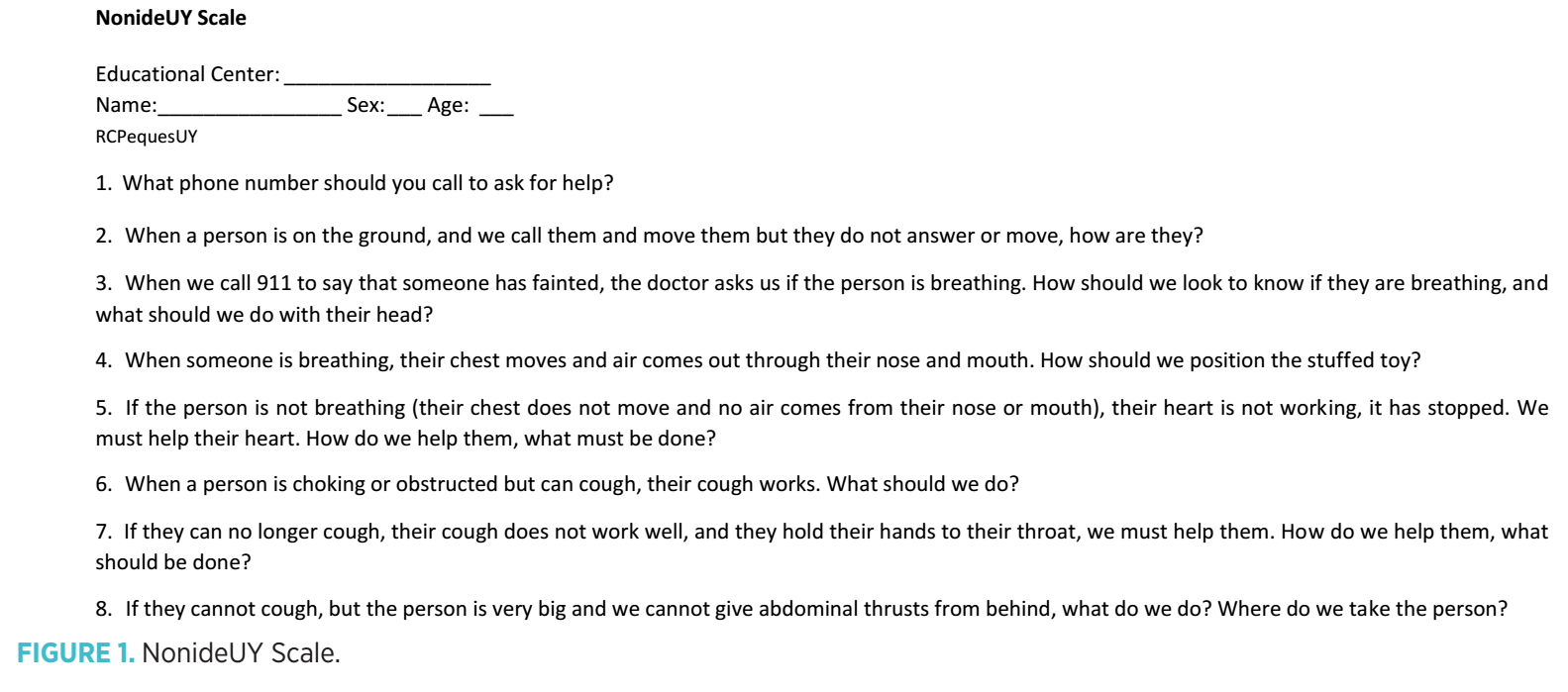
After the final workshop, a survey was administered to assess acceptability and impact on families.
The physical and emotional impact on children was assessed through a survey administered at least one month after the workshops. The evaluation was completed by parents/caregivers and teachers electronically via WhatsApp®.
Data were analyzed using SPSS® v15 and presented as absolute frequencies, means, and medians for quantitative variables, and percentages for qualitative variables. Quantitative variables were compared using the Kruskal-Wallis and Mann-Whitney U tests. Statistical significance was set at p<0.05.
The project was approved by the Institutional Committee of Clinical Research Ethics of CASMU, file 230264.
Results
The project was implemented in four educational centers, one public and three private (Table 1). All families signed consent forms; 98 preschoolers aged 4 to 6 years participated, with a median age of 5. Of these, 57.1% were female.
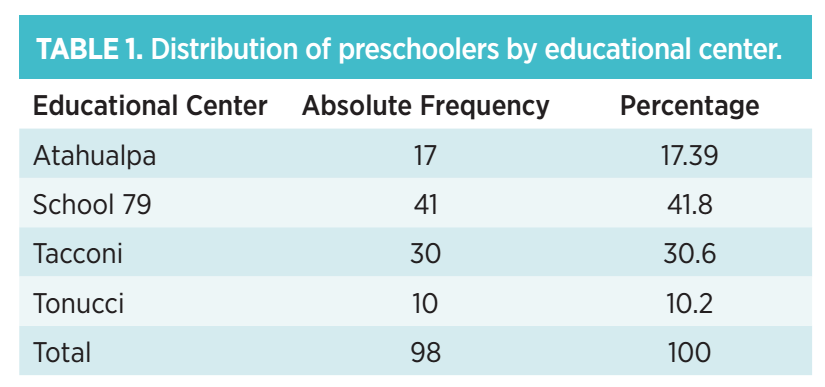
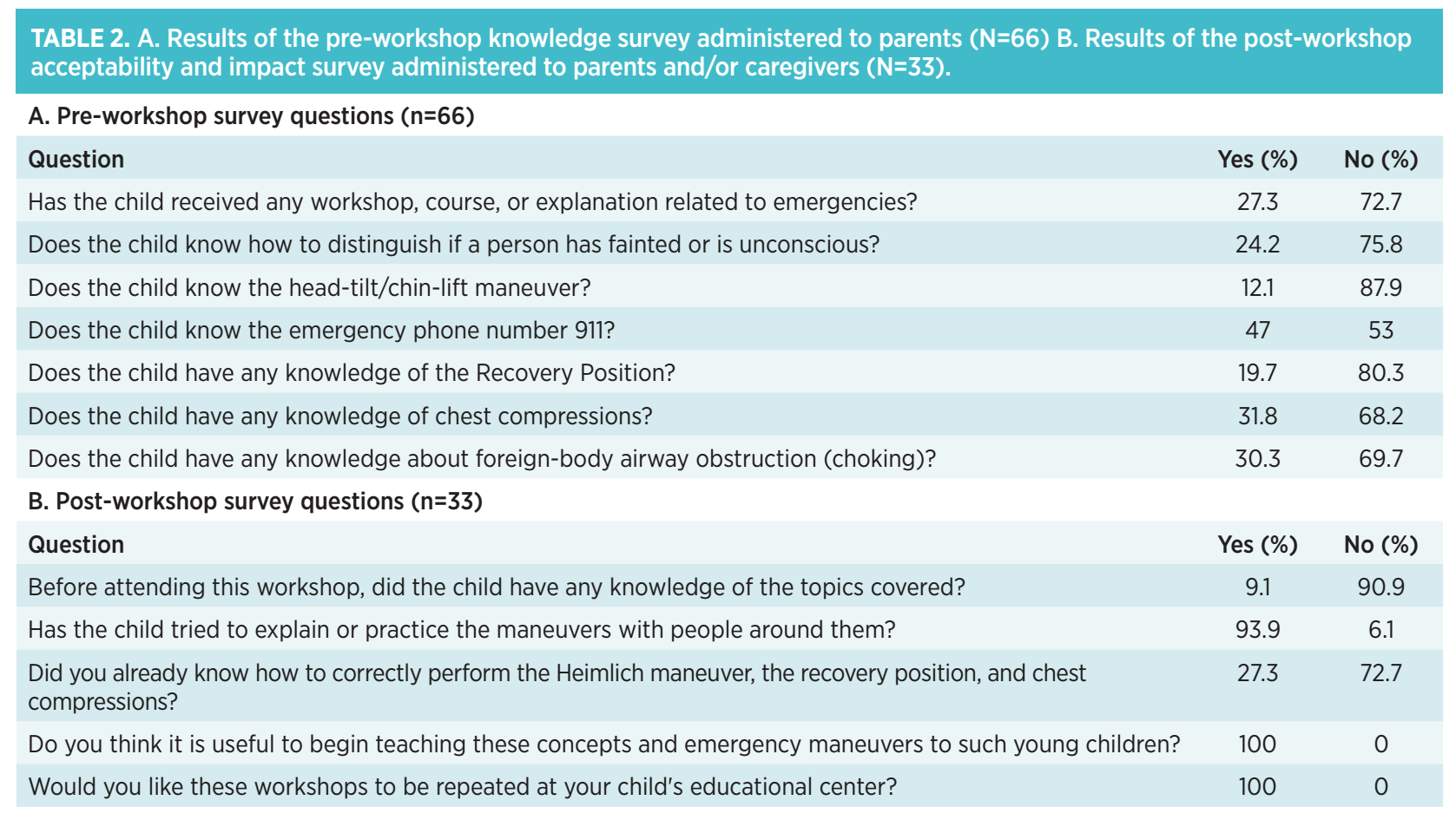
The baseline assessment of children’s emergency-response knowledge, completed by parents and caregivers (Table 2A), was answered by 67.3% (N=66). Responses showed that over 75% of parents believed their children had no prior experience or knowledge. The exception was recognizing 911 as the emergency number, with 53% answering affirmatively.
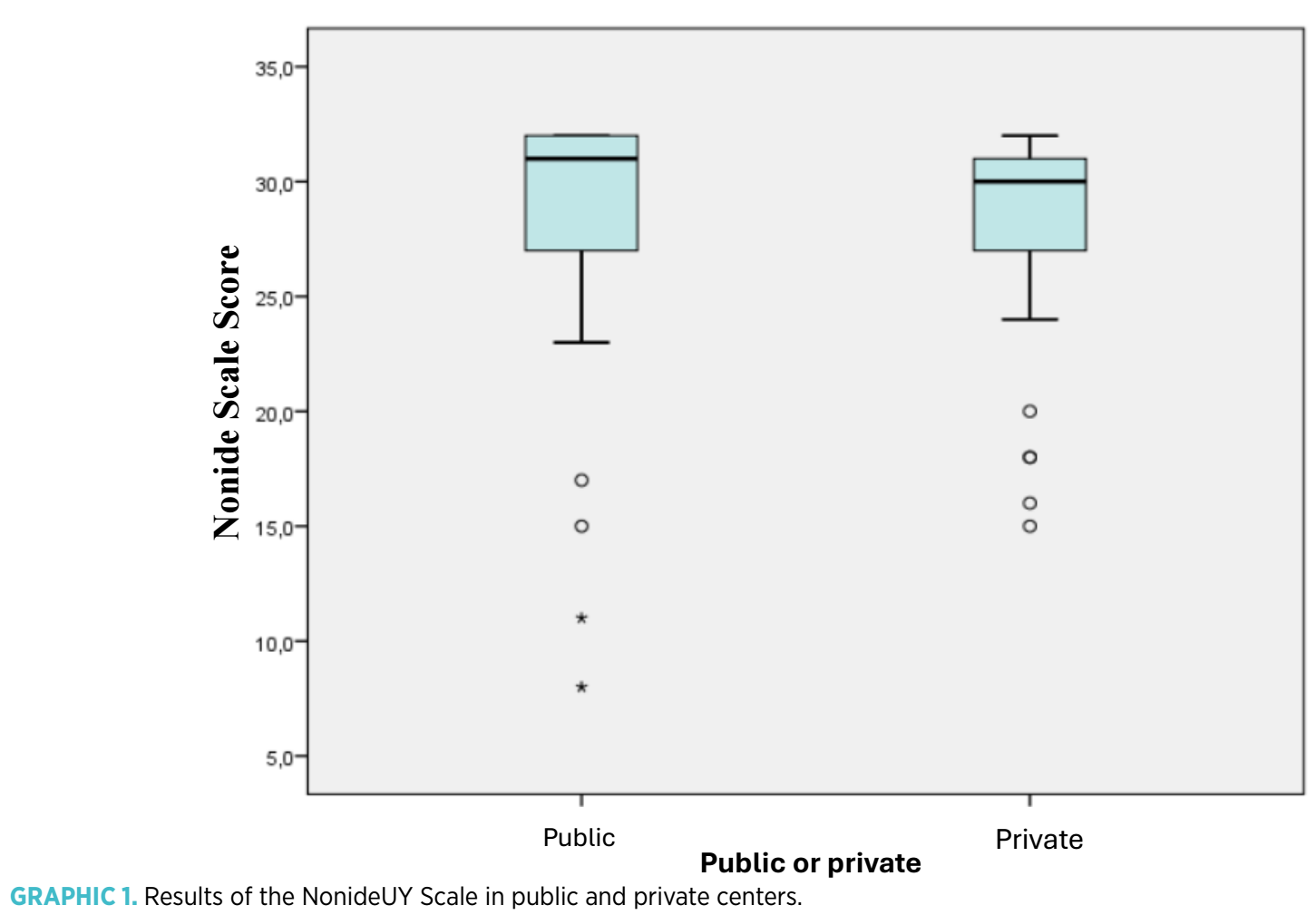
The mean score on the NonideUY Scale was 28.4, with a median of 30 out of a maximum of 32 points. Thirteen preschoolers (13.3%) scored below 80%. No significant differences were found between children attending public vs. private schools (p=0.144) (Graphic 1).
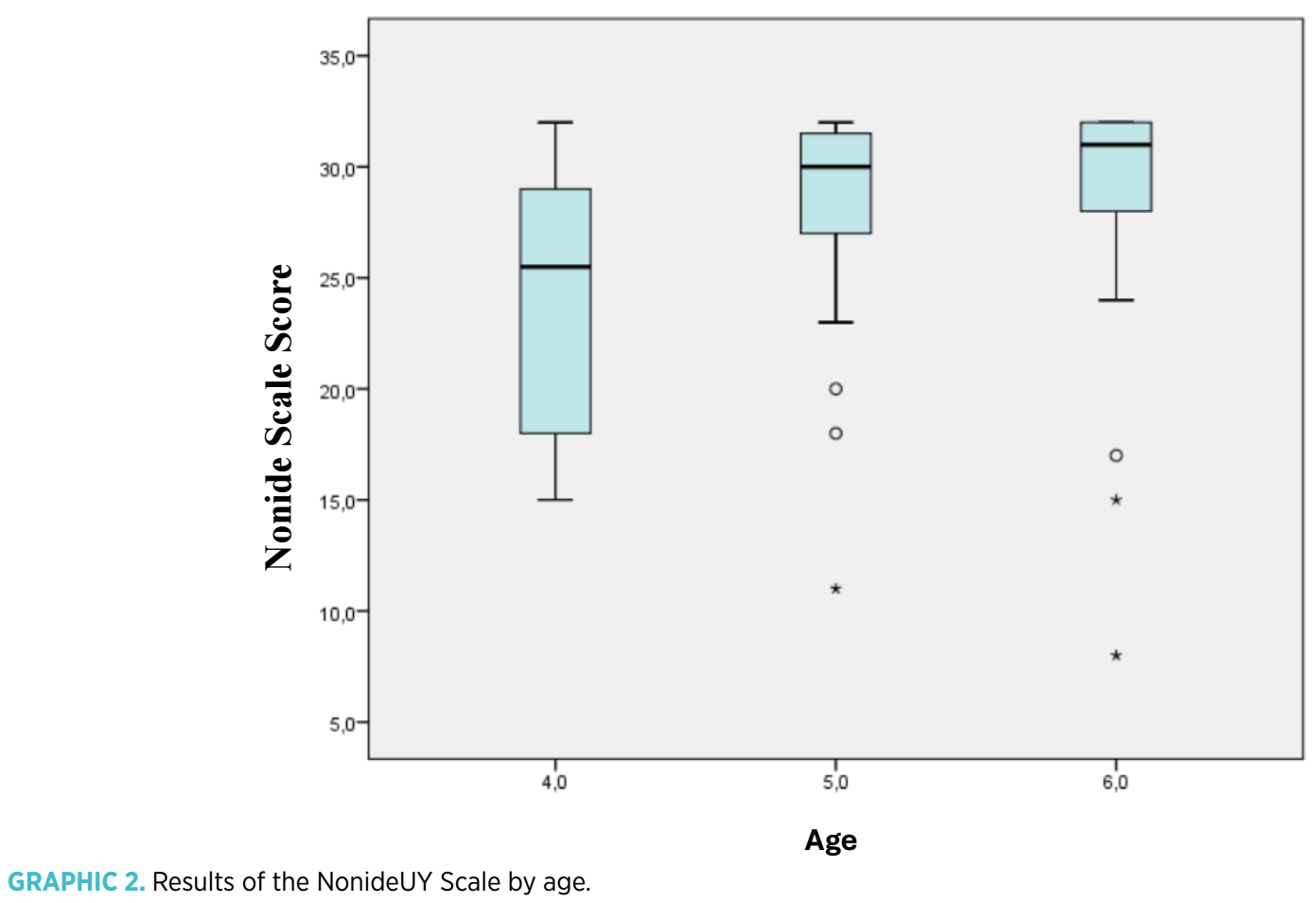
Significant score differences were found across ages (p=0.007). The 4-year-old group scored lower than the 5-year-old group (p=0.02) and the 6-year-old group (p=0.004). The 5- and 6-year-olds had similar results (p=0.122). (Graphic 2)
Analysis of individual NonideUY items (maximum 4 points) showed mean scores above 3.5 for items 1–6. The lowest-scoring items were number 7 (mean 3.3) and number 8 (mean 2.9).
The family acceptability survey was completed by 33 parents/caregivers. Results are shown in Table 2B. Ninety-four percent reported that the child attempted to explain or practice the maneuvers with people around them. Twenty-four percent reported not knowing how to correctly perform the Heimlich maneuver, recovery position, or chest compressions, while 49% knew only some maneuvers. All respondents considered it useful and important to begin teaching young children these concepts and techniques and expressed interest in repeating the workshops.
The satisfaction and emotional/physical impact survey was answered by 22 parents and 2 teachers. All agreed that the children experienced no problems following the workshops. Ninety-one percent felt that the workshop was age-appropriate, useful, and necessary.
Discussion
The baseline knowledge assessment revealed limited understanding of how to act during emergencies.
All scheduled workshops were completed in all centers, and family participation reached nearly 93% in the final session, reflecting strong family involvement.
Children’s knowledge acquisition was assessed with the NonideUY Scale. This was the most time-consuming component because it required individual evaluation with questions and practical demonstrations using a stuffed animal. Overall quantitative results showed that children acquired the expected knowledge: 87% achieved more than 80% accuracy. Items 7 and 8 (related to airway obstruction techniques such as the Heimlich maneuver) scored lowest. This may be because these maneuvers were not included in the storybook or song used in workshops—tools that strongly engage children. The performance differences between the 4-year-old group and the older groups may reflect developmental differences, but could also be due to evaluators’ learning curves, as the 4-year-olds were assessed first.
Dr. Nonide’s 2019 results involving 738 preschoolers showed overall improvement across all items. The percentage of children unaware of chest compressions dropped from 85.7% to 5.7%. Items related to airway obstruction had the lowest retention(6), consistent with our findings.
Family and emotional-impact surveys had low participation, likely because many workshops were held between October and November, when school workloads are high and time for survey response is limited. Nevertheless, all respondents reported that their children tried to explain or practice the maneuvers at home and believed the workshops were useful and should be repeated.
Dr. Nonide’s work found that only nine children (1.5%) reported very mild emotional effects after the workshop. In our study, no negative effects were detected.
The play-based approach using the book “The Fainting Spell” and the adapted CPR song facilitates dissemination of these topics to families. At the University of Castilla-La Mancha, Professor Ángel López developed the project “Saving Llanetes,” a playful tool that has reached Latin America. Workshops were implemented by nursing students(10). “Rescube” is another educational tool that enhances learning of the chain of survival among children aged 5–8 years(11).
Training the population to provide high-quality BLS is essential, starting with school-based education. Refresher workshops should occur at least every 12 months, as knowledge begins to decline after six months(6). The challenge is incorporating BLS into the national education curriculum and engaging teachers. The Catalan Resuscitation Council and the Department of Education of the Generalitat of Catalonia trained teachers using a “spiral methodology” to teach BLS and AED use across grade levels. By the end of 2018, over one thousand teachers and about 150,000 students had been trained(12).
Conclusions
Teaching theoretical-practical concepts of basic cardiopulmonary resuscitation to preschoolers is feasible and supported by parents and caregivers in this sample.
The use and development of playful strategies and tools is essential for facilitating BLS learning.
Post-training knowledge assessed with the NonideUY Scale shows that children at this age—especially from age 5—are capable of recognizing an unconscious person, calling 911, checking breathing using the head-tilt/chin-lift maneuver, placing someone in the recovery position, and understanding that chest compressions must be performed if the person is not breathing. Airway obstruction techniques should be incorporated into the playful tools used (storybook and song), which represents a challenge for future workshops.
Survey results after the intervention show that the workshops are useful and should be repeated. They should preferably take place at the beginning or middle of the school year to avoid end-of-year schedule congestion.
A coordinated agreement between the healthcare and education systems is needed to incorporate BLS training and train teachers.
Acknowledgments
To Dr. Mariela Garau for her advice and collaboration in statistical processing.
To the Francesco Tonucci Educational Center for allowing us to develop the pilot test and collaborating in the creation of the book.
To Dr. Marta Nonide Robles, for sharing her knowledge— our inspiration.
Funding
This research did not receive specific funding from public, commercial, or nonprofit agencies.
Author Contributions
Sergio Paz: conception, design, scientific and intellectual content, and manuscript drafting.
Soledad Guillermoni: design and manuscript drafting.
Gastón Farias: design and manuscript drafting.
Stella Gutiérrez: design and manuscript drafting.
Conflict of Interest
The authors declare no conflicts of interest.
References
- Mortalidad por enfermedades del sistema circulatorio en el Uruguay, 2021 – Comisión Honoraria para la Salud Cardiovascular [Internet]. [Consulted: 30 April 2024]. Available from: https://cardiosalud.org/mortalidad-por-enfermedades-del-sistema-circulatorio-en-el-uruguay-2021/
- Gräsner JT, Herlitz J, Tjelmeland IBM, Wnent J, Masterson S, Lilja G, et al. European Resuscitation Council Guidelines 2021: Epidemiology of cardiac arrest in Europe. Resuscitation. April 2021;161:61-79.
- Ávila Juárez SA, Morales López S, Daniel Guerrero AB, Olvera Cortés HE, García Barrón AM, Martínez Rodríguez MA, et al. Evaluation of skill acquisition in basic CPR and AED use with educational resources. Investig En Educ Médica. June 2020;9(34):43-52.
- Resucitación Cardíaca – Comisión Honoraria para la Salud Cardiovascular [Internet]. [Consulted: 30 April 2024]. Available from: https://cardiosalud.org/resucitacion-cardiaca/
- Learning Cardiopulmonary Resuscitation at School – Revista Española de Urgencias y Emergencias [Internet]. [Consulted: 30 April 2024]. Available from: https://revistaemer gencias.org/numeros-anteriores/volumen-24/numero-6/aprender-reanimacion-cardiopulmonar-desde-la-escuela/
- Nonide Robles M. Impacto de un proyecto educativo de formación en SVB para niños de 4 a 8 años [doctoral thesis]. 2023 [Consulted: 14 May 2024]. Available from: https://digibuo.uniovi.es/dspace/handle/10651/71406
- La comunidad escolar como objetivo de la formación en resucitación: la RCP en las escuelas – Revista Española de Urgencias y Emergencias [Internet]. [Consulted: 30 April 2024]. Available from: https://revistaemergencias.org/numeros-anteriores/volumen-20/numero-4/la-comunidad-escolar-como-objetivo-de-la-formacion-en-resucitacion-la-rcp-en-las-escuelas/
- Böttiger BW, Bossaert LL, Castrén M, Cimpoesu D, Georgiou M, Greif R, et al. Kids Save Lives – ERC position statement on school children education in CPR: “Hands that help – Training children is training for life”. Resuscitation. August 2016;105:A1-A3.
- Nonide-Robles M, Postigo Á, Arguelles J, Vigil-Lagranda R, Poyán-Poo A, García-Fernández JA. Cardio-Pulmonary Resuscitation (CPR) in Children Between 5 and 8 Years Old: Psychometric Properties of the Nonide Scale. Psicothema. May 2021;33(2):337-44.
- Salvando a Llanetes [Internet]. Enfermería en Desarrollo. 2020 [Consulted: 27 May 2025]. Available from: https://enfermeriaendesarrollo.es/en-sociedad/salvando-a-llanetes/
- ¿Podemos enseñar la «cadena de supervivencia» jugando? Validación de la herramienta «Rescube» [Internet]. [Consulted: 27 May 2025]. Available from: http://analesdepediatria.org/es-pdf-S1695403320302599
- APOYO VITAL A LAS ESCUELAS | CCR [Internet]. [Consulted: 27 May 2025]. Available from: https://ccr.cat/centres-educatius/informacio-sobre-el-programa-suport-vital-en-centres-educatius/
Explorar
Artículos
Volúmenes
Sobre la revista
Más leídos
Emergencias Pediátricas
Emergencias Pediátricas
Emergencias Pediátricas
1º Congreso Mundial de Emergencias Pediátricas
Emergencias Pediátricas
Una nueva mirada a la vía aérea pediátrica: secuencia de intubación diferida como alternativa segura en situaciones de urgencias
Emergencias Pediátricas