Carta científica
Vol. 5 Núm. 2 (English)
8 min
Comparison of clinical assessment scales in evaluating the severity of acute bronchospasm in children under 2 years of age
Comparativa de escalas de valoración clínica en la evaluación de la gravedad del broncoespasmo agudo en menores de 2 años
Paula García-Espinosa1, Victoria Trenchs-Sainz-de-la-Maza1,2,3, Pablo Donatiu3, Gemma Claret-Teruel1,2,3, Carles Luaces-Cubells1,2,3 , Víctor Aguilar-Gómez4,5*
1Pediatric Emergency Department, Hospital Sant Joan de Déu, Esplugues de Llobregat, Barcelona, Spain. 2Research Group "Influence of the environment on child and adolescent well-being", Institut de Recerca Sant Joan de Déu, Esplugues de Llobregat, Barcelona, Spain. 3University of Barcelona, Barcelona, Spain. 4Department of Pediatrics, Hospital Comarcal de Inca, Inca, Mallorca, Spain. 5Multidisciplinary Research Group in Pediatrics, Health Research Institute of the Balearic Islands (IdISBa), Palma, Mallorca, Spain
Correspondencia:
Recepción:
25/02/2026
Aceptación:
28/04/2026
Publicación:
26/06/2026
Métricas
50
Visualizaciones
5
Descargas
Compartir
Compartir
Resumen (EN)
Introduction: Acute bronchospasm is common in pediatric emergencies. Since no validated scores exist for children under 2, extrapolated tools like the Pulmonary Score (PS), BROSJOD, and modified TAL (mTAL) are frequently used.
Objective: To determine which of the three aforementioned scores best predicts the severity of bronchospasm exacerbations regarding hospital admission.
Methods: Retrospective observational study in a tertiary hospital, including patients aged 6-24 months (April-September 2024). Cases with incomplete data or concomitant pathologies were excluded. Initial clinical severity (mild vs. moderate-to-severe) was calculated and analyzed against the discharge destination.
Results: We analyzed 283 episodes (median age: 14 months; 64.3% male). Concordance between scores was 56.8%. Of the 62 admitted patients (21.9%), 85% were classified as moderate-to-severe by BROSJOD, compared to 74.1% by PS and 62.9% by mTAL (p=0.0016).
Conclusions: Significant variability exists among scores. While BROSJOD better predicts hospital admissions, developing and validating a specific score for this age group is necessary.
Palabras clave (EN):
Resumen (ES)
Introducción: El broncoespasmo agudo es frecuente en urgencias pediátricas. Al no existir una escala validada en menores de 2 años, se suelen extrapolar herramientas como Pulmonary Score (PS), BROSJOD y la escala TAL modificada (TALm).
Objetivo: Determinar cuál de las tres escalas mencionadas predice mejor la gravedad de la crisis de broncoespasmo respecto al ingreso hospitalario.
Métodos: Estudio observacional retrospectivo en un hospital de tercer nivel. Se incluyeron episodios en pacientes de 6 a 24 meses (abril-septiembre 2024), excluyendo casos incompletos o con patologías concomitantes. Se calculó la gravedad clínica inicial (leve o moderada-grave) y se analizó su relación con el destino al alta.
Resultados: Se analizaron 283 episodios (mediana: 14 meses; 64,3% varones). La concordancia entre escalas fue del 56,8%. De los 62 pacientes ingresados (21,9%), el 85% se clasificó como moderado-grave según BROSJOD, frente al 74,1% con PS y el 62,9% con TALm (p=0,0016).
Conclusiones: Existe gran variabilidad entre las escalas. Aunque BROSJOD predice mejor los casos que requieren ingreso, urge desarrollar y validar una herramienta específica para este grupo de edad..
Palabras clave (ES):
Bronchospasm crises are a very frequent cause of consultation in pediatric emergency departments(1) (PED). Accurately assessing their severity is key to guiding clinical management and determining the need for hospital admission. Despite its relevance, there is no universally accepted and specifically validated clinical assessment scale for acute bronchial obstruction in infants and young children, particularly in the group under 2 years of age(2).
Currently, various tools are used, often extrapolated from other pathologies or age ranges. The Pulmonary Score (PS), for example, has been validated in children over five years old for evaluating asthma severity(3). On the other hand, scales such as the Bronchiolitis Score of Sant Joan de Du (BROSJOD)(4) and the modified TAL scale (mTAL)(5) were designed and validated for bronchiolitis in children under 2 years old, an entity with a different pathophysiology than bronchospasm, characterized predominantly by bronchiolar inflammation, edema, and mucus obstruction, with less involvement of the bronchoconstriction component. However, in the absence of tools specifically validated for bronchospasm in this age group, these scales are frequently used in clinical practice to assess the severity of respiratory obstruction regardless of the underlying pathophysiological mechanism. The article by C. Gray et al(6) highlights a marked lack of global consensus, both in the recommendation and in the type of clinical scales for pediatric asthma, noting that most lack sufficient validation, although the Pulmonary Score (PS) and the Pediatric Respiratory Assessment Measure (PRAM) are the most commonly used.
Due to this, the objective is to determine which of the three mentioned scales best predicts the severity of the bronchospasm crisis regarding hospital admission.
A single-center, descriptive-observational, and retrospective study was designed in a tertiary pediatric hospital. All episodes of patients between 6 months and 2 years of age seen in the PED with a discharge diagnosis of “bronchospasm crisis” or “bronchospasm” attended during a five-month period (April 2024 - September 2024) were included. These are defined as episodes characterized by inflammation, hyperreactivity, and reversible airway obstruction, which cause difficulty breathing, wheezing, coughing, and a feeling of chest tightness or pain, associated with decreased lung function. Clinical information was obtained through the computerized clinical history, where vital signs and physical examination upon arrival are structured. These emergency clinical reports were reviewed by the study researchers, and based on the data recorded in the initial examination, the score for each of the three scales (PS, BROSJOD, and mTAL) was calculated for each episode based on oxygen saturation, respiratory rate, heart rate, findings on pulmonary auscultation, and the presence of respiratory distress. Cases where the necessary variables to calculate any of the scales were not recorded, and those who presented underlying or concomitant pathology that could modify the score or the clinical evolution, for example, bronchopneumonia, bronchopulmonary dysplasia, or cyanotic heart disease, were excluded. To minimize bias, in cases where there was a discrepancy between the score recorded in the report and the one calculated from objective variables, the score calculated by the researchers was assumed to be valid. An analysis was performed on the relationship between the severity level classified by each scale, differentiating between mild and moderate-severe, considering that the attitude adopted in the emergency department is similar in moderate and severe cases, and the patient’s destination upon discharge from the PED. Data were analyzed with the IBM SPSS Statistics for Windows version 28 statistical program. The study has the approval of the hospital’s ethics committee.
During the study period, 16,636 emergency episodes of patients between 6 and 24 months of age were attended; 466 episodes with a discharge diagnosis of bronchospasm crisis were included (corresponding to 2.8% of visits in this age group). 183 episodes were excluded (in 148 the data recording was incomplete, 15 presented underlying pathology, and 20 had concomitant pathology), finally including 283 episodes. The median age of the patients is 14 months (25-75 percentile: 9-19 months), and 64.3% (182) are male.
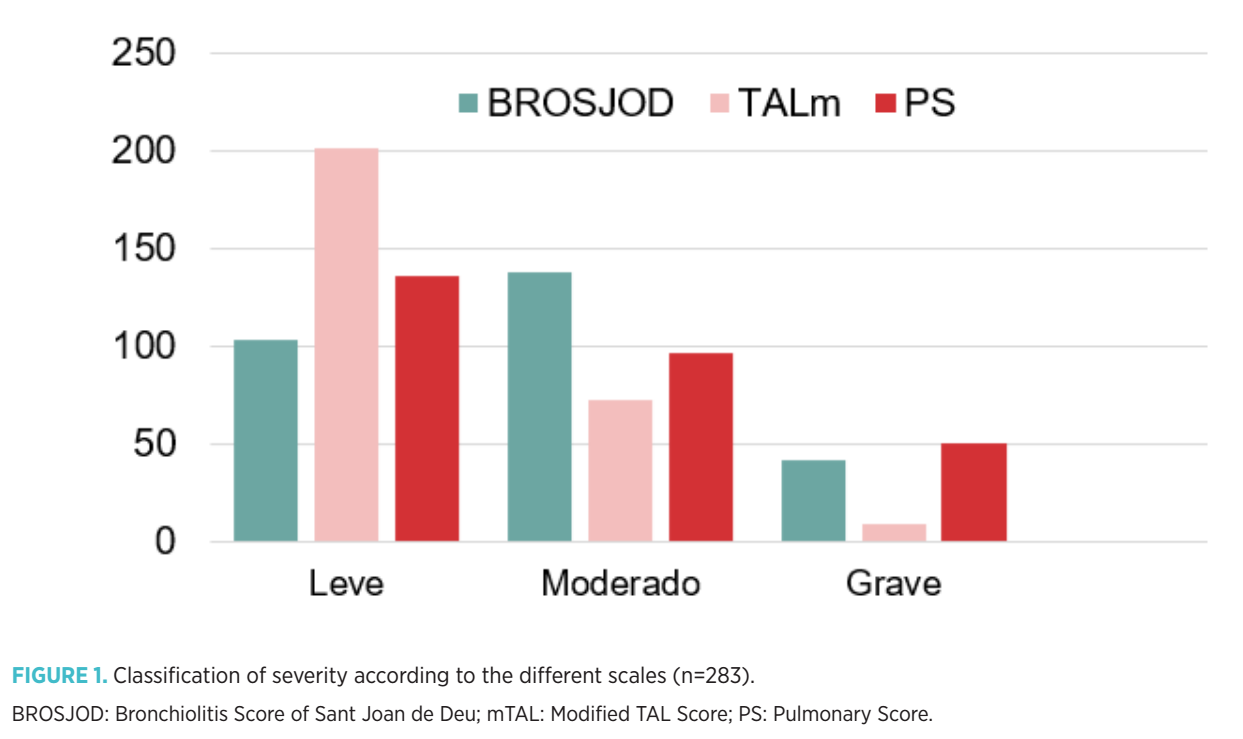
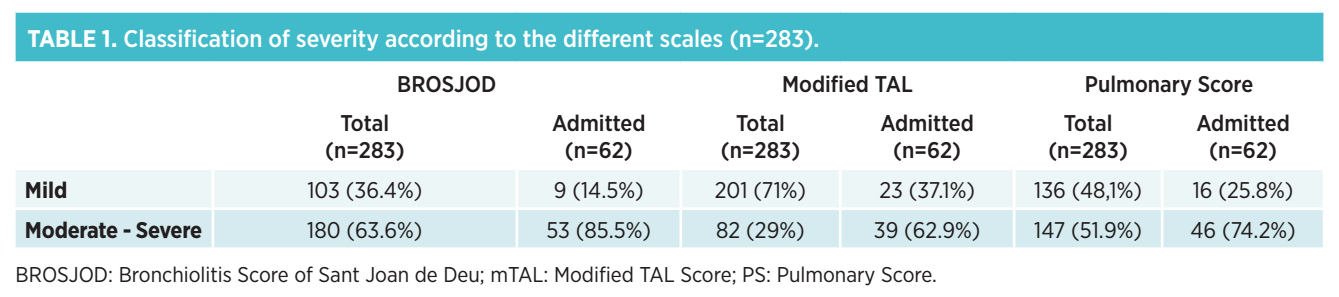
Figure and Table 1 show the severity level according to each of the scales. In 56.8% (160) of the episodes, the three scales coincide in the same level of severity (83 mild and 76 moderate-severe). 21.9% (62) of the patients were admitted; 85% (56) classified as moderate-severe according to BROSJOD, 74.1% (46) according to PS, and 62.9% (39) according to mTAL (p=0.0016).
Although not specifically validated for children under two years of age, the BROSJOD scale has proven to be the most effective in predicting the severity of bronchospasm crises in this group. This advantage may be because its items were designed considering the clinical particularities of the age group, including the stratification of respiratory and heart rate by age ranges, allowing for a more precise assessment. Additionally, BROSJOD evaluates six items, compared to three or four in other tools, which could give it greater diagnostic specificity.
Despite what was observed in our study, another prospective study conducted in a Spanish university hospital on a similar pathology, such as bronchiolitis, did not observe significant differences in the performance of any of the nine scales evaluated (including BROSJOD and mTAL)(2) to predict relevant results such as the need for oxygen or admission. In that study, all scales showed moderate precision, suggesting that the greater complexity of a scale does not always translate into better predictive capacity in real practice.
This lack of clinical superiority among the different scales could explain why Spain has decided to opt for the Pulmonary Score (PS). Its simplicity and operational agility, requiring only the evaluation of three clinical parameters, have made it the instrument unanimously recommended by 100% of the guides of Spanish hospitals integrated into the Research Network of the Spanish Society of Pediatric Emergencies (RISEUP-SPERG), as documented in the international study by Gray et al(6).
The main limitations of the study are those inherent to its retrospective design. On the other hand, it is a single-center study conducted in a tertiary maternal-child hospital, so the results obtained might not be extrapolatable to healthcare centers with different characteristics, given that the admission criteria for bronchospasm crises can vary according to the protocols in force at each center. Despite this, the heterogeneity in the assessment of the severity of bronchospasm crises according to the scale used is demonstrated, regardless of the destination upon discharge of these patients.
In conclusion, the three scales diverge substantially in the classification of the severity of bronchospasm episodes. Although the BROSJOD scale in our study seems to predict better than the PS and the mTAL those cases that are admitted, we consider it necessary to develop a validated scale for the evaluation of acute bronchospasm episodes in children under 2 years of age.
Funding
No funding was received for the research, authorship, and/or publication of this article.
Authorship contribution
Víctor Aguilar Gómez: Conceptualization, Writing - review & editing, Writing - original draft, Project administration, Data collection, Methodology
Paula García Espinosa: Data collection, Writing - original draft, Writing - review & editing
Vicky Trenchs Sainz de la Maza: Conceptualization
Pablo Donatiu: Data collection
Carles Luaces Cubells: Conceptualization, Writing - review & editing
Gemma Claret Teruel: Writing - review & editing
Conflicts of interest
The authors declare no commercial or financial conflicts of interest related to this research.
Ethical statements
This work (original article, clinical trial, research with humans/animals, etc.) complies with research regulations and has the approval of an Ethics Committee. The authors possess the official document or corresponding approval code.
CEIm Fundació Sant Joan de Déu Date: 09/01/2025
Data availability
The dataset supporting the results of this study is available upon reasonable request to the corresponding author.
Use of artificial intelligence tools
Artificial intelligence tools were used exclusively to support grammatical and spelling review of the manuscript, without intervening in the analysis, interpretation of data, or scientific conclusions.
References
- Marques Mejías MA, Tomás Pérez M, Hernández I, López I, Quirce S. Asthma Exacerbations in the Pediatric Emergency Department at a Tertiary Hospital: Association With Environmental Factors. J Investig Allergol Clin Immunol. 2019;29(5):365-370. Available from: https://doi.org/10.18176/jiaci.0364.
- Granda E, Urbano M, Andrés P, Corchete M, Cano A, Velasco R. Comparison of severity scales for acute bronchiolitis in real clinical practice. Eur J Pediatr. 2023 Apr;182(4):1619-1626. Available from: https://doi.org/10.1007/s00431-023-04840-5.
- Smith SR, Baty JD, Hodge D 3rd. Validation of the pulmonary score: an asthma severity score for children. Acad Emerg Med. 2002 Feb;9(2):99-104. Available from: https://doi.org/10.1111/j.1553-2712.2002.tb00223.x.
- Balaguer M, Alejandre C, Vila D, Esteban E, Carrasco JL, Cambra FJ, Jordan I. Bronchiolitis Score of Sant Joan de Déu: BROSJOD Score, validation and usefulness. Pediatr Pulmonol. 2017 Apr;52(4):533-539. Available from: https://doi.org/10.1002/ppul.23546.
- Golan-Tripto I, Goldbart A, Akel K, Dizitzer Y, Novack V, Tal A. Modified Tal Score: Validated score for prediction of bronchiolitis severity. Pediatr Pulmonol. 2018 Jun;53(6): 796-801. Available from: https://doi.org/10.1002/ppul.24007.
- Gray C, Collings M, Benito J, Velasco R, Lyttle MD, Roland D, et al. Analysis of the asthma scores recommended in guidelines for children presenting to the emergency department: a Pediatric Emergency Research Networks study. Arch Dis Child. 2025;110:422–428. Available from: https://doi.org/10.1136/archdischild-2024-327635.
Explorar
Artículos
Volúmenes
Sobre la revista
Más leídos
Emergencias Pediátricas
Emergencias Pediátricas
Emergencias Pediátricas
1º Congreso Mundial de Emergencias Pediátricas
Emergencias Pediátricas
Una nueva mirada a la vía aérea pediátrica: secuencia de intubación diferida como alternativa segura en situaciones de urgencias
Emergencias Pediátricas