Carta científica
Vol. 5 Núm. 1 (English)
9 min
Characteristics of oral communications presented at the annual SEUP meetings since 2019
Características de las comunicaciones orales presentadas en las reuniones anuales de la seup desde 2019
Laura de la Sen-de la Cruz* , Marta Rodríguez-Díaz, Arístides Rivas-García, Paula Vázquez-López, María García-de Oteyza, Soledad Amorós-Villaverde
Instituto de Investigación Sanitaria Gregorio Marañón (IiSGM), Madrid, Spain.
Correspondencia:
Recepción:
16/11/2025
Aceptación:
30/12/2025
Publicación:
11/03/2026
Métricas
74
Visualizaciones
13
Descargas
Compartir
Compartir
Resumen (ES)
Introducción y objetivos: Las comunicaciones en los congresos constituyen una de las principales vías de divulgación de los avances científicos.
El objetivo de este trabajo es conocer el perfil de los comunicadores y las características de las comunicaciones aceptadas en las reuniones anuales de la Sociedad Española de Urgencias Pediátricas (SEUP) en los últimos años.
Material y métodos: Estudio retrospectivo, descriptivo y unicéntrico. Se seleccionaron todas las Comunicaciones orales aceptadas en las Reuniones anuales de SEUP de los años 2019,2021,2022,2023 y 2024, incluidas en los programas publicados en su página web. Se excluyó el 2020 por no haberse celebrado congreso. Se analizaron como variables: comunicación larga/corta, estudio unicéntrico/multicéntrico, temática, hospital, pertenencia o no a RISEUP, nivel de complejidad del hospital, comunidad autónoma y año. Se agrupó la temática en 16 categorías a criterio de los investigadores; 14 consistían en urgencias de especialidades médicas, una de gestión y otra de miscelánea. Se identificó como Hospital responsable de la comunicación, aquel correspondiente al primer firmante. Los resultados se presentan como frecuencias absolutas y porcentajes.
Resultados: Se recogieron 1492 comunicaciones provenientes de un total de 100 hospitales. 1189 (79,7%) fueron enviadas por Hospitales pertenecientes a RISEUP. 598 comunicaciones (40,1%) correspondieron a solo 9 de los centros (G9) y 812 (54,4%) a 3 CCAA.112 comunicaciones se presentaron como comunicaciones largas (7,5%) 33 de ellos (30,8%) correspondieron a estudios multicéntricos.
107 fueron estudios multicéntricos (7,2%), 95 de ellos (88,8%) liderados por Hospitales pertenecientes a RISEUP.
El G9 presentó 69 (61,6%) comunicaciones largas y 62 (57,9%) estudios multicéntricos.
757 comunicaciones(50,7%), correspondieron a 4 temáticas: Infecciosas, respiratorio, psiquiatría y organización y gestión; siendo esta última la más prevalente entre las comunicaciones largas (22;19,6%). Apenas hubo diferencias entre los distintos años, a excepción de un aumento de las relacionadas con Psiquiatría en 2022 (17,9% sobre una media de 13,1%).
Conclusiones: Pocos hospitales acapararon la mayoría las comunicaciones presentadas en las reuniones de SEUP. 1/3 de las comunicaciones largas correspondieron a estudios multicéntricos, mayoritariamente enviados por centros con cultura investigadora. Psiquiatría y Organización son dos temáticas que han ocupado gran parte del espacio científico en los últimos años. RISEUP es una herramienta para facilitar el desarrollo de estudios multicéntricos, sin embargo, sus integrantes realizan mayoritariamente este tipo de estudios al margen de la Red.
Palabras clave (ES):
Resumen (EN)
Introduction and objectives: Communications presented at congresses constitute one of the main channels for disseminating scientific advances.
The aim of this study is to determine the profile of presenters and the characteristics of the communications accepted at the annual meetings of the Spanish Society of Pediatric Emergencies (SEUP) in recent years.
Material and methods: Retrospective, descriptive, single-center study. All oral communications accepted at the SEUP annual meetings in 2019, 2021, 2022, 2023, and 2024 were selected, based on the programs published on its website. The year 2020 was excluded as no congress was held. The following variables were analyzed: long/short communication, single-center/multicenter study, topic, hospital, membership in RISEUP, hospital complexity level, autonomous community, and year. Topics were grouped into 16 categories according to the researchers’ criteria; 14 corresponded to emergency conditions within medical specialties, one to management, and one to miscellaneous. The hospital responsible for the communication was defined as that of the first author. Results are presented as absolute frequencies and percentages.
Results: A total of 1,492 communications from 100 hospitals were collected. Of these, 1,189 (79.7%) were submitted by hospitals belonging to RISEUP. A total of 598 communications (40.1%) came from only 9 centers (G9), and 812 (54.4%) from 3 autonomous communities.
A total of 112 communications were presented as long communications (7.5%), of which 33 (30.8%) corresponded to multicenter studies.
There were 107 multicenter studies (7.2%), 95 of which (88.8%) were led by hospitals belonging to RISEUP.
The G9 submitted 69 (61.6%) long communications and 62 (57.9%) multicenter studies.
A total of 757 communications (50.7%) corresponded to four topics: infectious diseases, respiratory conditions, psychiatry, and organization and management; the latter being the most prevalent among long communications (22; 19.6%). there were hardly any differences between the different years, except for an increase in psychiatry-related communications in 2022 (17.9% compared to a mean of 13.1%).
Conclusions: A small number of hospitals accounted for the majority of communications presented at SEUP meetings. One-third of long communications corresponded to multicenter studies, mostly submitted by centers with a research-oriented culture. Psychiatry and organization are two topics that have occupied a significant portion of the scientific space in recent years. RISEUP is a tool that facilitates the development of multicenter studies; however, its members predominantly conduct this type of research independently of the network.
Palabras clave (EN):
The Spanish Society of Pediatric Emergencies (SEUP) has held an annual meeting of its members since November 1995 across various locations in the national territory. Oral communications have been a prominent feature of the program since the first edition.
Presentations at congresses are a primary format for scientific dissemination and are usually the first means of exposing research results(1,2). Scientific meetings provide a quick format for transmitting recent findings and foster professional development and continuing education, with the ultimate goal of improving patient care(3,4). Furthermore, the sharing of research can be a source of contributions to enrich its subsequent conversion into a scientific article(2).
The objective of this work was to determine the characteristics of the oral communications presented at the SEUP annual meetings in recent years.
To this end, an observational, descriptive, and cross-sectional study was conducted, in which all oral communications accepted at the SEUP annual meetings between 2019 and 2024, included in the programs published on its website, were analyzed. The year 2020 was excluded due to the cancellation of the meeting because of the epidemiological situation caused by SARS-CoV-2. The following variables were collected manually: long/short communication, unicentric/multicentric study, topic, hospital and complexity level (based on the National Catalogue of Hospitals of the Ministry of Health), affiliation or not with the SEUP Research Network (RISEUP), autonomous community, and year.
A communication was considered multicentric if it involved authors affiliated with different centers. Regarding the topic, they were grouped into 16 categories based on the criteria of one of the researchers: organization and management, psychiatric, respiratory, infectious, surgical-traumatic, neurological, nephro-urological, and oncohematologicalchronic pathology; related to sedoanalgesia, to critical patients, to neonate-small infants, and to pandemic-SARS-CoV-2; and miscellaneous. In studies with authors from different centers, the communication was assigned to the main author’s hospital. The first author’s affiliation to RISEUP was the criterion used to analyze this variable. The results are presented as absolute numbers and relative frequencies. The analysis was performed using the SPSS v28 program.
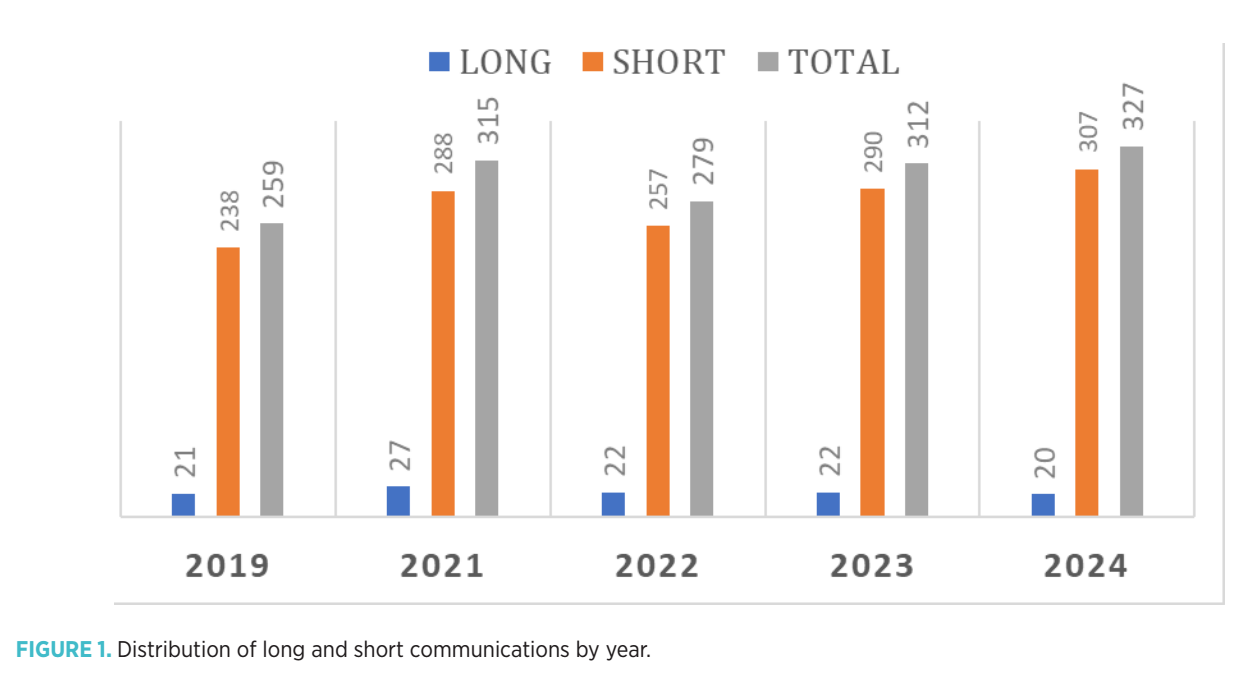
A total of 1,492 communications were registered, which translates into an annual average of 298.4. The year with the lowest number of communications was 2019, with 259 communications, while 2024 reached the maximum with 327, which implies an increase of 26.25% in the volume of communications in the analyzed period, at the expense of an increase in short communications. The distribution of long and short communications by year is shown in Figure 1.
Communications have been registered from a total of 100 hospitals, with a median of 8 communications per center (IQR: 2-19). The number of communications per center varies from a minimum of 1 to a maximum of 93. Notably, 9 centers, which we group as the Group of 9, represent 40.1% of the total communications (598 communications), and specifically, 61.6% of the long communications.
However, the Group of 9 has shown a relative decrease in the presented communications, compared to the increase in the rest of the centers, which highlights a greater diversification of the participation of different hospitals over the years.
In terms of complexity, 94.3% of the communications come from high-complexity centers. Three autonomous communities account for more than half of the communications (Madrid 24.4%, Catalonia 17.1%, and Basque Country 12.9%).
79.7% of the communications come from hospitals affiliated with the RISEUP network. It should also be noted that 88.8% of the multicenter studies were communicated by hospitals affiliated with RISEUP.
The majority of communications correspond to single-center studies, with a total of 1,385 communications (92.8%), implying an annual average of 277. In contrast, multicenter studies total 107 communications (7.2%), with an annual average of 21.4. Differentiating by type of communication, 29.5% of the long communications are multicenter, compared to 5.4% of the short ones. Of the total multicenter studies, the group of 9 represents 57.9% of the communications of this type.
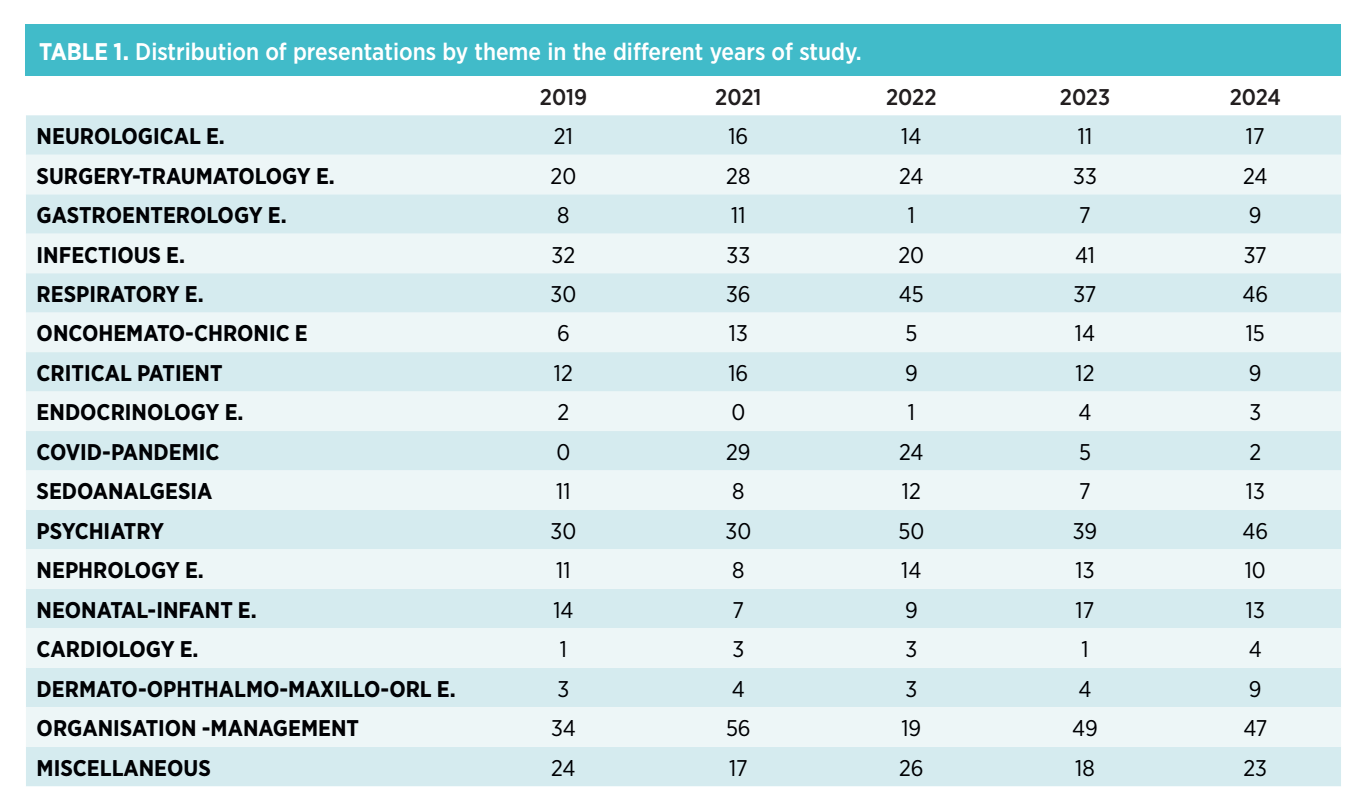
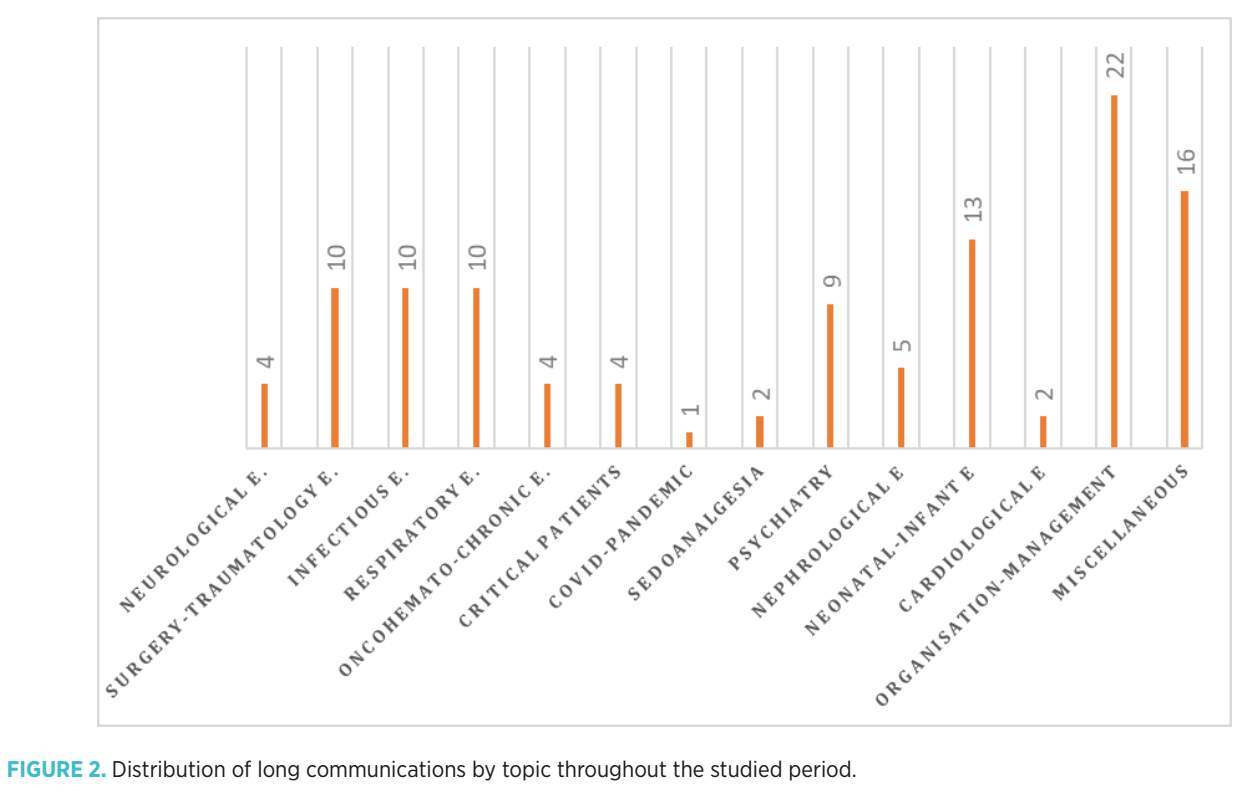
50.7% of the communications deal with four topics, in order of frequency: organization and management, psychiatric pathology, respiratory emergencies, and infectious emergencies. Most topics have maintained stability over the years, with the exception of organization and management, psychiatry, and the pandemic-SARS-CoV-2, with changes, as shown in Table 1. Figure 2 shows the topics of the long communications in the period studied.
The main limitations are that the topics were established subjectively by the researchers, without following a protocol that would allow this classification to be standardized for future studies. Furthermore, the participation of the centers may be underestimated, given that in multicenter studies only the center belonging to the first author was counted, and given the limitation of the number of authors per communication. This aspect could more significantly affect hospitals with less tradition in leading multicenter studies.
The progressive increase in communications raises challenges that might be interesting to address, as quantity is not always synonymous with quality. To ensure that the increase in communications is accompanied by an adaptation to the congress theme and a diversification of content, the selection criteria for submitted abstracts should be clearly established(1). The evaluation criteria, both for rejection and acceptance, as well as the domains and the score given, are well documented on the SEUP Meetings website. It is known that subjectivity can be difficult to manage, but aspects such as blinding the reviewers or including the option for authors to make improvements once an abstract has been accepted, are measures that could be included in future editions(1). Furthermore, the increase in communications is known, but there is no record of the number of rejected communications, a piece of data that could be of interest.
For the SEUP 2026 Meeting, a revamped format is planned, allowing more space for long oral communications and posters that enable a more interactive presentation, and less for short communications, which could change the paradigm presented in previous years.
Following the meetings, it is essential to encourage residents and young attendees to publish to share their findings. A possible strategy would be to draft them before the congress, use the congress feedback to make changes, and subsequently submit them(3,5). Pérez-Porra et al. analyzed whether the communications presented at the SEUP from 2017 to 2020 were published in indexed journals(6). Future studies on what has happened in recent years could be useful to inform about changes in this regard.
Congresses are postulated, besides being a source of scientific knowledge impulse, as an attractive social environment to meet colleagues and establish collaborations(7). In this line, the fact that 11.2% of multicenter studies have been carried out by hospitals not affiliated with RISEUP highlights the need to continue expanding the network’s influence. The challenge arises to promote collaborative work that changes the profile of a majority of single-center communications. In this regard, support from the network can be an opportunity for methodological improvement, for example through the SEUP grant that annually promotes research in pediatric emergencies within the network, which would allow for diversifying the participating centers in the congresses. Furthermore, analyzing the studies presented by authors from outside Spain could reflect a growing interest in establishing collaborations beyond our environment, such as the one existing between SEUP and the Latin American Society of Pediatric Emergency (SLEPE).
It can be concluded that there has been a progressive increase in communications at the expense of short ones, with more than 40% of the communications presented by 9 of the 100 participating hospitals. This group of 9 provides the majority of the long communications and multicenter studies. Organization and management is the most researched topic recently, and it represents one in five long communications. It would be of great interest to diversify the presented topics to expand knowledge in the area of pediatric emergencies. Little more than 7% of the communications correspond to multicenter studies, and RISEUP could be an interesting way to improve this figure.
This work was presented as a long oral communication at the XXIX Meeting of the Spanish Society of Pediatric Emergencies in Seville, from May 22 to 25, 2025.
Funding
No funding was received for the research, authorship, and/or publication of this article.
Author contributions
Laura de la Sen de la Cruz: Conceptualization, Methodology, Writing – original draft, Writing – review and editing.
Soledad Amorós Villaverde and María García de Oteyza: Methodology, Formal analysis, Data curation, Review and editing.
Marta Rodriguez Díaz: Investigation, Data collection, Writing – review and editing.
Arístides Rivas García: Supervision, Validation, Project administration.
Paula Vázquez López: Funding acquisition, Supervision, Review and editing.
All authors have read and agreed to the published version of the manuscript.
Conflicts of interest
The authors declare that there are no commercial or financial conflicts of interest for this research.
Ethical declarations
Due to the nature of this manuscript (review, opinion, theoretical study, etc.), no Ethics Committee approval or patient consent is required.
Use of artificial intelligence tools
I declare that no artificial intelligence tools (such as ChatGPT, Copilot, Gemini, or others) have been used in the writing, analysis, or review of this article.
References
- Kuczmarski TM, Raja AS, Pallin DJ. How do medical societies select science for conference presentation? How should they? Western Journal of Emergency Medicine. 2015;4:546-550. Available from: https://doi.org/10.5811/westjem.2015.5.25518.
- Gulceck M, Inci F, Ceyhan E, Gurhan U, Kahve Y, Ucaner A. Rate of conversion of reports presented at the Turkish society of sports traumatology, arthroscopy and knee surgery congress into publication. Acta Orthopaedica et Traumatologica Turcica. 2018;52: 447-451. Available from: https://doi.org/10.1016/j.aott.2018.08.002.
- Gandhi D, Mclean RW, Layemo AO. Analysis of the publication rate of the abstracts presented at a national gastroenterology meeting after 6 years. Digestion. 2016;94(4): 215–221. Available from: https://doi.org/10.1159/000450785.
- Waljee JF, Larson BP, Wan-Chu Chan K, Ono S, Holland AL, Haase SC, et al. Developing the art of scientific presentation. JHS. 2012;37: 2580-2588. Available from: https://doi.org/10.1016/j.jhsa.2012.09.018.
- Patel AJ, Cherian J, Fox BD, Whitehead WE, Curry DJ, Luerssen TG, et al. Publication patterns of oral and poster presentations at the annual meetings of the Congress of Neurological Surgeons and the American Association of Neurological Surgeons. J Neurosurg. 2011;115:1258–1261.
- Pérez-Porra S, Bullón-González I, Ferrer-Ortiz I, Andrés-Porras MP, Velasco R. ¿Qué ocurre después del congreso? Publicaciones de las comunicaciones presentadas en las reuniones anuales de la Sociedad Española de Urgencias de Pediatría. Anales de Pediatría. 2023;98: 76-80. Available from: https://doi.org/10.1016/j.anpedi.2022.10.003.
- Brown NJ, Mehkri Y, Hartke Jn, Chakravarti S, Gendreau J, Catapano JS, et al. Publication patterns of posters and oral presentations at the annual meeting of the Joint AANS/CNS Cerebrovascular Section. J Neurosurg. 2024;140:1399–1405. Available from: https://doi.org/10.3171/2023.8.JNS231549.
Explorar
Artículos
Volúmenes
Sobre la revista
Más leídos
Emergencias Pediátricas
Emergencias Pediátricas
Emergencias Pediátricas
1º Congreso Mundial de Emergencias Pediátricas
Emergencias Pediátricas
Una nueva mirada a la vía aérea pediátrica: secuencia de intubación diferida como alternativa segura en situaciones de urgencias
Emergencias Pediátricas